

Updated: August 2026.
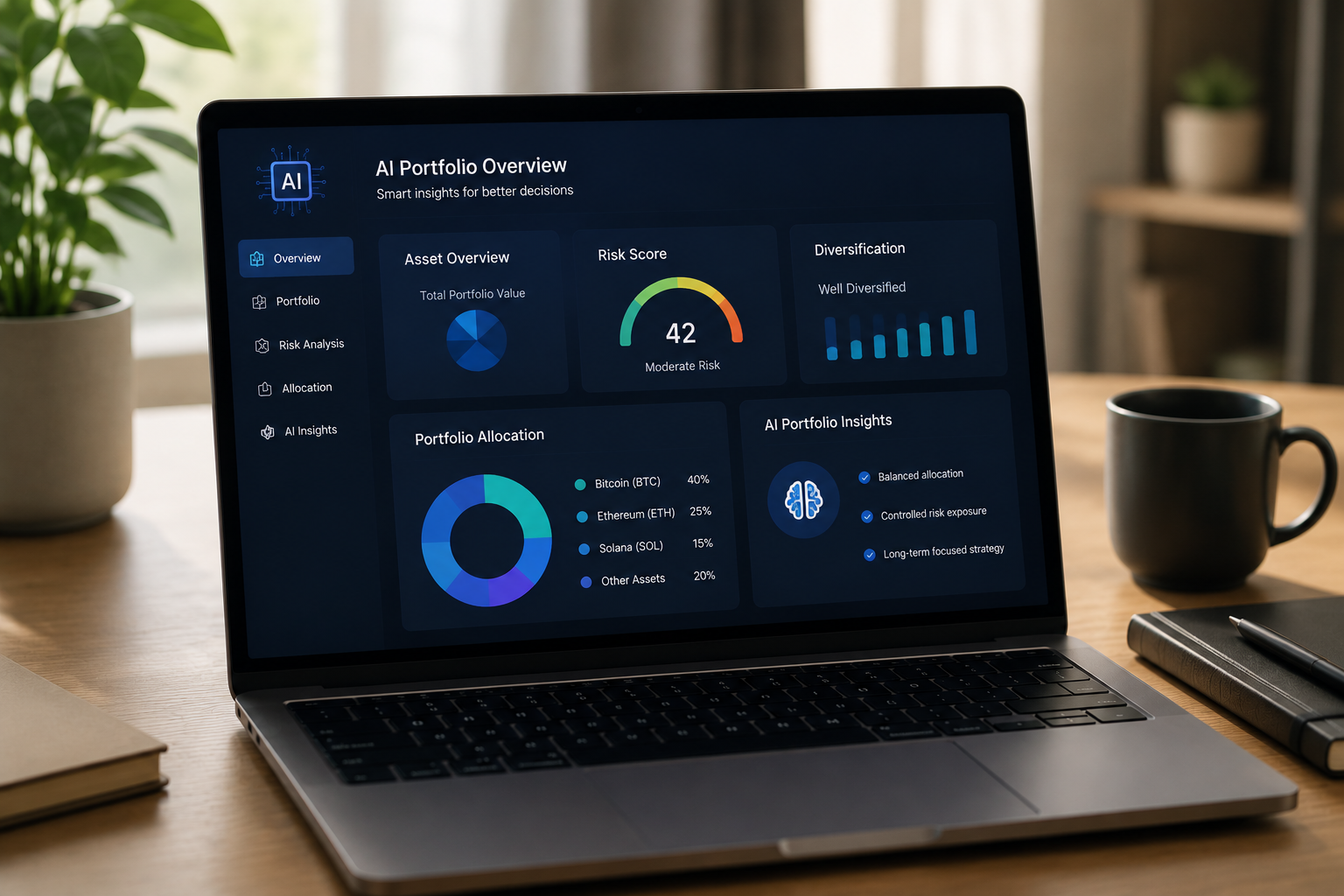
AI crypto portfolio management tools can help investors bring scattered holdings into one view, measure concentration and volatility, and turn portfolio data into clearer decisions. They cannot remove crypto risk, predict returns with certainty, or replace an investment plan.
For beginners and long-term investors, the most useful tool is usually not the one with the most automation. It is the one that answers three practical questions: What do I own? Where is my risk concentrated? What action, if any, is consistent with my plan?
This guide explains the main types of AI crypto portfolio tools, how they differ from trading bots, and how to evaluate security, permissions, transparency, and investor control before connecting an account.
What Are AI Crypto Portfolio Management Tools?
AI crypto portfolio management tools are applications that organize portfolio data and use analytical models to identify patterns, risks, or possible portfolio adjustments. Depending on the product, they may import balances and transactions from exchanges or wallets, classify assets, calculate allocation, monitor changes, and generate risk or rebalancing insights.
The term AI can describe very different capabilities. One platform may use machine learning to detect unusual portfolio changes, while another may use rules and optimization models to suggest a target allocation. The label alone does not tell you whether a tool is accurate, secure, or appropriate for your goals.
What these tools can do:
- Combine holdings from multiple wallets or exchanges into one dashboard.
- Show asset, sector, platform, or chain concentration.
- Track performance, allocation drift, and portfolio volatility.
- Generate alerts, risk summaries, or rebalancing scenarios.
- Reduce the manual work involved in reviewing a portfolio.
What they cannot reliably do:
- Guarantee a return or predict the next market move.
- Make poor-quality or incomplete data accurate.
- Determine your personal risk tolerance for you.
- Protect you from every market, platform, custody, or smart-contract risk.
If you are new to the broader discipline, start with our guide to crypto portfolio management before comparing tools.
AI Portfolio Management Tools vs. AI Trading Bots
Portfolio tools and trading bots are often grouped together because both may use automation. Their primary jobs, however, are different.
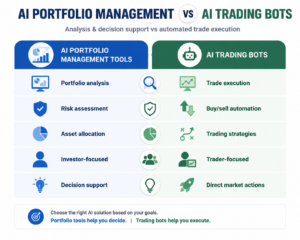
| Area | Portfolio management tool | Trading bot |
|---|---|---|
| Primary purpose | Understand and manage holdings | Execute trades from a strategy or signal |
| Typical output | Allocation, performance, risk, and scenario insights | Orders, entries, exits, or position changes |
| Common permission | Read-only access may be sufficient | Trading access is usually required |
| Investor role | Reviews information and decides | Defines rules and supervises execution |
| Main risk | Misleading analysis or poor data | Incorrect or unintended execution |
A tool may offer both functions. If it can place orders, rebalance automatically, or transfer assets, evaluate it as an execution platform—not only as an analytics dashboard.
Five Types of AI Crypto Portfolio Tools
Most products fall into one or more of the following categories.
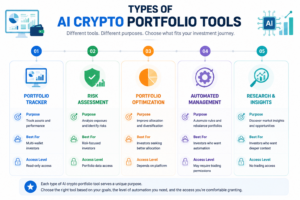
| Tool type | Best used for | Important limitation |
|---|---|---|
| Portfolio tracker | Aggregating balances, transactions, allocation, and performance | Incorrect imports or missing wallets can distort the full picture |
| Risk assessment tool | Finding concentration, volatility, correlation, or asset-level risk | A risk score is only as useful as its inputs and methodology |
| Portfolio optimization tool | Comparing allocations or rebalancing scenarios | Historical relationships can change during stressed markets |
| Automated portfolio platform | Applying predefined rebalancing or execution rules | More permissions and automation create more operational risk |
| Research and intelligence tool | Summarizing market, project, or on-chain information | Summaries may omit context or repeat low-quality sources |
A beginner who mainly wants visibility may only need a tracker plus a risk-analysis layer. A long-term investor may benefit from allocation and rebalancing scenarios without allowing the tool to execute trades.
How to Evaluate an AI Crypto Portfolio Management Tool
Feature lists are easy to compare. The harder—and more important—questions concern data access, methodology, and what the tool can do after you connect it.
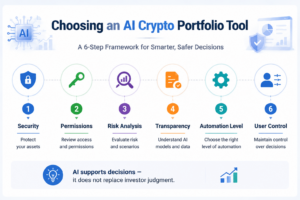
1. Start With the Decision You Need to Make
Choose a tool around a recurring decision, not around the AI label. Examples include checking whether one asset has become too large, comparing current allocation with a target, or identifying which holdings contribute most to volatility.
Write down the job before comparing products. If the job is “show all holdings and flag concentration,” automated trading permissions are unnecessary.
2. Review Security and API Permissions
API permissions determine what a connected application can access. Official Coinbase documentation, for example, separates view, trade, and transfer permissions; transfer access can include deposits or withdrawals. This is why “connect your exchange” is not a single risk level.
For a portfolio analytics use case, prefer the least privilege the tool needs:
- Use read-only or view access when the tool only needs balances and transaction history.
- Do not enable trading unless automated execution is an intentional feature you want.
- Do not enable transfer or withdrawal permissions for a tracking or analysis tool.
- Use two-factor authentication and an exchange-specific API key.
- Use IP restrictions or allowlists when both the exchange and tool support them.
- Know how to revoke the connection and delete stored data.
Also verify the product domain before entering credentials. FINRA’s crypto risk guidance highlights theft, fake service providers, fraud, and the limited protections that may apply to crypto assets. For a concrete example of permission scopes, see the official Coinbase API authentication documentation.
3. Check Data Coverage and Data Quality
A polished dashboard can still be wrong if it misses wallets, chains, staking positions, token migrations, fees, or cost-basis records. Before trusting recommendations, compare imported balances with the original exchange and wallet records.
Ask whether the tool explains:
- Which exchanges, wallets, chains, and assets it supports.
- How often balances and prices refresh.
- How it handles missing prices, illiquid tokens, and stablecoins.
- Whether users can correct duplicates or misclassified transactions.
4. Look for Transparent Risk Outputs
A useful risk result should be explainable. Instead of showing only “high risk,” the tool should reveal the drivers: concentration in one asset, exposure to correlated assets, unusual volatility, low liquidity, or a change from the investor’s target allocation.
The same principle applies to project-level scoring. If you review an unfamiliar asset, use a transparent framework such as the Forvest Crypto Trust Score as one input—then verify the underlying information rather than treating any single score as a recommendation.
5. Separate Analysis From Action
Good decision support shows assumptions and alternatives. For example, it may compare the portfolio before and after a hypothetical rebalance, show the trades and fees involved, and let the investor decide whether to proceed.
Automation is not automatically better. For many beginners, alerts and scenarios provide enough support while preserving control. If a platform can act automatically, check for approval steps, position limits, pause controls, logs, and a clear way to disconnect it.
6. Compare Total Cost, Not Just Subscription Price
Include subscription fees, exchange trading fees, spreads, network fees, tax-reporting needs, and the potential cost of unnecessary rebalancing. A “free” tool that encourages frequent execution may cost more than a paid analytics tool.
A Beginner Workflow for Using AI Portfolio Tools
- Define the goal. Write down your time horizon, risk limit, and the decisions the tool should support.
- Build a complete inventory. List exchanges, wallets, staking positions, and assets before connecting anything.
- Start manually or with read-only access. Confirm balances and allocation before trusting automated imports.
- Review risk drivers. Look for concentration, correlation, volatility, liquidity, and platform exposure—not only a single score.
- Test a scenario. Compare a possible allocation change with doing nothing, including fees and tax implications.
- Make the decision yourself. Record why you acted or chose not to act. Review the portfolio on a schedule rather than reacting to every alert.
For more context on market-level risk, read our guide to crypto market volatility and risk factors. You can then use Forvest Portfolio Management to organize portfolio analysis around your own holdings and objectives.
Limitations You Should Expect
Even a well-designed AI portfolio tool has limits:
- Models learn from the past. Relationships that appeared stable can break during a market shock.
- Crypto data is fragmented. Wallets, exchanges, bridges, derivatives, and staking positions may not be captured consistently.
- Risk is broader than price volatility. Custody, liquidity, smart-contract, counterparty, regulatory, and operational risks matter too.
- Outputs can look more precise than they are. A score or forecast is an estimate, not a fact.
- More automation increases the impact of errors. A poor suggestion is different from an incorrect trade or transfer executed automatically.
Crypto assets can be extremely volatile and may lack protections common in traditional financial markets. Investor.gov’s crypto asset resources provide additional investor education on these risks.
Final Checklist Before You Connect a Tool
- Does the tool solve a specific portfolio decision?
- Can it work with manual entry or read-only access?
- Are trade and transfer permissions disabled unless truly required?
- Can you verify its imported balances and prices?
- Does it explain the drivers behind risk scores or recommendations?
- Can you preview changes before any action is executed?
- Can you revoke access and delete your data easily?
Final Thoughts
The best AI crypto portfolio management tool is not the one that promises the most. It is the one that makes your portfolio easier to understand while asking for the least access necessary.
For a beginner or long-term investor, start with visibility, risk awareness, and decision support. Add automation only when you understand the permissions, costs, failure modes, and controls. AI can improve the review process, but responsibility for the final investment decision remains with the investor.
Next step: Explore Forvest Portfolio Management to review your holdings, then use the Crypto Trust Score when you need an additional project-level risk check.
Disclaimer
This article is for educational purposes only and does not constitute financial, investment, legal, or tax advice. Crypto assets are volatile and involve a significant risk of loss. Always conduct your own research and consider consulting a qualified professional before making investment decisions or granting account permissions to a third-party tool.