


A crypto portfolio rebalancing strategy is a written rule for restoring a portfolio toward its target allocation after market movements create meaningful drift. It defines what to measure, when a deviation is large enough to review, how far to trade back, and which costs or risks can justify waiting.
Short answer: choose target weights before prices move, monitor current weights on a consistent schedule, and trade only when a documented calendar or tolerance-band rule is triggered. Use deposits, rewards or withdrawals to reduce drift before selling when practical. Rebalancing controls exposure; it does not predict the next winner or guarantee a higher return.
Crypto assets can be extremely volatile and less liquid than traditional investments, and losing the full amount invested is possible. FINRA’s crypto-asset risk guidance highlights volatility, liquidity and platform risks. This article is an educational framework, not a personalized investment, tax or legal recommendation.
What Crypto Portfolio Rebalancing Is – and Is Not
Rebalancing compares a current portfolio with a target portfolio and takes controlled action when the difference breaches a rule. Its primary purpose is to keep risk and concentration reasonably aligned with a plan.
It is different from redesigning the portfolio. If an asset’s security, liquidity, governance or investment thesis has materially changed, the investor may need a new target allocation. That is a policy decision, not routine rebalancing.
| Decision | Question | Appropriate process |
|---|---|---|
| Rebalancing | Have current weights moved too far from still-valid targets? | Apply the existing review and tolerance rule |
| Portfolio redesign | Are the goal, risk limit, eligible assets or thesis no longer valid? | Review the investment policy and set new targets |
| Performance measurement | How much profit or loss came from each asset and cash flow? | Use an auditable P&L and return calculation |
| Optimization | Could a different structure better fit the objective and constraints? | Test alternative allocations before changing policy |
Use our crypto portfolio profit and loss guide for measurement and our crypto portfolio optimization framework for allocation design. This page owns the execution question: when and how to move current weights back toward approved targets.
Set Target Weights Before You Measure Drift
A rebalancing rule cannot work without a target. Write the target in a portfolio policy while decisions are calm, not after one token has rallied or fallen sharply. A crypto-only target should also sit inside a limit for crypto’s role in the investor’s total financial portfolio.
Investor.gov’s asset allocation and diversification guidance explains that allocation should reflect time horizon and risk tolerance and that market movements can change a portfolio’s risk level. Several crypto tickers can still share the same market, liquidity, custody or protocol risks, so ticker count alone does not establish diversification.
| Policy field | Illustrative entry | Control question |
|---|---|---|
| Portfolio boundary | All long-term crypto wallets and exchange accounts | Which accounts, cash balances and locked assets are included? |
| Eligible assets | Assets that pass research, liquidity and custody checks | Can every holding be valued and traded responsibly? |
| Target weights | BTC 50%, ETH 30%, SOL 20% | Do targets total 100% and reflect the risk plan? |
| Tolerance rule | Review when absolute drift exceeds 5 percentage points | Is this an example or a rule justified for this portfolio? |
| Review schedule | Monthly monitoring, quarterly policy review | Is monitoring separate from automatic trading? |
| Destination | Return fully to target or partway inside the band | How much trading is actually required? |
| Exceptions | Incomplete data, thin liquidity, locked staking or operational risk | Who documents and approves a delay? |
The percentages above are a calculation example, not a recommended allocation or universal threshold. The right policy depends on the investor’s goals, loss capacity, portfolio size, jurisdiction and operating constraints. Our crypto portfolio allocation strategy guide covers how target weights fit into the wider portfolio plan.
Measure Absolute and Relative Allocation Drift
Use one base currency and one valuation timestamp across every included wallet and exchange. Match transfers between the investor’s own accounts so units are not duplicated or omitted.
Current asset weight (%) = current asset value / total portfolio value x 100
Absolute drift (percentage points) = current weight – target weight
Relative drift (%) = absolute value of (current weight – target weight) / target weight x 100
Absolute drift is easy to interpret: a position at 63% versus a 50% target is 13 percentage points overweight. Relative drift can be useful for smaller allocations. A move from a 4% target to 6% is only 2 percentage points, but it is 50% above the target weight.
The policy should state which measurement controls the decision. Mixing percentage points and percentages is a common source of accidental trades. If the rule says “5% drift,” an operator may interpret a 20% target as breaching at 25%, while another may calculate a 5% relative change and trigger at 21%. Write the upper and lower weight boundaries explicitly for every target so the rule can be tested without interpretation.
Different positions may need different bands. A narrow band around a small or illiquid token can cause repeated trades whose costs exceed any exposure benefit. A very wide band around a dominant position can allow concentration to grow beyond the investor’s loss capacity. Bands should therefore be reviewed as part of policy design, but they should not be widened temporarily just because a position has become a recent winner.
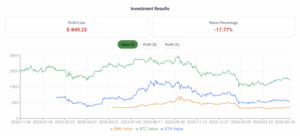
A consistent crypto portfolio tracker can calculate current weights, but the investor must still define the boundary, targets, tolerance bands and exceptions.
Choose a Rebalancing Rule You Can Follow
There is no universally best rebalancing frequency or threshold. The rule should balance exposure control against fees, spreads, taxes, monitoring effort and the risk of trading illiquid assets. Common approaches include:
| Method | Trigger | Strength | Main limitation |
|---|---|---|---|
| Calendar-based | Trade on a fixed monthly, quarterly or annual date | Simple to administer | May trade with little drift or miss large drift between dates |
| Threshold-based | Trade when a weight breaches a tolerance band | Links action directly to exposure | Requires reliable monitoring and can overtrade if the band is too narrow |
| Calendar plus threshold | Review on schedule; trade only after a breach | Combines operational discipline with drift control | Needs a clearly documented review cadence and band |
| Cash-flow rebalancing | Direct new deposits, rewards or withdrawals toward the target | Can reduce selling and transaction costs | May be too slow when drift is large |
| Partial rebalancing | Trade back inside the band, not necessarily to the exact target | Can reduce turnover | Leaves some intentional drift |
Vanguard’s investor education page compares calendar, threshold and combined rebalancing. Its conclusions come from diversified traditional portfolios, not crypto-only portfolios, so they should inform the framework rather than be copied as a crypto rule.
A practical beginner policy might say: “Review weights monthly. Do not trade unless an absolute or relative tolerance is breached. Before trading, check costs, tax impact, liquidity and whether the target remains valid.” The exact schedule and bands are investor-specific.
Rebalancing to equal weights is not automatically more diversified or safer. A 25% allocation to each of four tokens is simply an equal-weight policy; it may ignore differences in liquidity, custody, network exposure and downside risk. Rebalancing should preserve a justified target, not force every asset to the same size.
Likewise, a rule should not be judged only by whether it would have increased historical returns. A strategy that happened to sell a future loser or buy a future winner can look impressive in hindsight. The more durable evaluation is whether the rule kept exposure within limits, was executable after costs and could be followed consistently without using future information.
Worked Crypto Rebalancing Example
Assume a hypothetical BTC, ETH and SOL portfolio began with targets of 50%, 30% and 20%. After market movements, the portfolio is worth $11,000:
| Asset | Current value | Current weight | Target weight | Absolute drift |
|---|---|---|---|---|
| BTC | $7,000 | 63.64% | 50% | +13.64 points |
| ETH | $2,400 | 21.82% | 30% | -8.18 points |
| SOL | $1,600 | 14.55% | 20% | -5.45 points |
| Total | $11,000 | 100% | 100% | – |
If the policy calls for a review after an absolute 5-point breach, all three positions require review. That does not automatically mean immediate market orders. First confirm that prices, balances, targets and constraints are correct.
Ignoring fees, taxes and price movement during execution, a full rebalance to target would be:
| Asset | Target value | Current value | Illustrative trade |
|---|---|---|---|
| BTC | $5,500 | $7,000 | Sell $1,500 |
| ETH | $3,300 | $2,400 | Buy $900 |
| SOL | $2,200 | $1,600 | Buy $600 |
Target asset value = target weight x total portfolio value
Trade amount = target asset value – current asset value
Positive trade amounts are purchases and negative amounts are sales. The sell total equals the buy total before costs. In real execution, reserve enough cash for fees and use updated values after each material trade.
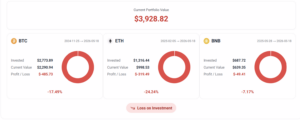
Use Cash Flows Before Selling When Practical
New contributions can be directed to underweight positions. Withdrawals can be funded from overweight positions. Staking rewards or other incoming units can also be included in the next review. These methods can reduce the number and size of sales, although they may not fully correct a large imbalance.
In the example, BTC is $1,500 above its target at the current total value. A modest new contribution allocated only to ETH and SOL would reduce BTC’s percentage without selling BTC, but the exact destination changes because the total portfolio value also increases. Recalculate targets after adding the cash flow rather than using the old $11,000 denominator.
For example, a new $1,000 contribution increases total value to $12,000. The new target values become $6,000 for BTC, $3,600 for ETH and $2,400 for SOL. BTC would still be $1,000 overweight, while ETH and SOL would be $1,200 and $800 underweight. Directing the contribution to ETH and SOL reduces part of the deficit, but it cannot fully restore all three targets without selling some BTC or accepting residual drift.
Cash-flow rebalancing is not cost-free. Buying still involves spread, slippage, trading fees and potentially network fees. It is simply one way to reduce unnecessary disposals.
Decide Whether to Rebalance Fully or Partially
Trading exactly to target provides a clean reset but may create more turnover. A partial rebalance moves the position to a destination inside the allowed band. For example, a 50% target with a 5-point upper limit could trigger at 55%, while the policy might trade back to 52% rather than all the way to 50%.
The destination must be written in advance. Otherwise, “partial” becomes an excuse for discretionary timing. A portfolio with smaller balances, wider spreads or frequent cash flows may benefit from a minimum trade size or a no-trade zone. Any such rule should still prevent a position from growing beyond the investor’s real concentration limit.
Estimate Fees, Slippage and Tax Impact Before Trading
Rebalancing decisions should compare the benefit of reducing drift with the cost of execution. Investor.gov explains that fees and expenses reduce portfolio returns. In crypto, visible trading fees are only one part of the cost.
| Cost or constraint | Evidence to collect | Possible response |
|---|---|---|
| Trading fee | Venue fee schedule and account tier | Estimate both sell and buy legs |
| Bid-ask spread | Executable order book, not only chart price | Use a liquid venue and suitable order method |
| Slippage | Order size relative to available liquidity | Reduce size, stage execution or set a limit |
| Network fee | Current network conditions and transfer route | Avoid unnecessary on-chain movements |
| Tax consequence | Lots, basis, holding period and local rules | Review with a qualified professional before disposal |
| Operational risk | Withdrawal status, custody controls and address verification | Pause until the route is verified |
Tax treatment varies by jurisdiction, and a crypto-to-crypto swap or fee paid in crypto may have consequences beyond portfolio performance. Keep transaction IDs, timestamps, quantities, fees and basis records. Rebalancing software should not be treated as a tax determination.
Add Crypto-Specific Safety Checks
A conventional percentage rule is not enough for crypto. Before each trade, check:
- Liquidity: can the intended size trade without unacceptable spread or slippage?
- Custody and venue exposure: does the rebalance require leaving assets on a platform longer than the policy allows?
- Locked or staked assets: are units actually available, and is there an unbonding delay?
- Token or protocol event: is a migration, exploit, depeg or suspension affecting price quality and execution?
- Shared risk: do multiple tokens depend on the same chain, bridge, protocol, custodian or market factor?
- Data quality: are balances, prices and internal transfers complete across every account?
A rebalance cannot repair a broken investment thesis or remove systemic crypto risk. Use a separate crypto risk management framework to define position limits, liquidity rules, custody controls and downside responses.
Execute Rebalancing in a Controlled Sequence
- Freeze a portfolio snapshot with one base currency and timestamp.
- Reconcile balances and match transfers between the investor’s own accounts.
- Confirm that the goal, eligible assets and target weights remain valid.
- Calculate current weights, absolute drift and relative drift.
- Apply the documented calendar and tolerance rule.
- Use upcoming deposits, rewards or withdrawals where they reduce drift.
- Simulate full and partial trade plans before placing orders.
- Estimate fees, spread, slippage, liquidity and tax consequences.
- Execute only the approved plan using suitable venue and order controls.
- Recalculate actual weights with fills and fees, then save the evidence.
Trade sequencing matters when several legs are required. Selling first can create the cash needed for purchases, but it also temporarily changes market exposure. Buying first requires available cash. Large or illiquid orders may need staged execution, and the final amounts should be recalculated if prices move materially. The policy should identify who can approve a deviation from the proposed plan.
Never publish exchange credentials, private keys or seed phrases in a tracker, spreadsheet or support request. If a portfolio tool uses exchange connectivity, use the minimum permissions required for the intended read-only or trading workflow and follow the platform’s security controls.
FINRA’s asset allocation and diversification guide notes that sales, charges, fees and potential taxes should be considered when rebalancing. The same principle is especially important when a crypto rebalance requires several trade legs.
When Not to Rebalance Automatically
A breached band is a review signal, not permission to ignore operational reality. Pause automatic execution when:
- the data is incomplete or wallet transfers do not reconcile;
- an asset cannot be priced reliably or has severely limited liquidity;
- withdrawals, deposits or trading are suspended at the intended venue;
- the target allocation is under formal policy review;
- staking or custody restrictions prevent safe delivery;
- the tax or legal treatment of a planned disposal is unclear;
- the estimated trade is smaller than the policy’s cost-aware minimum.
Do not widen a tolerance band simply because an overweight asset is rising, and do not force a trade merely because a calendar reminder appeared. Both decisions replace the policy with market emotion.
Verify the Portfolio After Every Rebalance
Execution changes prices, cash and fees, so the proposed allocation is not the final allocation. Recalculate using actual fills. Confirm that every trade and fee entered the ledger, that units match wallet and exchange balances, and that the final weights sit at the policy destination.
Record the trigger, pre-trade weights, proposed trades, actual fills, total costs, post-trade weights and any approved exceptions. These records show whether the strategy controlled risk as intended and support the wider crypto portfolio management process.
Model a Rebalance With Forvest
The Forvest Crypto Portfolio Calculator can help you enter multiple holdings, inspect allocation and model portfolio-level changes. Use the output as a decision aid, then compare it with the written targets, tolerance bands and cost controls in your policy.
A workflow for managing a crypto portfolio with AI tools can use monitoring and alerts to flag allocation drift or review triggers without authorizing automatic execution; each trade should remain subject to the written policy and investor approval.
A calculator does not know whether a target is suitable, whether two wallets belong to the same investor, whether a token is liquid enough to trade, or how a disposal is treated in a specific jurisdiction. Reliable rebalancing combines the tool with complete data and documented judgment.
Crypto Rebalancing Checklist
| Stage | Required check | Completion evidence |
|---|---|---|
| Policy | Targets, bands, schedule, destination and exceptions are documented | Dated portfolio policy |
| Data | Balances, prices and transfers reconcile across all included accounts | Valuation snapshot and transaction ledger |
| Trigger | Drift breaches the rule and targets remain valid | Current-versus-target calculation |
| Plan | Cash-flow, partial and full alternatives are compared | Proposed trade sheet |
| Cost | Fees, spread, slippage, liquidity and tax questions are reviewed | Cost estimate and exceptions |
| Execution | Actual fills and fees are captured | Venue confirmations and transaction IDs |
| Verification | Post-trade units and weights match the approved destination | Reconciled post-trade report |
Reviewed: 10 August 2026. All allocations and thresholds are hypothetical examples. Rebalancing can reduce allocation drift but cannot eliminate market, liquidity, custody, platform or total-loss risk.