


Most crypto investors believe they understand their performance because they can see their profits. However, this assumption often breaks down once a portfolio includes multiple assets. When you hold Bitcoin, Ethereum, and several altcoins at different entry points, simply looking at profit no longer tells the full story. This is where a tool for tracking a crypto portfolio, combined with calculation features, becomes essential for understanding real performance.
At first glance, tracking a portfolio seems simple. You check prices, estimate gains, and assume your portfolio performs well. However, as the number of assets increases, perception starts to diverge from reality. Some positions may perform strongly but have little impact due to small allocation, while others quietly drive the overall result.
Because of this, the key challenge is not access to data—it is understanding how that data translates into real performance.
👉 If you want to see how your own portfolio actually behaves across multiple assets, try using a
crypto portfolio calculator for tracking real performance across multiple assets
and compare how allocation, timing, and fees impact your overall results.
👉 Insight:
In most cases, investors do not misunderstand the market—they misunderstand how their portfolio behaves.
Why Tracking Crypto Portfolio Performance Becomes Difficult With Multiple Assets
Tracking a single asset feels straightforward. However, once multiple coins enter the picture, performance becomes a result of interactions rather than isolated outcomes.
For example, imagine a portfolio with three assets. One gains 40%, another gains 10%, and the third loses 15%. At a surface level, this may appear positive. However, without knowing how much capital you allocate to each position, the overall performance remains unclear.
This is where many investors make a critical mistake. They focus on visible gains without considering how much those gains actually matter within the portfolio.
Portfolio Performance Depends on Allocation, Not Just Price Movement
Allocation drives portfolio performance. In other words, the amount you invest in each asset determines how much it influences the final outcome.
Portfolio Allocation vs Performance Impact
| Asset | Allocation | Price Change | Portfolio Impact |
|---|---|---|---|
| Bitcoin | 50% | +10% | +5% |
| Ethereum | 30% | +20% | +6% |
| Altcoin | 20% | -15% | -3% |
👉 Total Portfolio Result ≈ +8%
Source: Weighted return model based on standard portfolio performance calculations (framework used in financial analysis, e.g., Investopedia).
As shown above, the asset with the highest return does not always create the biggest impact. Instead, allocation defines influence. Therefore, you must evaluate both variables together to understand performance.
👉 Insight:
A portfolio is not defined by its best-performing asset, but by how capital is distributed across all assets.
What a Portfolio Tracking Tool Actually Does
A portfolio tracking tool does more than display balances. It structures how you monitor performance.
Instead of jumping between assets and estimating results, it provides a consistent way to evaluate the entire portfolio. It aligns entry prices, allocation sizes, and current values into a single framework.
As a result, you can measure performance instead of guessing it.
Moreover, this structure shifts your thinking. Instead of asking “Which coin performs best?”, you start asking “How does my portfolio perform overall?”.
How Multi-Asset Portfolios Distort Performance Perception
When multiple assets exist in a portfolio, perception becomes selective. Investors usually focus on assets that perform well while ignoring those that underperform.
For instance, a strong gain in one position can create the illusion of overall success. However, if that position represents only a small portion of the portfolio, its real impact stays limited. Meanwhile, losses in larger positions may offset those gains.
Additionally, volatility adds noise. High-volatility assets often create short-term spikes that look significant but fail to translate into stable performance. Consequently, portfolios can look stronger than they actually are.
Why Structure Matters More Than Data in Portfolio Tracking
Most investors already have access to price data. However, more data does not automatically lead to better decisions. Without structure, data becomes fragmented and difficult to interpret.
A crypto portfolio tracking system solves this by standardizing how performance is measured. Instead of comparing unrelated numbers, it aligns all variables into a consistent view.
For example, when you evaluate allocation, entry price, and current value together, portfolio performance becomes clear. Without this structure, even accurate data can lead to misleading conclusions
👉 Insight:
Better decisions come from structured interpretation—not from more data.
How a Crypto Portfolio Calculator Improves Decision Quality
A crypto portfolio calculator extends tracking into analysis. It allows you to evaluate how changes in one part of the portfolio affect the entire system.
For example, adding a new asset may seem beneficial in isolation. However, when you evaluate it at the portfolio level, it may increase risk without improving performance. Therefore, structured calculation provides clarity before decisions.
Over time, consistent tracking reveals patterns. You begin to understand how your portfolio behaves under different conditions, which leads to more stable strategies.
👉 Insight:
Consistency in tracking leads to consistency in decision-making.
How to Calculate Crypto Portfolio Performance Across Multiple Assets
Tracking a crypto portfolio is only the first step. The real value comes from understanding how you calculate performance across multiple assets. While many investors look at total balance changes, this approach often hides how different positions contribute to the overall result.
At a surface level, portfolio performance appears simple: compare your current portfolio value to your initial investment. However, this becomes more complex when multiple assets enter at different times and prices.
For example, if you invest in Bitcoin, Ethereum, and several altcoins over time, each position has its own cost basis. As a result, you must combine all these positions into a unified structure.
👉 Insight:
Portfolio performance is not a single number—it is the result of multiple positions interacting together.
Instead of estimating portfolio performance manually, let’s walk through a real multi-asset example using a crypto portfolio calculator.
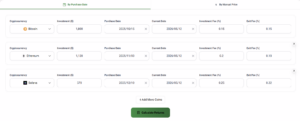
Example of entering Bitcoin, Ethereum, and Solana positions into a crypto portfolio calculator to track allocation, entry dates, and fees across multiple assets.
In this example, we use different allocation sizes, entry dates, and fee structures to simulate a realistic crypto portfolio.
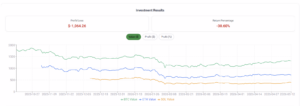
As shown above, the portfolio experienced an overall decline during this period, resulting in a total loss of around 30%. However, this decline does not affect all assets equally.
While all positions moved in the same direction, Bitcoin showed relatively stronger performance compared to Ethereum and Solana. This difference highlights how allocation and asset behavior directly shape overall portfolio outcomes, even under the same market conditions.
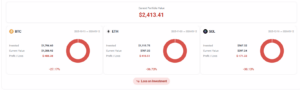
Looking at the breakdown, it becomes clear that each asset contributes differently to the final result. Even though all positions declined, Bitcoin had a relatively smaller impact on the total loss due to its allocation and more stable performance.
This highlights a critical point: portfolio performance is not driven by individual returns alone, but by how capital is distributed across assets and how each position behaves under the same market conditions.
Total Portfolio Value vs Invested Capital (The Core Calculation)
To calculate crypto portfolio performance correctly, two key components must be aligned:
- total invested capital
- current portfolio value
The difference between these two defines overall performance. However, the challenge lies in calculating them accurately.
Invested capital is not just your initial deposit. It includes all entries made over time across different assets. Similarly, current value is not based on a single price—it is the combined value of all positions at their latest market prices.
Because of this, portfolio tracking requires a structured method rather than estimation.
Portfolio Performance Calculation Example (Multi-Asset Scenario)
| Asset | Total Invested | Current Value | Individual Result |
|---|---|---|---|
| Bitcoin | $2,000 | $2,400 | +20% |
| Ethereum | $1,500 | $1,650 | +10% |
| Altcoins | $1,000 | $900 | -10% |
| Total | $4,500 | $4,950 | +10% Portfolio |
Source: Aggregated portfolio return model based on weighted asset performance (standard methodology used in portfolio analysis frameworks such as Investopedia).
As shown above, individual asset performance does not directly translate into total portfolio performance. Even though one segment underperforms, the portfolio can still generate a positive result due to overall allocation balance.
👉 Insight:
Portfolio performance reflects balance, not perfection.
How Profit Works at the Portfolio Level (Not Trade Level)
Many investors calculate profit at the trade level. While this works for single positions, it becomes less meaningful when applied to a portfolio.
At the portfolio level, profit must be understood as a cumulative outcome. This means combining all gains and losses across assets into a single result.
However, the key difference is that portfolio profit depends heavily on allocation. A small loss in a large position may outweigh gains in smaller ones. Therefore, profit must always be interpreted in context.
This is where a crypto portfolio calculator becomes useful. It aligns all positions into a single framework, allowing you to see how profit actually behaves across your entire portfolio.
How ROI Applies to Crypto Portfolios (Beyond Single Trades)
Return on investment (ROI) is often used to measure performance efficiency. However, applying ROI at the portfolio level requires a broader perspective.
Instead of calculating ROI for a single trade, portfolio ROI evaluates the efficiency of total capital deployment. This includes all assets, all entries, and all market conditions.
For example, a portfolio may show a 10% overall gain. However, this number only becomes meaningful when compared to the total capital invested. Without this context, performance can be misinterpreted.
Moreover, portfolio ROI smooths out volatility across assets. While individual coins may experience sharp movements, the portfolio as a whole often behaves more consistently.
👉 Insight:
Portfolio ROI reduces noise by measuring performance at the system level, not the position level.
Why Portfolio Performance Can Look Stronger (or Weaker) Than It Really Is
One of the most common challenges in crypto investing is misinterpreting performance due to fragmented data.
For instance, investors often focus on high-performing assets while ignoring underperforming ones. This creates a bias that makes the portfolio appear stronger than it actually is.
On the other hand, short-term losses in volatile assets can make the portfolio seem weaker, even if long-term performance remains stable.
Additionally, timing plays a major role. Assets bought at different times will respond differently to market conditions. As a result, performance must be evaluated across a timeline, not just a single moment.
How a Crypto Portfolio Calculator Connects Profit, ROI, and Value
A crypto portfolio calculator acts as a bridge between different performance metrics. Instead of viewing profit, ROI, and value separately, it integrates them into a single system.
This allows investors to:
- understand total profit across assets
- measure ROI relative to capital
- track portfolio value over time
More importantly, it provides consistency. Rather than switching between different metrics, investors can evaluate performance under a unified framework.
Why Structured Portfolio Tracking Improves Long-Term Decisions
Structured portfolio tracking improves long-term decisions by turning raw data into consistent insight. Many investors rely on short-term price movements, but without structure, these signals often lead to reactive and inconsistent behavior.
A structured portfolio tracking tool helps investors evaluate performance over time instead of focusing on isolated outcomes. By combining allocation, entry price, and current value, it provides a clear view of how the portfolio evolves under different market conditions.
In addition, a structured portfolio tracking system reveals patterns that are not visible in fragmented data. Investors can identify which positions consistently drive performance and which introduce unnecessary risk.
As a result, decisions become more stable and less dependent on short-term volatility. Over time, this consistency improves both strategy execution and overall portfolio performance.
👉 Insight:
Long-term performance improves when decisions follow structured tracking—not market noise.
How Portfolio Allocation Shapes Crypto Performance (Beyond Simple Tracking)
Tracking and calculating your crypto portfolio provides clarity. However, allocation shapes real performance across assets. In other words, even with perfect tracking, a poorly structured portfolio can still underperform.
At a basic level, allocation determines how much capital you expose to each asset. While this may seem like a simple decision, it directly controls how your portfolio reacts to market conditions. Therefore, portfolio performance depends not only on asset selection—it also depends on how you assign weight to each position.
For example, holding a high-performing asset in a small allocation may create limited impact. Conversely, a larger position in a moderately performing asset may drive the overall result. As a result, allocation becomes the hidden driver behind most portfolio outcomes.
👉 Insight:
In most cases, allocation decisions—not asset selection—drive performance differences.
Why Diversification in Crypto Portfolios Is Often Misunderstood
Investors widely recommend diversification, yet many misunderstand how it works in crypto markets. Most assume that holding multiple assets automatically reduces risk. However, in practice, this assumption often fails.
Crypto assets frequently move in the same direction, especially during strong market trends. As a result, portfolios that appear diversified may still carry similar risks. Therefore, true diversification depends not just on the number of assets—it depends on how those assets behave relative to each other.
For instance, Bitcoin and Ethereum often move together. Adding multiple altcoins may increase exposure instead of reducing it. Consequently, you must evaluate diversification through correlation—not quantity.
How Correlation Affects Portfolio Performance Across Multiple Assets
Correlation shows how assets move in relation to one another. In crypto markets, high correlation can amplify both gains and losses across the entire portfolio.
When assets move together, a single market shift can affect all positions at once. As a result, the portfolio behaves like one large position rather than a diversified system.
Correlation Impact on Portfolio Behavior
| Correlation Type | Portfolio Effect | Keywords |
|---|---|---|
| High Correlation | Amplified gains and losses | crypto correlation |
| Moderate Correlation | Partial diversification | portfolio diversification crypto |
| Low Correlation | Balanced exposure | multi asset portfolio |
Source: Correlation principles based on multi-asset portfolio theory and market behavior analysis (e.g., Investopedia).
👉 Insight:
A portfolio with many assets does not guarantee diversification—it may still behave like a concentrated position.
How Risk Exposure Builds Across a Crypto Portfolio
Risk does not increase linearly inside a portfolio. Instead, exposure compounds as positions grow.
For example, when several assets move in the same direction, their combined exposure increases portfolio volatility. Even small market changes can then create large shifts in total value.
Moreover, investors often underestimate how quickly exposure builds. Adding new positions without adjusting existing ones increases total risk unintentionally.
Therefore, you must track exposure alongside performance.
👉 Insight:
Total exposure—not individual positions—defines portfolio risk.
How Portfolio Tracking Improves Allocation Decisions
A crypto portfolio calculator does more than measure performance—it supports decision-making.
A structured portfolio tracking system helps investors understand how allocation changes affect the entire portfolio. Instead of relying on isolated numbers, it connects performance, exposure, and capital distribution into a single system.
As a result, investors can evaluate decisions before execution. Rather than reacting to market changes, they can analyze how allocation adjustments impact overall portfolio performance.
From Tracking to Strategy: Turning Data Into Action
Tracking and calculation only matter when they lead to better decisions. Without a strategic layer, even accurate data has limited value.
A structured approach typically includes:
- monitoring portfolio performance consistently
- adjusting allocation based on risk exposure
- evaluating correlation between assets
- balancing growth and stability
However, consistency remains the key. Sporadic adjustments based on short-term movements often create unstable outcomes. In contrast, a systematic approach produces more reliable results over time.
👉 Insight:
Data becomes valuable when you apply it within a consistent framework.
Why Most Investors Struggle With Portfolio Performance Consistency
Even with access to tools and data, many investors fail to maintain consistent performance. The problem rarely comes from lack of information—it comes from structure.
Common challenges include overreacting to short-term price movements, ignoring allocation balance, and focusing on individual assets instead of the portfolio as a whole. These behaviors create inconsistency, even when the underlying strategy works.
Moreover, without structured tracking, investors struggle to identify what actually drives results. As a result, they often change strategies unnecessarily.
Use a Crypto Portfolio Calculator to Monitor Real Performance Accurately
Manual tracking provides only a rough understanding. However, as portfolios grow more complex, structured tools become essential.
A crypto portfolio calculator allows you to:
- monitor performance across multiple assets
- evaluate allocation impact
- understand total exposure
- improve decision consistency
Final Conclusion: Portfolio Performance Is a System, Not a Single Metric
Crypto portfolio performance cannot be reduced to a single number. Profit, ROI, and price movement each provide partial insight, but none of them alone define success.
Instead, performance emerges from how these elements interact within a structured system. Allocation controls impact, correlation shapes behavior, and exposure defines risk.
Therefore, understanding your portfolio requires more than observation—it requires structured tracking and consistent evaluation.
👉 Final Insight:
Investors who understand their portfolio as a system make better decisions than those who focus only on individual assets.
While understanding portfolio performance provides a broader view of how your investments behave as a system, some investors may also want to evaluate profit at the individual trade level.
If you’re trying to calculate profit for individual positions, factors like fees, multiple entries, and partial sells make a big difference, so a more precise approach is needed.
From Tracking to Better Portfolio Decisions
A tracker is most useful when it feeds a clear plan. Use the crypto portfolio management guide for the overall workflow, the multi-asset profit and loss guide to interpret results, and a portfolio allocation strategy to explain why performance changes.
Review the portfolio with a rebalancing strategy and, where useful, add an AI portfolio-monitoring workflow.