


A crypto profit calculator with leverage is essential for calculating profit in leveraged crypto trading accurately. Unlike spot trading, where profit depends only on price movement, futures trading introduces additional variables such as margin, liquidation thresholds, and funding costs.
Many traders assume that multiplying price change by leverage is enough. However, this simplified method often leads to incorrect expectations. Therefore, using a crypto profit calculator with leverage becomes essential for accurate evaluation. Instead of relying on simplified formulas, a structured crypto profit calculator helps estimate real profit under realistic market conditions, including fees, volatility, and position exposure.
In practice, leveraged trading is not only about maximizing gains. Instead, it is about understanding how exposure, volatility, and risk interact with each other. As a result, accurate calculation becomes more important than speed.
Additionally, traders who ignore liquidation risk often misjudge their actual position strength. Consequently, they may overestimate profit potential while underestimating downside risk.
How to Calculate Crypto Profit With Leverage vs Spot Trading (Crypto Profit Calculator Comparison)
In spot trading, profit is calculated based on a simple price difference. However, in leveraged trading, profit depends on both price movement and position exposure.
For example, a 5% move in price produces very different outcomes depending on leverage, since leverage amplifies both gains and losses in financial markets.
Key Differences Between Spot and Leverage Profit Calculation
- Position size expands beyond your initial capital
- Leverage multiplies both gains and losses
- Margin determines how long your position remains active
- Liquidation risk defines the survival threshold
- Volatility has a stronger impact on leveraged positions
Moreover, leveraged trading reacts faster to price changes. As a result, even small fluctuations can significantly affect your profit.
Spot vs Leverage Profit Calculation Table (Crypto Leverage Profit Analysis)
| Trading Type | Price Change | Effective Outcome | Keywords |
|---|---|---|---|
| Spot | 5% | 5% gain | crypto profit calculation |
| 5x Leverage | 5% | 25% gain | crypto leverage profit |
| 10x Leverage | 5% | 50% gain | crypto futures profit calculator |
| 20x Leverage | 5% | 100% gain | calculate crypto gains with leverage |
As shown above, leverage increases both opportunity and risk. Therefore, traders must calculate outcomes before entering positions.
What Is Leverage in Crypto Futures Trading and How It Affects Profit Calculation
Leverage allows traders to control a larger position using a smaller amount of capital. However, this increased exposure also increases sensitivity to price changes.
For instance, a trader using 10x leverage can experience large gains from small price movements. Nevertheless, the same applies to losses.
Core Variables in Crypto Leverage Profit Calculation
- Margin defines the capital used to open the position
- Position size determines total exposure
- Leverage ratio amplifies returns and losses
- Liquidation price defines the exit threshold
- Funding rate impacts long-term profitability
Furthermore, these variables interact dynamically. Therefore, a small mistake in one parameter can lead to a significant miscalculation.
How Leverage Changes Profit Behavior (Crypto Profit Calculator With Leverage)
- Higher leverage increases profit potential but reduces margin safety
- Lower leverage reduces profit but improves stability
- Volatility amplifies both gains and losses
- Position size directly affects exposure
Consequently, traders must evaluate both profit and risk simultaneously.
How to Calculate Crypto Futures Profit With Leverage Step-by-Step
To calculate crypto profit with leverage correctly, a structured process is required. Without this structure, calculations become inconsistent.
To better understand how crypto profit calculation works in practice, let’s use a real example with a crypto profit calculator, including trading fees and realistic market prices.
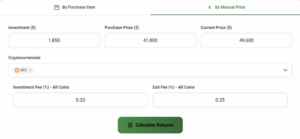
Many investors calculate return on investment (ROI) without considering costs. However, in practice, fees can significantly reduce actual returns, especially in active trading strategies where transaction costs accumulate over time.
Step-by-Step Crypto Futures Profit Calculation
- Identify entry price and exit price
- Calculate percentage change in price
- Multiply price change by leverage
- Apply result to margin
- Adjust for fees and funding rate
However, this model assumes ideal conditions. In real markets, additional factors must be considered.
Example Calculation (Crypto Leverage Profit Calculation)
- Entry price: $20,000
- Exit price: $21,000
- Price change: 5%
- Leverage: 10x
👉 Result: 50% profit on margin
Nevertheless, this result does not include liquidation risk or volatility effects.
However, this simplified example does not include fees or real market conditions. The following output shows how profit changes when using a structured crypto profit calculator with realistic inputs.
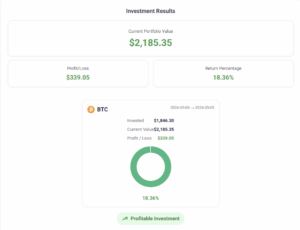
Real Scenario: BTC Futures Profit and Loss Calculation With 10x Leverage
To understand how leverage works in real conditions, consider this scenario:
- Asset: Bitcoin (BTC)
- Entry price: $20,000
- Position size: $10,000
- Margin: $1,000
- Leverage: 10x
Scenario Outcomes (Crypto Profit Calculator With Leverage)
| Price Move | New Price | Profit / Loss | Keywords |
|---|---|---|---|
| +5% | $21,000 | +50% | bitcoin futures profit |
| -5% | $19,000 | -50% | crypto loss calculation |
| -10% | $18,000 | High liquidation risk | liquidation price crypto |
| +10% | $22,000 | +100% | crypto leverage profit |
As demonstrated, leverage amplifies outcomes significantly. Therefore, traders must calculate both upside and downside scenarios.
How Liquidation Price Impacts Crypto Profit Calculation With Leverage
Liquidation occurs when your margin is no longer sufficient to maintain your position. Unlike spot trading, you cannot hold indefinitely.
Key Factors That Influence Liquidation Price
- Higher leverage reduces distance to liquidation
- Smaller margin increases risk
- Market volatility accelerates liquidation
- Maintenance margin defines thresholds
Moreover, liquidation eliminates the possibility of recovering losses. Therefore, it must be considered in every calculation.
Why Manual Crypto Leverage Profit Calculation Often Fails
Although formulas appear simple, real-world conditions introduce complexity. As a result, manual calculations often become unreliable.
Common Mistakes in Crypto Futures Profit Calculation
- Ignoring liquidation thresholds
- Miscalculating effective exposure
- Overlooking funding rates
- Underestimating volatility impact
- Using approximate instead of exact values
Consequently, traders may overestimate profit potential.
Use a Crypto Profit Calculator With Leverage to Estimate Real Profit and Risk
Instead of relying on manual calculations, using a structured tool improves accuracy. A proper crypto profit calculator with leverage allows you to:
- Simulate profit based on leverage
- Evaluate downside risk before entry
- Understand liquidation scenarios
- Adjust position size dynamically
Key Takeaways for Accurate Crypto Futures Profit Calculation
- Leverage amplifies both gains and losses
- Liquidation risk defines trade survival
- Volatility impacts leveraged positions more strongly
- Structured calculation improves decision-making
- Accurate estimation matters more than speed
How to Calculate Crypto Futures Profit With Leverage Including Fees and Funding Rates
While basic crypto profit calculation considers only price movement, real futures trading includes additional costs. Therefore, to calculate crypto profit with leverage correctly, traders must include both trading fees and funding rates.
In leveraged markets, ignoring these costs leads to an overestimation of profit. Consequently, many traders believe a position is profitable when it is actually neutral or slightly negative.
Additionally, funding rates can significantly impact long-term positions, especially in perpetual futures markets where they directly affect profitability over time.
Key Cost Components in Crypto Profit Calculator With Leverage
- Trading fees (entry and exit)
- Funding rates (periodic payments)
- Spread between bid and ask
- Slippage during execution
Moreover, these costs accumulate over time. Therefore, even small percentages can reduce total profit significantly.
Impact of Fees and Funding on Crypto Profit Calculation
| Component | Effect on Profit | Keywords |
|---|---|---|
| Trading Fees | Reduces net profit | crypto profit after fees |
| Funding Rate | Adds or subtracts value | funding rate crypto |
| Slippage | Alters execution price | crypto trading slippage |
| Spread | Hidden cost in entry | bid ask spread crypto |
As shown above, fees and funding must be included in any crypto futures profit calculator for realistic results.
Real Scenario: ETH Futures Profit Calculation With Leverage, Fees, and Funding
To better understand how these variables interact, consider a realistic Ethereum scenario.
- Asset: Ethereum (ETH)
- Entry price: $1,500
- Exit price: $1,575
- Price change: 5%
- Leverage: 10x
- Margin: $1,000
Initial Profit Calculation (Without Fees)
- Price change: 5%
- Leveraged result: 50%
- Profit: $500
Adjusted Profit Calculation (With Fees and Funding)
- Entry fee: $10
- Exit fee: $10
- Funding cost: $15
👉 Total cost: $35
👉 Net profit: $465
ETH Futures Profit Breakdown Table (Crypto Profit Calculator With Leverage)
| Step | Value | Result | Keywords |
|---|---|---|---|
| Gross Profit | $500 | Before costs | crypto leverage profit |
| Fees | -$20 | Entry + exit | crypto fees futures |
| Funding | -$15 | Holding cost | funding rate crypto |
| Net Profit | $465 | Final result | calculate crypto profit correctly |
As demonstrated, even small costs can reduce profit noticeably. Therefore, accurate calculation requires including all variables.
How to Calculate Crypto Loss With Leverage and Downside Risk
While profit scenarios are attractive, understanding loss scenarios is more important. In leveraged trading, losses increase at the same rate as gains.
For example:
- 5% price drop with 10x leverage → 50% loss
- 10% drop → near liquidation
Downside Risk Factors in Crypto Leverage Trading
- High leverage reduces margin safety
- Volatility increases drawdown speed
- Liquidation removes recovery opportunity
- Fees accelerate losses
Moreover, traders often underestimate how quickly losses accumulate.
Loss Scenario Table (Crypto Futures Loss Calculation)
| Price Move | Leverage | Loss Impact | Keywords |
|---|---|---|---|
| -2% | 10x | -20% | crypto loss leverage |
| -5% | 10x | -50% | crypto futures loss |
| -8% | 10x | -80% | margin loss crypto |
| -10% | 10x | Liquidation risk | liquidation price crypto |
Therefore, calculating downside scenarios is essential before entering any leveraged trade.
Common Mistakes in Crypto Profit Calculation With Leverage
Even experienced traders make mistakes when calculating leveraged profit. These errors often result from oversimplification.
Frequent Calculation Errors
- Ignoring funding rate impact
- Assuming constant market conditions
- Using approximate instead of exact values
- Forgetting liquidation thresholds
- Overestimating profit potential
Additionally, many traders focus only on profit while ignoring risk.
Why These Mistakes Matter (Analytical Insight)
In volatile markets, leverage amplifies noise rather than trend direction. As a result, traders may experience liquidation even when the overall trend appears favorable.
Therefore, accurate calculation must include both expected and unexpected scenarios.
How to Use a Crypto Profit Calculator With Leverage for Scenario Analysis
Instead of relying on static calculations, traders should simulate multiple scenarios. A proper crypto profit calculator with leverage allows dynamic analysis.
Best Practices for Using a Crypto Futures Profit Calculator
- Test different leverage levels
- Simulate both profit and loss scenarios
- Adjust position size before entry
- Include fees and funding costs
- Evaluate liquidation distance
Moreover, scenario analysis improves decision-making consistency.
Comparing Best-Case vs Worst-Case Crypto Profit Scenarios
Understanding different outcomes helps traders avoid biased expectations.
Scenario Comparison Table (Crypto Profit Calculator With Leverage)
| Scenario | Price Move | Result | Keywords |
|---|---|---|---|
| Best Case | +10% | +100% | crypto profit leverage |
| Moderate Case | +5% | +50% | crypto futures profit |
| Worst Case | -5% | -50% | crypto loss calculation |
| Extreme Case | -10% | Liquidation | liquidation risk crypto |
Consequently, traders can better evaluate risk-reward balance.
Use This Crypto Profit Calculator to Simulate Futures Profit and Loss
Manual calculations provide a basic understanding. However, they cannot capture real-time complexity.
Therefore, using a structured tool improves both accuracy and speed.
Key Takeaways for Crypto Profit Calculation With Leverage and Fees
- Fees and funding reduce real profit
- Leverage amplifies both gains and losses
- Loss scenarios are as important as profit scenarios
- Liquidation risk must be included in calculations
- Scenario analysis improves trading decisions
Advanced Crypto Profit Calculator With Leverage: Multi-Position Strategy and Real Risk Control
In real trading environments, profit calculation rarely happens at a single-position level. Instead, traders manage multiple leveraged positions across different assets. Therefore, a simple calculation is no longer sufficient.
A professional crypto profit calculator with leverage should help you understand how your entire portfolio behaves, not just one trade.
Moreover, when multiple positions are active, risk does not increase linearly. Instead, it compounds under volatility. As a result, traders who ignore portfolio-level exposure often misjudge their real risk.
How to Calculate Crypto Profit Across Multiple Futures Positions
When managing several positions, each trade has its own variables. However, your final outcome depends on how these positions interact.
Therefore, calculating crypto futures profit requires a structured approach.
Multi-Position Crypto Profit Calculation Framework
- Track each position independently
- Calculate profit or loss per position
- Combine all results into total portfolio outcome
- Adjust for shared margin exposure
- Include funding costs across positions
Additionally, traders should evaluate how one position affects another under market stress.
Multi-Position Profit Table (Crypto Futures Portfolio Calculation)
| Position | Entry | Leverage | Result | Keywords |
|---|---|---|---|---|
| BTC Long | $20,000 | 10x | +50% | bitcoin futures profit |
| ETH Long | $1,500 | 5x | +25% | ethereum futures profit |
| SOL Short | $100 | 8x | -16% | crypto short calculation |
As shown above, individual profits do not always translate into overall gains. Therefore, portfolio balance becomes more important than isolated success.
How Total Exposure Changes Crypto Profit Calculation With Leverage
Exposure defines how much of the market you control relative to your capital. In leveraged trading, this number can grow quickly.
For example:
- Capital: $2,000
- Total exposure: $20,000
👉 Effective leverage across portfolio: 10x
However, this level of exposure increases sensitivity to market movement.
Key Exposure Drivers in Crypto Leverage Profit Calculation
- Total position size across assets
- Margin allocation per trade
- Correlation between positions
- Volatility across markets
Furthermore, when exposure increases, even small price movements can trigger large changes in portfolio value.
Why Correlation Changes Real Profit and Risk in Crypto Futures
In crypto markets, assets often move together. Therefore, holding multiple positions does not always reduce risk.
For example:
- BTC and ETH often trend in the same direction
- Altcoins amplify BTC movements
- Market-wide volatility affects all leveraged positions
Correlation Impact on Profit (Crypto Portfolio Leverage Analysis)
| Correlation Type | Impact | Keywords |
|---|---|---|
| High correlation | Amplified gains and losses | crypto correlation |
| Low correlation | Balanced exposure | diversification crypto |
| Mixed assets | Partial hedge | crypto portfolio strategy |
As a result, traders must consider correlation when calculating profit with leverage.
Advanced Insight: Why Real Profit Is Often Lower Than Expected
Many traders calculate profit correctly but still experience lower-than-expected results. This happens because calculation alone does not reflect real execution conditions.
Several hidden factors affect outcomes:
- Funding costs reduce long-term profit
- Fees accumulate across multiple trades
- Slippage alters entry and exit prices
- Volatility introduces noise
Moreover, leveraged trading amplifies these effects.
👉 Insight:
“In leveraged environments, accuracy matters more than direction.”
Even if your market prediction is correct, poor calculation or ignored costs can reduce actual returns.
Common Strategic Mistakes in Crypto Profit Calculation With Leverage
Even experienced traders make systematic mistakes when working with leverage. These mistakes often come from overconfidence in simplified models.
High-Impact Errors in Crypto Futures Profit Calculation
- Overestimating profit without including fees
- Ignoring liquidation distance
- Using maximum leverage without margin buffer
- Assuming correlation reduces risk
- Focusing only on best-case scenarios
Additionally, traders often underestimate how quickly risk compounds.
How to Use a Crypto Profit Calculator With Leverage for Smarter Decisions
A structured crypto profit calculator with leverage is not just a tool for calculation, but part of a broader framework for managing profit, risk, and portfolio decisions.
It allows traders to:
- Simulate multiple scenarios before entering a trade
- Compare different leverage levels
- Evaluate both upside and downside outcomes
- Understand liquidation thresholds
- Adjust position size based on risk
Therefore, using a calculator improves consistency and reduces emotional decision-making.
Final Scenario Comparison: Profit vs Risk in Leveraged Trading
To summarize how leverage affects outcomes, consider this comparison:
Crypto Profit vs Risk Table (Leverage Decision Framework)
| Scenario | Price Move | Outcome | Keywords |
|---|---|---|---|
| Controlled Trade | +5% | +50% | crypto leverage profit |
| Aggressive Trade | +10% | +100% | futures profit crypto |
| Risk Scenario | -5% | -50% | crypto loss leverage |
| Failure Scenario | -10% | Liquidation | liquidation risk crypto |
As shown above, leverage creates asymmetric outcomes. Therefore, understanding risk becomes more important than maximizing profit.
Use This Crypto Profit Calculator to Calculate Real Futures Profit and Risk
Manual calculations provide a basic understanding. However, they cannot capture real trading complexity.
A structured tool allows you to evaluate positions with greater accuracy and confidence.
Final Takeaways for Crypto Profit Calculation With Leverage
- Leverage amplifies both opportunity and risk
- Real profit depends on cost, not just price movement
- Liquidation defines the limits of your position
- Portfolio exposure matters more than single trades
- Structured calculation improves long-term consistency
Ultimately, traders who rely on accurate calculation frameworks make more stable decisions.