

- TL;DR:
- Major 2025 AVAX News (Chronological)
- Key Growth Catalysts in 2025
- Avalanche Technology & Architecture
- Current Ecosystem Statistics (Oct-2025)
- Market Capitalization & Supply
- DeFi & TVL
- Network Usage
- Staking & Security
- Ecosystem Scale
- Community Sentiment (2025)
- Fundamental Analysis
- Tokenomics
- Treasury & Funding
- Developer Activity
- Protocol Upgrades
- Competition
- Technical Analysis (2025 Price Action)
- Investment Potential (Oct-2025)
- Weaknesses and Risks
- Network Centralization Concerns
- Past Outages and Reliability
- Competition
- Regulatory Uncertainty
- Market Volatility
- Ecosystem Depth
- Conclusion
Avalanche’s 2025 year saw both turbulence and progress. Early in the year, crypto markets plunged on US–China tariff fears, dragging AVAX prices lower. As tensions eased, Avalanche’s ecosystem advanced: Wyoming’s FRNT stablecoin and enterprise use cases (fine wine, sports tickets) emerged, and network upgrades boosted throughput. By year-end these catalysts helped restore momentum, though AVAX remained sensitive to global market swings
Review Avalanche’s Trust Score before making portfolio moves.
TL;DR:
-
Avalanche’s 2025 was volatile but ultimately growth-focused. Early-year US–China tariff fears triggered crypto sell-offs, pushing AVAX down. Subsequent ecosystem milestones—like the FRNT state-backed stablecoin launch on Avalanche, enterprise tokenization projects, and the Avalanche 9000 upgrade (major fee reduction)—revived confidence. By October AVAX traded ~$20–25 with ~$10–11B market cap. Expanding DeFi (TVL ~$2B) and developer interest buttress long-term potential, though centralization and volatility remain key risks.
-
Key Risks: High concentration (top 100 wallets ~65% of AVAX); potential centralization of validators; regulatory/macro uncertainty (trade wars, stablecoin rules); and crypto market volatility (sharp swings in AVAX price).
-
Current Metrics: Market cap ≈$10.3–10.5B (Oct 2025); daily trading ~$750M (≈7% of market cap); ~48–53% of AVAX staked (~$2.5B); DeFi TVL $1.5–2B (up 60% Q1); ~18.5M daily transactions, 146k active addresses in Q3 (up 203%/70% QoQ)
Major 2025 AVAX News (Chronological)
A series of key events shaped Avalanche’s narrative in 2025, from institutional launches to funding announcements. The timeline below highlights the biggest news and their significance:
| Date | Event & Significance |
|---|---|
| Aug 18, 2025 | FRNT state-backed stablecoin launches on Avalanche: Wyoming’s FRNT, the first fully-backed state-issued USD stablecoin, went live on Avalanche. This highlights institutional trust in Avalanche’s speed and security (integration with Visa via Rain card). |
| Sep 11, 2025 | $1B+ Treasury Fundraise: The Avalanche Foundation announced plans to raise ~$1 billion to create two AVAX-denominated treasury vehicles. These would buy AVAX from the Foundation at a discount, signaling massive long-term confidence and funding for the ecosystem. |
| Oct 2, 2025 | Blockchain Ticketing for Copa Beisbol: Tixbase launched blockchain ticketing for the 2025 Copa América de Béisbol on an Avalanche Layer-1. Over 200,000 tickets (sports NFTs) were sold on a custom Avalanche chain, demonstrating real-world enterprise adoption. |
| Oct 7, 2025 | Fine Wine Tokenization (CruTrade): Avalanche enabled the first on-chain tokenization of physical fine wine bottles. Using RFID tags, each bottle’s provenance is recorded on Avalanche, showcasing a novel real-world asset use case on its subnets. |
| Oct 27, 2025 | Avalanche Treasury SPAC ($675M): Avalanche Treasury Co. (AVAT) announced a $675 M SPAC merger to build a $1B+ AVAX treasury. AVAT will hold and buy AVAX (discounted initial purchase), aligning institutional capital with AVAX’s value and adoption. |
Each of these milestones underscores Avalanche’s growing footprint in both DeFi and enterprise applications, even as overall crypto markets faced headwinds.
 Related: Weekly Crypto News and Analysis
Key Growth Catalysts in 2025
Avalanche’s expansion in 2025 was driven by several converging factors, which together bolstered its ecosystem and adoption. The table below summarizes the most important growth drivers:
| Catalyst | Impact / Example |
|---|---|
| Institutional & RWA Adoption | State-backed projects like FRNT stablecoin (Wyoming USD) launched on Avalanche; enterprises tokenized real assets (fine wine NFTs). These builds and partnerships (e.g. Passolig sports platform) attract new users and legitimize the platform. |
| DeFi Ecosystem Growth | DeFi TVL roughly doubled in early 2025 (to ~$1.5–2.0B). Top DEXs and lending protocols (TraderJoe, Aave, etc.) saw resumed activity, and stablecoin liquidity (USDC/USDT/DAI ~$1.7B) surged, indicating renewed investor interest. |
| Protocol Upgrades & Incentives | Avalanche 9000 upgrade (Oct 2025) dramatically cut base fees (from 25 nAVAX to 1 nAVAX) and enabled fee-burning. Avalanche’s Retro9000 program offered ~$40M in grants to L1 builders, spawning 500+ new chains on testnet. These incentivized developers and improved UX. |
| Ecosystem & Developer Expansion | Stack.money data shows ~1007 developers contributed over the last year. Avalanche supports 100+ active subnets, and Q3 usage jumped to ~18.5M daily transactions. The growing number of subnets and DApps (500+ live) reflects broadening network utility. |
Together, these catalysts helped Avalanche regain momentum after early-year volatility, building a foundation for longer-term growth (as detailed in subsequent sections).
Avalanche Technology & Architecture
Avalanche is a high-performance Proof-of-Stake L1 blockchain built around three specialized chains. The Exchange Chain (X-Chain) manages asset creation and transfers, the Contract Chain (C-Chain) runs EVM-compatible smart contracts, and the Platform Chain (P-Chain) coordinates validators and subnet creation. This architecture is designed for sub-second finality and high throughput (thousands of transactions per second). Its unique consensus (“Avalanche protocol”) uses randomized validator sampling, enabling rapid agreement without heavy communication overhead. In practice, Avalanche achieves near-instant confirmations and very low fees.
A key innovation is Avalanche subnets: any group of validators can launch a dedicated subnet (custom blockchain) tailored for specific applications or compliance needs. By late 2025, Avalanche supported over 100 active subnets, ranging from gaming to finance. These subnets inherit Avalanche’s security while allowing custom parameters (like block times or token economics). In sum, Avalanche’s multi-chain design and consensus make it both scalable and flexible – factors that underpin its attraction for DeFi, NFTs, and enterprise use.
Current Ecosystem Statistics (Oct-2025)
Market Capitalization & Supply
As of October 2025, AVAX has a market cap of roughly $10.3–10.5 billion (≈0.27% of total crypto market cap). AVAX trades in the low-$20s range per token. The circulating supply is about 422.3 million AVAX (~59% of the 720M cap); the remainder unlocks over time (next significant unlock ~Nov 13, 2025). Trading volumes have been healthy (~$750–800M/day, roughly 7–8% of market cap), indicating active liquidity.
DeFi & TVL
Avalanche’s DeFi metrics rebounded in 2025. Total Value Locked (TVL) in Avalanche-based protocols climbed back above $1.5–2.0 billion. One report shows TVL jumped ~62% quarter-over-quarter to ~60M AVAX (~$1.6B) by March 2025. Leading platforms (Trader Joe, Pangolin, Aave, etc.) saw renewed deposits, and stablecoins (USDC/USDT/DAI) on Avalanche exceeded $1.7B combined. This growth suggests DeFi users are redeploying capital as volatility eased.
Network Usage
Avalanche’s on-chain activity is expanding. In Q3 2025, the network averaged about 18.5 million daily transactions (up ~203% QoQ) with ~146,600 active addresses daily (up ~70% QoQ). These surges reflect more users and applications engaging the network. Such volumes underscore Avalanche’s technical strength (sub-second finality at scale). Subnets like the Avalanche tokenization chain and gaming chains (e.g. SocialFi apps) have helped drive this usage.
Staking & Security
The network’s security comes from AVAX staking. Roughly 48–53% of AVAX (≈$2.4–2.6B) is currently staked. Validators must lock a minimum of 2,000 AVAX to run a node, but delegators can stake as little as 25 AVAX. Avalanche does not slash stakes for downtime, only discourages misbehavior. Major staking providers report yields in the 6–7% range (e.g. Allnodes ~6.1%). The high stake participation and multiple independent validators help maintain decentralization and network uptime. (Notably, a 2022 bug was patched before causing an outage, and no major network downtime has occurred in 2025.)
Ecosystem Scale
Avalanche’s ecosystem is sizable but still smaller than top L1s. Over 500 dApps have launched on Avalanche by 2025, spanning DeFi, NFTs, and gaming. Gaming/NFT projects have driven much of the recent on-chain activity (e.g. 500k daily gamers at peak). The Avalanche 9000 upgrade cut fees dramatically (down to 1 nAVAX per transaction), which has attracted developers to build more aggressively. However, compared to Ethereum or even Solana, Avalanche’s total TVL and developer pool remain modest, indicating room to grow its community.
Community Sentiment (2025)
Social and on-chain signals suggest the AVAX community remained cautiously optimistic by late 2025. After price dips, traders on crypto forums and Twitter noted strong buy-side interest. For example, analysts cited a 60:40 buy/sell imbalance in order books as evidence of accumulation, and traders on X anticipated a swift rebound (one called for a recovery to ~$25 within 48 hours). Notably, whales have been accumulating: public on-chain data showed an entity purchasing ~200,000 AVAX (~$6M) during October’s selloff, signaling confidence in the token’s future.
On-chain metrics support this improved outlook. Avalanche’s daily trading volume jumped by ~$200M recently, pushing total volume to nearly $950B and indicating renewed interest. Decentralized exchanges now account for ~33% of that volume. Meanwhile, development activity (measured in smart contracts and commits) has risen: according to Messari, over 44 million contracts were deployed and 4.8 million AVAX were burned through fees in recent weeks, reflecting heavy usage. In sum, community chatter (forums, tweets) and data points show that after a scare, many AVAX supporters view the pullback as an opportunity, not panic
Fundamental Analysis
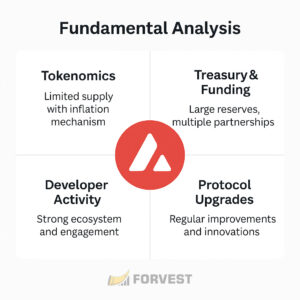
Avalanche’s fundamental strengths in 2025 — balanced across tokenomics, funding, developer engagement, and protocol upgrades.
Tokenomics
AVAX has a fixed max supply of 720 million. About 422.3 million are currently circulating (~59% of the cap), with the remainder unlocked over several years (e.g. a foundation allocation vesting Nov 2025). Annual inflation is modest (~7.5%). Crucially, Avalanche burns a portion of transaction fees: the Avalanche 9000 upgrade introduced dynamic fee burning, which will gradually make the supply deflationary under high usage. Overall, AVAX’s supply schedule and fee mechanism support scarcity over time. The token is used for fees, staking, and governance on subnets, aligning incentives with network growth.
Treasury & Funding
Avalanche’s funding outlook is very strong. The non-profit Avalanche Foundation is assembling massive war-chests: in Sept 2025 it revealed plans to raise $1 billion for two AVAX-based treasury companies. One will acquire AVAX via a public SPAC (Avalanche Treasury Co) which just announced a $675M deal to build a $1B AVAX portfolio. These treasuries will buy AVAX (at discounts) and then deploy capital back into the ecosystem (ventures, grants). This strategy mirrors successful crypto treasury models (e.g. MicroStrategy’s Bitcoin treasury) and should materially backstop AVAX demand. The fact that Wall Street investors (e.g. Michael K. in the SPAC) and a white-house advisor were involved underscores institutional confidence. Such large-scale funding and token buybacks significantly bolster AVAX’s financial foundation.
Developer Activity
Avalanche’s codebase is actively maintained. Over the past year, about 1,007 developers have contributed to Avalanche’s GitHub repositories. Key projects see thousands of updates: for instance, the core node software AvalancheGo recorded ~3,240 commits in the last year, and documentation repos likewise saw heavy activity. This sustained development pace suggests that upgrades, security audits, and new features are regularly applied. The community of builders is growing, supported by grants (e.g. Retro9000) and hackathons. In short, Avalanche’s developer metrics are robust for its stage – indicating a healthy and evolving protocol, though still smaller than Ethereum’s contributor base.
Protocol Upgrades
Avalanche continues to enhance its protocol. Notably, the Avalanche 9000 upgrade (rolled out in late 2025) drastically reduced C-Chain fees by ~25× and enabled automatic fee burning. These changes make DeFi and dApps on Avalanche cheaper and economically attractive. Research from Ava Labs and Cornell (the Frosty consensus protocol) is also set to improve speed under load. In 2025, the network frequently deployed minor upgrades (e.g. small forks improving staking efficiency) and tool improvements. Overall, the upgrade track record shows Avalanche can iterate rapidly, maintaining technical edge – a positive for investors who value an improving, future-proofed platform.
Competition
Avalanche operates in a crowded Layer-1 field. Its closest competitor is Ethereum, as Avalanche’s C-Chain is Ethereum-compatible. As one analyst notes, Avalanche “faces tough competition from Ethereum,” which dominates DeFi and has many developers. Other rivals include Solana, Aptos, and newer high-throughput chains. Each has unique features (e.g. Solana’s speed, Aptos’s Move VM) that siphon activity. Avalanche’s counter is its subnet architecture and cross-chain messaging, but there’s no guarantee it will outpace networks with larger communities or deeper liquidity. Competition remains a fundamental challenge: AVAX must keep innovating to defend market share.
Technical Analysis (2025 Price Action)
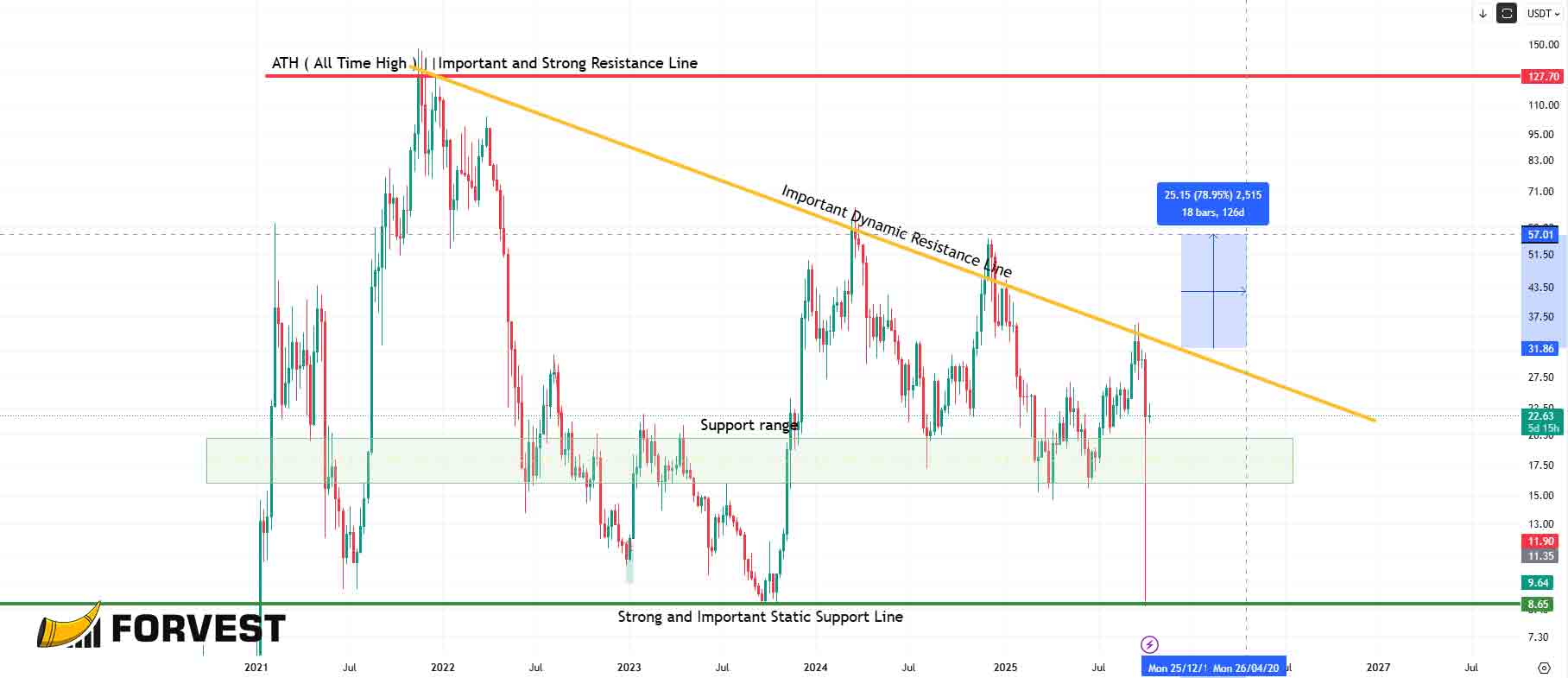
AVAX technical analysis chart showing key support and resistance levels, dynamic trendline from all-time high, and price range between $17 support and $31–$57 resistance in October 2025.
Based on the current AVAX (Avalanche) technical chart, the asset remains in a consolidation phase within a well-defined range. The descending dynamic resistance line (yellow) — drawn from the all-time high — continues to act as a strong barrier against upward movement. A confirmed breakout above this trendline could trigger a 70–80% rally, with limited resistance until the next major supply zone. On the downside, the static green support range between $17 and $20 serves as the main defense area; losing this level could expose AVAX to a deeper correction toward the $8.65 strong support zone. In summary, AVAX’s next major trend will likely depend on how price reacts to these key technical levels — a breakout may open a medium-term bullish scenario, while a breakdown could signal renewed bearish momentum.
Investment Potential (Oct-2025)
Avalanche’s investment case is mixed. On the positive side, its expanding ecosystem – state-backed stablecoins, RWA tokenizations, gaming/NFT growth, and deep subnets – provides tangible use cases. Analysts have noted that with such structural growth, a technical rebound above the mid-$20s could pave the way to $35–$50 over time, assuming broader crypto markets recover. On the downside, AVAX has underperformed the largest altcoins this year and remains tied to macro sentiment. Investors should consider that macroeconomic factors (inflation, trade policies) could continue to drive short-term swings. Given this, AVAX seems best suited for those bullish on crypto’s long-term trend and looking for higher reward (with higher volatility).
For a concise, data-driven snapshot of AVAX’s strengths and risks, check Forvest’s Avalanche Trust Score analysis. The Trust Score page (updated Oct 2025) aggregates Avalanche’s metrics on fundamentals, ecosystem depth, and sentiment. For more details and the latest scores, see Avalanche (AVAX) Trust Score on Forvest (explore grades on liquidity, development activity, and more).
Related: Bitcoin 2025: Full-Year Price Analysis
Weaknesses and Risks
Network Centralization Concerns
Avalanche’s model requires high stakes to validate, which raises centralization issues. The top 100 AVAX addresses hold roughly 65% of the total supply, meaning large players (exchanges, institutions) control most tokens. Combined with the 2,000-AVAX minimum stake, this concentration could allow a few entities to dominate validation. OSL notes this as a key con: “a small number of validators” can tip consensus. In short, if AVAX distribution remains skewed, the network’s decentralization promise may be diluted.
Past Outages and Reliability
Historically, Avalanche has avoided major outages. No network-wide downtime occurred in 2025. (A significant 2022 bug was discovered and patched before causing harm.) The protocol’s modular design (three chains) provides some fault isolation. That said, any future software bug or coordination failure could risk network disruptions. Investors should watch upgrade testing and respond to reported vulnerabilities. So far, Avalanche’s uptime track record is solid, but it remains a risk factor for mission-critical use cases.
Competition
(Repeating some points for emphasis.) Avalanche competes with far larger ecosystems. Ethereum’s dominance in DeFi and NFTs puts Avalanche at a disadvantage. Solana and emerging Layer-1s (like Aptos/Sui) also chase similar use cases (gaming, DeFi). If capital flows into these competitors or if Ethereum’s scalability improves, AVAX might struggle to gain share. Competition isn’t unique to Avalanche, but the sheer number of rivals and limited market attention can cap AVAX’s upside.
Regulatory Uncertainty
Global policy shifts are a wildcard. Avalanche’s growth plan includes stablecoins (FRNT, UST) and tokenization of real assets – both areas of regulatory scrutiny. Changes in stablecoin regulation or cross-border trade rules could affect Avalanche’s projects. For example, tighter oversight of DeFi or state digital assets might slow adoption. In addition, geopolitical tensions (trade wars, sanctions) can abruptly impact crypto markets (as seen). Regulatory clarity is improving in some jurisdictions, but uncertainty remains a broad risk to AVAX’s institutional ambitions.
Market Volatility
AVAX’s price is highly sensitive to crypto market sentiment. Major sell-offs in 2025 coincided with macro shocks (tariff rumors, rate fears). Even technical positives had limited immediate effect if Bitcoin and macro took hits. The flip side is that bullish phases cause rapid AVAX rallies – so volatility is two-sided. Investors should expect continued 15–30% swings until crypto markets stabilize. As OSL notes generally for crypto, “volatile market conditions” are a prime risk.
Ecosystem Depth
While Avalanche’s network is growing, it still lags Ethereum in scale. Currently ~500 dApps and 100+ subnets are live, but many projects are niche (gaming or enterprise pilots). Liquidity and user base on Avalanche are modest by comparison. If few new major applications emerge, network usage could plateau. In particular, DeFi on Avalanche (TVL ~$2B) is tiny next to Ethereum’s $70–80B. Avalanche needs more “killer apps” outside of gaming to deepen its ecosystem. Until then, its market depth and resilience to shocks may be limited.
Conclusion
Avalanche’s 2025 was a study in contrasts. Macroeconomic headwinds (trade tensions, inflation fears) clearly dampened AVAX’s price; yet underlying growth was tangible. By year-end the protocol’s on-chain activity (daily transactions, TVL, fees burned) was at multi-year highs, indicating “real momentum, not speculation”. Institutional-grade developments (FRNT, SPAC treasuries) and network upgrades point to structural strengthening of Avalanche’s ecosystem. In sum, Avalanche has built significant foundations: expanded subnets, new tokenized assets, and a large-scale treasury apparatus. These give it credibility beyond pure hype, suggesting that AVAX’s value is increasingly tied to real utility.
Looking ahead, AVAX’s prospects will depend on broader market tides. If crypto sentiment recovers, Avalanche’s robust fundamentals may translate into a strong rally (potentially revisiting $35–$50 levels). Even if markets remain choppy, Avalanche’s diversified use cases (DeFi, NFTs, enterprise) should support long-term relevance. For now, AVAX sits at an inflection: volatile in the short term, but backed by genuine growth catalysts. Investors should keep a close watch on upcoming economic news and Forvest’s Trust Score for AVAX to gauge whether this promising platform finally breaks out or stays tethered by global uncertainties.
