


AI Crypto Prediction: Can AI Predict Crypto Prices Reliably?
Artificial intelligence and cryptocurrency analysis are often discussed together, but they do not always answer the same analytical question.
AI prediction does not mean certainty. An AI forecast is not knowledge of future market outcomes, and a model output does not automatically represent what will happen next.
AI systems can process large amounts of market information, identify patterns, and generate forecasts based on available data. However, an AI-generated forecast does not mean that a system can know the future price of Bitcoin, Ethereum, or another cryptocurrency.
This distinction matters because investors often confuse AI analysis with guaranteed prediction.
AI crypto prediction is not about removing uncertainty from financial markets. Instead, it focuses on using data-driven methods to analyze market conditions, identify possible patterns, and evaluate different scenarios.
Cryptocurrency markets create additional challenges because digital assets are influenced by changing liquidity conditions, market sentiment, regulation, global events, and unexpected shifts in market behavior.
For this reason, the more useful question is not only:
Can AI predict crypto prices?
A more practical question is:
What does an AI forecast actually measure, and how should investors evaluate whether its output is reliable?
Understanding this difference helps investors view AI as an analytical tool rather than a guaranteed prediction system.
What Does AI Crypto Prediction Actually Mean?
The term AI crypto prediction can describe different types of systems and analytical approaches.
AI crypto prediction refers to the use of artificial intelligence models to analyze market data and estimate possible future scenarios. These estimates are based on patterns and available information, not certainty about future prices.
Some models evaluate historical market behavior, volatility changes, trading activity, sentiment signals, and relationships between different market indicators.
AI models may attempt to forecast different outcomes, including price movement, volatility, market direction, or broader market conditions.
Depending on the design of the model, the output may focus on possible price direction, changing market conditions, or probability-based scenarios.
However, these outputs represent interpretations of available information, not certainty about future events.
The reliability of an AI forecast depends on several factors, including the quality of the data being analyzed, the variables included in the model, the method used to evaluate performance, and how uncertainty is measured.
Many AI forecasting systems rely on machine learning methods that identify relationships within historical and current market data. However, identifying relationships does not automatically mean that a model can accurately predict future market behavior.
A model that identifies a historical pattern is not automatically proving that the same pattern will repeat.
This is why evaluating an AI forecast requires looking beyond the final result.
Instead of asking only:
“Will Bitcoin go up tomorrow?”
investors should consider:
What patterns exist in current market data?
How similar is the current market environment to previous conditions?
What factors could influence the forecast?
How reliable is the model’s output?
These questions shift the focus from prediction claims toward forecast evaluation.
AI Prediction, AI Analysis, and AI Automation Are Different
One of the most common misunderstandings in crypto AI is treating every AI system as a prediction engine.
Although these concepts may overlap, they perform different analytical functions.
| Concept | What It Does | Main Purpose |
|---|---|---|
| AI Analysis | Processes market information and identifies patterns | Helps users understand current market conditions |
| AI Forecasting | Estimates possible future outcomes based on available data | Creates probability-based scenarios |
| AI Automation | Performs predefined actions based on rules or instructions | Improves workflow efficiency |
An AI system that analyzes cryptocurrency markets does not automatically mean that it can accurately predict future prices.
For example, an AI model may identify changes in volatility, unusual trading activity, or shifts in market sentiment. These insights may help investors understand the current environment, but they do not guarantee what happens next.
The difference between analysis and prediction is important because investors need to understand what information an AI system is actually providing.
Why AI Crypto Prediction Is Challenging
Understanding what an AI system does is only the first step.
The next challenge is understanding why forecasting cryptocurrency markets remains difficult.
Crypto markets operate in environments where conditions can change quickly. Unlike traditional financial markets with longer histories and more established structures, digital assets can experience rapid changes in volatility, liquidity, trading activity, and investor behavior.
Historical data can help AI models identify relationships and patterns, but past market conditions do not guarantee future outcomes.
A model that performs well during one market environment may behave differently when conditions change. For example, changes in liquidity, market sentiment, or broader market conditions can influence whether previous patterns remain useful.
This means that evaluating an AI forecast requires more than reviewing the prediction itself.
Investors also need to understand the information behind the forecast, including what the model is attempting to predict, what data sources support the analysis, how the model was tested, whether results were evaluated using new data, and how uncertainty is handled.
These factors provide important context when assessing the reliability of AI-generated insights.
How AI Analyzes Cryptocurrency Markets
AI crypto analysis systems can combine different types of market information to evaluate patterns and possible market conditions.
In cryptocurrency markets, this may include historical price behavior, trading activity, market sentiment signals, blockchain-related information, and market indicators.
The purpose of combining these inputs is not to create certainty, but to help identify relationships within complex market environments.
However, the usefulness of an AI output depends heavily on the quality of the information behind it.
A model using incomplete, outdated, or poorly structured data may produce unreliable conclusions even when the underlying technology is advanced.
This creates an important distinction:
A sophisticated AI model does not automatically create a reliable forecast.
The reliability of the result depends on the data, methodology, testing process, and limitations of the system.

Why Forecast Credibility Matters
Many discussions about AI crypto prediction focus only on the final forecast. However, the forecast itself represents only one part of the evaluation process.
Investors also need to understand how that forecast was created, including what is being predicted, which data sources support the analysis, how performance was evaluated, and how uncertainty is handled.
The quality of an AI forecast should not be judged only by whether a prediction was correct once, but by how the system is designed, tested, and evaluated over time.
A reliable AI approach is therefore not defined by claiming perfect accuracy. The credibility of a forecast depends on transparency, validation, and a clear understanding of the model’s limitations.
This is why forecast credibility is often more important than simply searching for the strongest prediction claim.
Evaluating an AI forecast requires understanding not only the output, but also the methodology, evidence, and limitations behind it.
A practical way to evaluate this process is to examine five areas:
Forecast Claim
↓
Data Sources
↓
Testing Method
↓
Performance Evaluation
↓
Uncertainty and Real-World Use
The next section introduces the framework for assessing AI forecast credibility.
How Should Investors Evaluate an AI Crypto Forecast?
An AI-generated forecast can appear convincing because it provides a clear outcome. However, the presence of a prediction does not determine whether that forecast deserves trust.
In cryptocurrency markets, evaluating an AI forecast requires looking beyond the final result and understanding the process behind it.
An AI forecast comes from a combination of decisions: what the model aims to predict, which information the system analyzes, how developers test the system, and how the model measures uncertainty. These factors influence how investors should interpret the output.
This distinction is important because a forecast result and forecast credibility are not the same thing.
A prediction can appear accurate once without proving that the underlying model is reliable. Similarly, a model can provide useful analytical context even when it cannot accurately predict every future market movement.
For investors, the more important question is not only:
“What does the AI predict?”
A stronger question is:
“How did developers create, test, and evaluate this forecast?”
Understanding this difference helps investors evaluate AI as an analytical process rather than a source of certainty.
Why Forecast Claims Need Clear Definitions
Before evaluating an AI forecast, investors need to understand what the model actually attempts to predict.
The term AI crypto prediction can describe different forecasting objectives. Some systems may analyze possible price movement, while others may evaluate volatility changes, market direction, sentiment shifts, or broader market conditions.
These outcomes represent different analytical tasks.
A model designed to identify changing volatility does not perform the same function as a model designed to estimate possible price scenarios.
For this reason, forecast evaluation begins with defining the forecast claim itself.
Investors should understand:
What exactly does the model predict?
Does the model forecast price, direction, volatility, or market conditions?
What timeframe does the forecast apply to?
Without this context, it becomes difficult to determine whether an AI output matches the purpose it was designed for.
Investors can only evaluate a forecast fairly when they clearly understand the original claim.
Why Data Sources Matter in AI Forecasting
AI systems depend on the information they analyze.
In cryptocurrency markets, this information may include historical price data, trading activity, market sentiment signals, blockchain-related information, and market indicators.
However, the amount of available data does not automatically determine forecast quality.
The usefulness of an AI system depends on whether the information remains relevant, structured correctly, and appropriate for the forecasting objective.
For example, two AI models may analyze similar cryptocurrency market data but produce different outputs. One model may focus on volatility changes, while another may attempt to estimate possible price scenarios. Even when both systems use similar information, the model purpose and interpretation method can create different results.
This is why investors should evaluate not only what an AI forecast produces, but also the foundation behind that forecast.
Data quality, source selection, and model objectives all influence how investors should interpret the final output.
Why Testing Methods Influence Forecast Reliability
A forecast becomes more meaningful when investors understand how developers evaluate the model.
A model that performs well using historical information does not automatically prove that it will produce similar results in future market conditions.
Cryptocurrency markets continuously change. Volatility levels, liquidity conditions, market participation, and investor behavior can shift over time.
As a result, a pattern identified during one market environment may become less useful in another.
A stronger evaluation process examines whether developers test a model using information it has not previously analyzed and whether performance remains consistent under different conditions.
| Evaluation Area | Weak Evaluation Approach | Strong Evaluation Approach |
|---|---|---|
| Forecast Claim | Focuses only on the final prediction | Defines what the model actually forecasts |
| Data Sources | Looks only at the output | Reviews the information used by the model |
| Testing Method | Relies on isolated historical examples | Evaluates performance using appropriate testing methods |
| Performance | Highlights individual successful outcomes | Reviews consistency across different conditions |
| Uncertainty | Ignores possible limitations | Considers uncertainty and potential weaknesses |
This distinction changes how investors interpret AI forecasts.
The question is not whether a model produced one successful prediction.
The question is whether investors can evaluate and understand the process behind that prediction.

Why Prediction Accuracy Alone Is Not Enough
One of the most common mistakes in evaluating AI forecasts is treating previous successful predictions as proof of reliability.
A single correct outcome does not demonstrate that a model will continue performing under different market conditions.
Forecast quality depends on broader factors, including the methodology behind the system, the conditions used for testing, the consistency of results, and the way the model communicates uncertainty.
For example, an AI model may identify useful patterns during a period with stable market behavior. However, the same approach may produce different results when volatility increases, liquidity changes, or market conditions shift.
This does not mean the model has no value.
It means investors need to understand the environment in which developers created the forecast and the limitations of applying previous results to future conditions.
A reliable AI forecasting approach does not depend on presenting the strongest prediction outcome.
Instead, it depends on transparency around how the system works, how developers evaluate results, and where uncertainty remains.
From Prediction Results to Forecast Credibility
Evaluating an AI forecast requires examining the complete process behind the output rather than focusing only on the final prediction.
A credible evaluation considers whether the forecast claim is clear, whether the supporting data is appropriate, whether the testing method reflects real conditions, and whether the system explains uncertainty honestly.
This approach changes the way investors interpret AI-generated insights.
Instead of asking whether an AI system can eliminate uncertainty from cryptocurrency markets, investors can ask whether the forecast provides useful analytical context and whether they can independently evaluate the methodology behind it.
No forecasting system can remove uncertainty completely.
The goal is not to find a prediction with absolute certainty. The goal is to understand the evidence, limitations, and evaluation process behind an AI forecast.
This creates the foundation for a structured approach to assessing forecast credibility.
The next section introduces the AI Forecast Credibility Framework, which examines five important areas: forecast claims, data sources, testing methods, performance evaluation, and real-world uncertainty.
The AI Forecast Credibility Framework: A Better Way to Evaluate AI Crypto Predictions
An AI forecast and a reliable AI forecast are not the same thing.
A prediction output only represents the final result produced by a model. It does not automatically explain why the model reached that conclusion, how the system was tested, or whether the result remains meaningful under different market conditions.
This distinction is important because investors often focus on the prediction itself while overlooking the process behind it.
AI forecast output ≠ forecast credibility.
A model may generate a prediction, but investors still need to understand whether the forecast has a clear purpose, uses appropriate information, follows a reliable evaluation process, and communicates its limitations.
In cryptocurrency markets, this evaluation becomes even more important because market conditions can change rapidly. Volatility shifts, liquidity differences, unexpected events, and changing investor behavior can influence whether previous patterns remain useful.
For this reason, evaluating AI forecasts requires a structured approach.
The AI Forecast Credibility Framework helps investors examine the process behind an AI-generated forecast instead of judging the result alone.
AI Forecast Credibility Framework Overview
| Evaluation Area | Question Investors Should Ask | Why It Matters |
|---|---|---|
| Forecast Claim | What exactly is the model predicting? | Defines the purpose of the output |
| Data Sources | What information supports the forecast? | Shows whether inputs match the objective |
| Testing Method | How was the model evaluated? | Helps understand reliability |
| Performance | Were results consistent across conditions? | Avoids judging from single outcomes |
| Uncertainty | What limitations remain? | Creates realistic expectations |
This framework does not attempt to determine whether an AI system can predict cryptocurrency prices perfectly.
Instead, it helps investors understand what a forecast represents and whether the process behind it provides enough context for evaluation.
1. Define the Forecast Claim
The first step in evaluating an AI forecast is understanding what the model actually attempts to predict.
The phrase AI crypto prediction can describe different analytical objectives.
Some models may analyze potential price movement. Others may focus on volatility changes, market direction, sentiment shifts, or broader market conditions.
These outcomes answer different questions.
A model designed to identify changing volatility is not performing the same task as a model designed to estimate possible future price scenarios.
Before evaluating the quality of a forecast, investors need to define the original claim.
Important questions include:
What is the model predicting?
Is the output related to price, direction, volatility, or market conditions?
What timeframe does the forecast apply to?
Without this context, investors cannot determine whether the forecast matches the purpose of the model.
A prediction can only be evaluated fairly when the original objective is clear.
2. Inspect the Data Sources
AI models depend on the information they analyze.
In cryptocurrency markets, this information may include historical market behavior, trading activity, sentiment signals, blockchain-related information, and other market indicators.
However, the presence of more data does not automatically create a better forecast.
The quality of an AI output depends on whether the information supports the forecasting objective and whether the model uses appropriate inputs.
For example, two AI models may analyze the same Bitcoin market environment but produce different results.
One model may focus on identifying volatility changes.
Another model may attempt to estimate possible price scenarios.
Even when both systems analyze similar market information, they may produce different outputs because they are designed to answer different questions.
This is why investors should evaluate not only the forecast result but also the information and methodology behind it.
3. Verify the Testing Method
A forecast becomes more meaningful when investors understand how developers evaluate the model.
A common mistake is assuming that strong historical results automatically prove future reliability.
However, cryptocurrency markets do not remain constant.
Market conditions change through different volatility environments, liquidity conditions, and periods of changing investor behavior.
A model that performs well during one market environment may produce different results when conditions change.
A stronger evaluation process considers whether developers test the model using information it has not previously analyzed and whether performance remains consistent across different situations.
Investors should consider:
How was the model tested?
Did the evaluation include different market conditions?
Were results measured consistently instead of focusing on isolated successful predictions?
Testing methods provide important context because they show whether a forecast represents a repeatable process or a result influenced by specific market circumstances.
4. Compare Performance Beyond Individual Predictions
A single successful prediction does not prove that an AI system is reliable.
Forecast evaluation requires examining broader performance rather than focusing only on individual outcomes.
A useful evaluation process considers whether the model produces consistent results across different conditions and whether the methodology behind those results is transparent.
For example, an AI model may identify useful patterns during a period of stable market behavior. However, the same model may behave differently during periods of high volatility or changing liquidity.
This does not mean the model provides no value.
It means investors need to understand the environment where the forecast performed well and the limitations of applying previous results to future situations.
The goal is not to find an AI system that never produces incorrect forecasts.
The goal is to understand how the system performs and where its limitations exist.
5. Understand Uncertainty and Real-World Use
The final step is understanding how uncertainty affects the usefulness of an AI forecast.
No forecasting system can remove uncertainty from cryptocurrency markets.
Unexpected events, regulatory changes, liquidity shifts, and changes in market behavior can influence outcomes that a model cannot fully anticipate.
A responsible AI forecasting approach does not present uncertainty as a problem that technology can eliminate.
Instead, it explains how uncertainty affects interpretation.
Investors should understand:
What limitations does the model have?
How does the system communicate uncertainty?
What assumptions influence the forecast?
How should the output be used within a broader market analysis process?
This perspective changes the role of AI.
AI can help investors organize information, identify patterns, and analyze complex market conditions.
However, the value of an AI forecast depends not only on the prediction it produces, but also on the transparency and evaluation process behind that prediction.
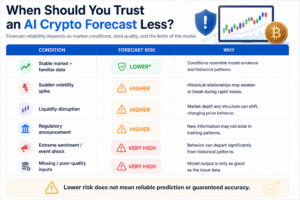
Why Forecast Credibility Matters More Than Prediction Claims
The cryptocurrency market contains many AI-based forecasting systems, but the existence of a prediction does not automatically determine whether that prediction deserves trust.
A stronger evaluation process focuses on the factors behind the forecast:
- what the model predicts
- what information supports it
- how performance is tested
- how uncertainty is explained
The AI Forecast Credibility Framework provides a structured way to evaluate these factors.
By examining forecast claims, data sources, testing methods, performance evaluation, and uncertainty, investors can better understand what an AI system actually provides.
AI can support cryptocurrency market analysis, but it should be evaluated as an analytical tool rather than a source of certainty.
The most important question is not:
“Which AI predicts cryptocurrency prices perfectly?”
A more useful question is:
“Can investors understand how this forecast was created, tested, and evaluated?”
Important Disclaimer
AI-generated forecasts are not guarantees of future cryptocurrency prices or market outcomes.
Market conditions can change quickly, and past performance or historical patterns do not ensure future results.
AI analysis should be considered one source of information within a broader research process. Investors should evaluate risks, limitations, and available evidence before making financial decisions.