
Blockchain analysis turns public-ledger records—transactions, addresses, token transfers, and smart-contract activity—into evidence for research or investigation. It can help investors test a hypothesis and understand network behavior, but it does not identify every wallet owner or predict price direction on its own.
Today, investors rely on structured tools such as a portfolio monitoring tool instead of guessing based on price alone.
Blockchain analysis is no longer limited to investigators. It is used to track whale activity, analyze exchange flows, and evaluate network adoption, while compliance teams rely on it to detect risk and suspicious transactions.
Although often confused with on-chain analysis or cryptocurrency analytics, blockchain analysis is a broader framework that combines transaction tracking, wallet intelligence, and network behavior into a structured decision-making process.
Because on-chain activity does not explain every market move, analysts should combine blockchain data with verified crypto news to understand whether a transaction pattern reflects a confirmed event, a developing narrative, or unrelated market noise.
What Is Blockchain Analysis?
At its core, blockchain analysis is the process of collecting, organizing, and interpreting blockchain data. Official resources such as Ethereum’s data and analytics documentation explain how explorers and APIs expose blocks, transactions, accounts, validators, and other on-chain activity.
Rather than focusing only on price movements, blockchain analysis examines how assets move across a network and how participants interact with the blockchain itself.
For example, analysts may investigate:
- Wallet activity
- Transaction patterns
- Exchange inflows and outflows
- Whale movements
- Smart contract interactions
- Network growth
- Fund flows between entities
Because blockchain ledgers are transparent by design, analysts can study information that would be unavailable in many traditional financial systems.
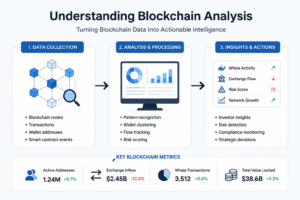
Blockchain Analysis at a Glance
| Analysis Area | What It Measures | Why It Matters |
|---|---|---|
| Wallet Analysis | Address activity and ownership patterns | Reveals user behavior |
| Transaction Analysis | Fund movement across the network | Identifies trends and risks |
| Exchange Flow Analysis | Deposits and withdrawals from exchanges | Helps evaluate market sentiment |
| Whale Tracking | Activity of large holders | Reveals potential market influence |
| Risk Detection | Exposure to suspicious entities | Supports compliance and security |
| Network Analysis | Adoption and blockchain usage | Measures ecosystem health |
This broader perspective is one reason blockchain analysis has become increasingly valuable in both investing and compliance.
Why Blockchain Analysis Matters in Crypto
Price charts show only part of the story. A cryptocurrency can rally while network activity declines, while another may gain adoption even with weak short-term price performance. This gap is exactly why blockchain analysis matters.
Instead of relying on sentiment alone, analysts examine wallet activity, transaction flows, and exchange movements to understand whether price is driven by real usage or speculation, which is why combining data-driven insights with fundamental vs technical vs quantitative analysis helps investors build more structured and reliable market strategies.
Consider a token rally accompanied by transfers to addresses labeled as exchanges. That pattern may increase immediately available supply, but it can also reflect an exchange’s internal wallet reorganization, custody migration, collateral movement, or an incorrect label. Treat it as a question to investigate—not as a sell signal—and compare it with repeated flows, liquidity, verified events, and confidence in the address attribution.
What Price Shows vs What Blockchain Analysis Reveals
| Market Observation | What Blockchain Analysis Can Reveal |
|---|---|
| Price is rising | Are users actually increasing? |
| Market looks bullish | Are whales accumulating or selling? |
| Trading volume is growing | Is the activity organic or speculative? |
| Token is trending online | Is real network usage increasing? |
| New all-time high | Is adoption supporting the move? |
For this reason, many professional investors combine market analysis with blockchain analysis rather than relying on a single source of information.
Blockchain Analysis Is More Than On-Chain Metrics
One of the biggest misconceptions is that blockchain analysis only means looking at on-chain indicators.
While on-chain analysis is an important component, blockchain analysis extends much further.
It includes wallet attribution, transaction tracing, entity identification, behavioral analysis, compliance monitoring, and risk assessment. In other words, blockchain analysis attempts to understand not only what happened on a blockchain but also why it happened and what it might mean.
This broader perspective makes blockchain analysis useful for multiple audiences.
Investors use it to understand market behavior. Researchers use it to evaluate blockchain ecosystems. Compliance teams use it to monitor financial crime risks. Investigators use it to trace suspicious fund movements.
Although their objectives differ, they all rely on the same foundation: blockchain data.
That foundation creates the framework for everything that follows.
The next step is understanding how blockchain analysis actually works and how analysts transform raw transaction records into actionable intelligence.
How Blockchain Analysis Works: The Three-Layer Model
Understanding blockchain analysis becomes much easier when you view it as a structured process rather than a collection of disconnected metrics. Analysts do not simply open a block explorer and start drawing conclusions. Instead, they move through several stages that transform raw blockchain records into meaningful insights.
A useful way to think about this process is through the Three-Layer Model of Blockchain Analysis. Each layer builds on the previous one and adds more context to the data.
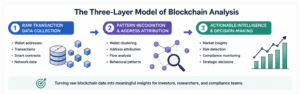
Layer 1: Raw Transaction Data Collection
Everything begins with data.
Every blockchain records information such as wallet addresses, transaction hashes, timestamps, token transfers, smart contract interactions, and transaction values. Because these records are publicly available on most blockchains, analysts have access to a massive amount of information.
However, raw blockchain data is often difficult to interpret on its own.
For example, seeing a wallet transfer 500 ETH to another address does not immediately reveal whether the transaction came from an exchange, a whale investor, a trading firm, or a decentralized application.
At this stage, analysts focus on collecting and organizing data from multiple sources, including:
- Wallet addresses
- Transaction histories
- Smart contract activity
- Exchange deposits and withdrawals
- Token transfers
- Network usage statistics
The goal is not to make conclusions yet. The objective is to create a reliable dataset that can be analyzed further.
Layer 2: Pattern Recognition and Address Attribution
Once the data has been collected, the next step is identifying patterns.
This is where blockchain analysis becomes more powerful than simply reading transaction records. Analysts begin looking for relationships between wallets, entities, and transaction behavior.
A single wallet address rarely tells the full story. Instead, analysts examine groups of addresses and recurring patterns that may indicate common ownership or related activity.
Wallet clustering and attribution are probabilistic. The peer-reviewed USENIX research on Bitcoin address clustering demonstrates how heuristics can associate addresses, but a cluster is still an analytical inference rather than proof that one named person controls every address.
Some common techniques include:
| Technique | Purpose |
|---|---|
| Wallet Clustering | Groups addresses likely controlled by the same entity |
| Address Attribution | Links wallets to exchanges, funds, protocols, or known organizations |
| Flow Analysis | Tracks how assets move between entities |
| Behavioral Analysis | Identifies recurring transaction patterns |
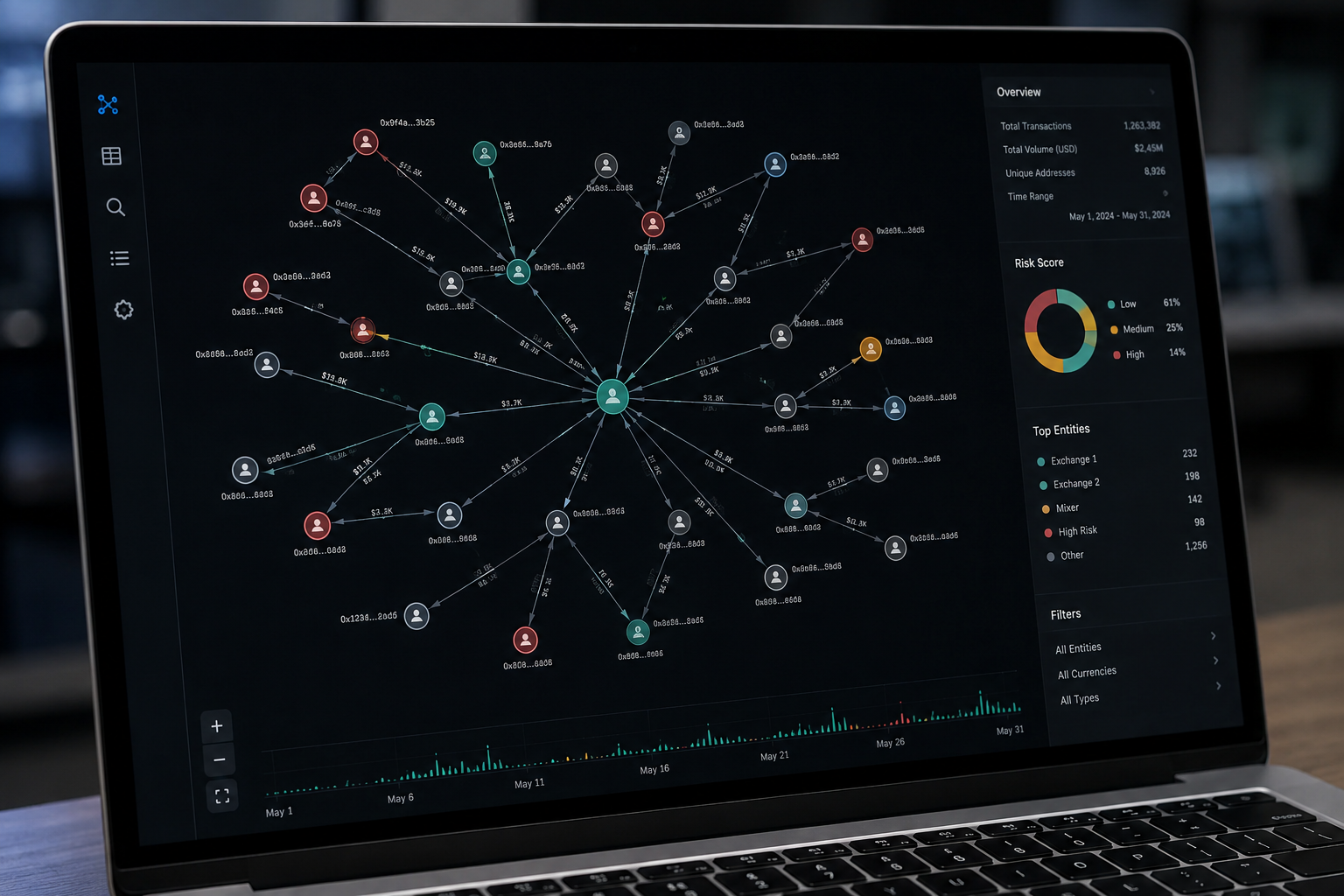
| Network Mapping | Visualizes relationships across wallets and contracts |
For investors, this layer helps reveal whether large holders are accumulating assets, distributing tokens, or moving funds toward exchanges.
For compliance teams, it helps identify exposure to suspicious entities and high-risk transaction activity.
Layer 3: Actionable Intelligence and Decision-Making
Data becomes valuable only when it can support decisions.
The third layer focuses on transforming blockchain observations into actionable intelligence. Rather than asking what happened, analysts begin asking what the data means.
Exchange inflows can add context about assets becoming available on trading venues, but they are not a directional signal. Rising address activity may reflect adoption, automation, airdrops, or spam. Large-holder transfers likewise require reliable labels and transaction context before they support any investment conclusion.
At this stage, blockchain analysis supports several different objectives.
| User Type | Primary Goal |
|---|---|
| Investors | Identify opportunities and market trends |
| Traders | Monitor liquidity and capital flows |
| Researchers | Evaluate ecosystem growth |
| Compliance Teams | Detect risk exposure |
| Investigators | Trace suspicious transactions |
Although these groups use blockchain data differently, they all rely on the same analytical foundation.
Blockchain Analysis vs On-Chain Analysis
Many investors use blockchain analysis and on-chain analysis interchangeably. However, while they are closely related, they are not the same.
The simplest way to understand the difference is to see on-chain analysis as a subset of blockchain analysis, especially when compared to cryptocurrency analytics used to interpret blockchain data, market behavior, and investor activity more effectively.
On-chain analysis focuses on network activity and investor-driven metrics such as active addresses, transaction volume, exchange flows, and holder behavior to evaluate market conditions.
Blockchain analysis includes these elements but goes further. It combines transaction tracing, wallet attribution, risk detection, compliance monitoring, and blockchain forensics to provide a broader and more structured view of network behavior.
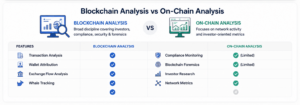
Quick Comparison: Scope and Use Cases
| Feature | Blockchain Analysis | On-Chain Analysis |
|---|---|---|
| Transaction Analysis | Yes | Limited |
| Wallet Attribution | Yes | Limited |
| Exchange Flow Analysis | Yes | Yes |
| Whale Tracking | Yes | Yes |
| Compliance Monitoring | Yes | No |
| Blockchain Forensics | Yes | No |
| Investor Research | Yes | Yes |
| Network Metrics | Yes | Yes |
This distinction is important because many beginners assume blockchain analysis is only useful for traders. In reality, it serves a much broader role across investing, compliance, security, and investigative workflows.
As blockchain adoption continues to grow, the ability to interpret blockchain data is becoming a valuable skill for far more than just market participants.
Blockchain Forensics, Risk Detection, and Compliance
As blockchain adoption continues to expand, blockchain analysis is no longer used only by investors and researchers. Exchanges, financial institutions, regulators, and cybersecurity teams increasingly rely on blockchain data to identify risks, monitor transactions, and investigate suspicious activity.
One of the most important applications is blockchain forensics.
Blockchain forensics focuses on tracing the movement of digital assets across wallets, exchanges, protocols, and networks. The goal is not simply to see where funds moved, but to understand the relationships between addresses and identify potentially risky behavior.
For example, analysts may investigate:
- Large transfers linked to hacked wallets
- Exposure to sanctioned addresses
- Transactions involving known scams
- Suspicious movement patterns across multiple wallets
- Fund flows through mixers or obfuscation services
Because blockchain transactions are permanently recorded, investigators can often reconstruct the path assets followed through the ecosystem.
However, blockchain analysis is not perfect. Wallet addresses are typically pseudonymous, meaning analysts can observe activity without always knowing the real-world identity behind an address.
For compliance use, context is essential. The FATF virtual-asset red-flag guidance lists unusual patterns that may warrant review, while emphasizing that an indicator should be evaluated with other facts and a plausible business explanation. A risk label is not, by itself, evidence of criminal activity.
This is why modern blockchain analytics platforms combine transaction data with address attribution, risk databases, behavioral analysis, and entity labeling to create a more complete picture.
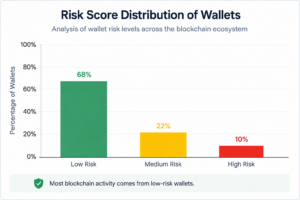
Investor Analytics vs Compliance Analytics
Although both groups analyze the same blockchain data, their objectives are very different.
| User Type | Primary Question |
|---|---|
| Investor | Is this network growing and attracting capital? |
| Trader | Are market participants accumulating or selling? |
| Compliance Team | Does this activity create regulatory risk? |
| Investigator | Where did these funds originate and move? |
Understanding this distinction helps explain why blockchain analysis has become such a broad discipline. The same transaction can provide market intelligence for an investor while simultaneously providing risk signals for a compliance team.
The Limitations of Blockchain Analysis
Despite its advantages, blockchain analysis is not a crystal ball.
One common misconception is that blockchain data can predict future market movements with certainty. In reality, blockchain analysis provides context and probabilities rather than guarantees.
Several limitations should be considered.
First, blockchain data does not always reveal identity. Analysts can often observe wallet activity, but determining who controls an address may require additional evidence.
Second, not every transaction has economic meaning. Internal exchange transfers, automated smart contracts, and bot activity can sometimes create misleading signals.
Third, blockchain networks are becoming increasingly interconnected. Assets frequently move across bridges, Layer 2 networks, and multiple blockchains, making transaction tracking more complex than it was a few years ago.
Finally, market behavior is influenced by many factors beyond blockchain activity. Macroeconomic conditions, regulation, liquidity, investor sentiment, and unexpected events can all affect asset prices.
For this reason, blockchain analysis works best when combined with other forms of research rather than used in isolation.
Final Thoughts
Understanding Blockchain Analysis is becoming increasingly important as cryptocurrency markets mature and blockchain ecosystems grow more complex. While price charts remain useful, they represent only one layer of information.
Blockchain analysis adds evidence about wallet behavior, transaction flows, network activity, and risk indicators. Investors and investigators still need attribution confidence, off-chain context, and a clear decision rule before acting on that evidence.
The most effective approach is not to replace traditional analysis methods, but to complement them. When blockchain data is combined with fundamental research, technical analysis, and sound risk management, it can provide a more complete understanding of how digital asset markets actually function.
In an industry built on transparency, blockchain analysis helps transform public data into meaningful insight—and that ability is becoming a competitive advantage for anyone operating in the crypto ecosystem.