
Short answer: Choose crypto research tools by the question you need to answer. Market data, charts, on-chain activity, protocol fundamentals, wallet intelligence, security, news and portfolio risk are separate layers; no single dashboard verifies all of them.
| Research question | Tool category | Primary evidence |
|---|---|---|
| What is price and liquidity doing? | Market data/charting | Exchange coverage, spread, volume and history |
| What is happening on-chain? | Block explorer/on-chain analytics | Transactions, entities and methodology |
| Is the protocol economically active? | Fundamental/DeFi analytics | Fees, revenue, TVL and token supply |
| Is the project credible? | Security and due diligence | Audits, admin keys, incidents and governance |
| How does it affect my holdings? | Portfolio/risk monitoring | Positions, exposure, drawdown and alerts |
What Are Top Tools for Analyzing Cryptocurrencies?
Cryptocurrency analysis tools are platforms designed to collect, organize, and visualize data from blockchain networks and financial markets. Rather than presenting raw information, they convert complex datasets into dashboards, charts, and actionable metrics that are easier to understand.
Depending on the platform, users can analyze technical indicators, on-chain activity, exchange reserves, wallet behavior, DeFi statistics, or even tokenomics. As a result, different tools serve different audiences and research objectives.
For example, a day trader may prioritize charting software to identify short-term opportunities. Meanwhile, a long-term investor might focus on network growth and holder behavior before allocating capital. Researchers and institutions often require even deeper datasets to evaluate protocol health and long-term sustainability.
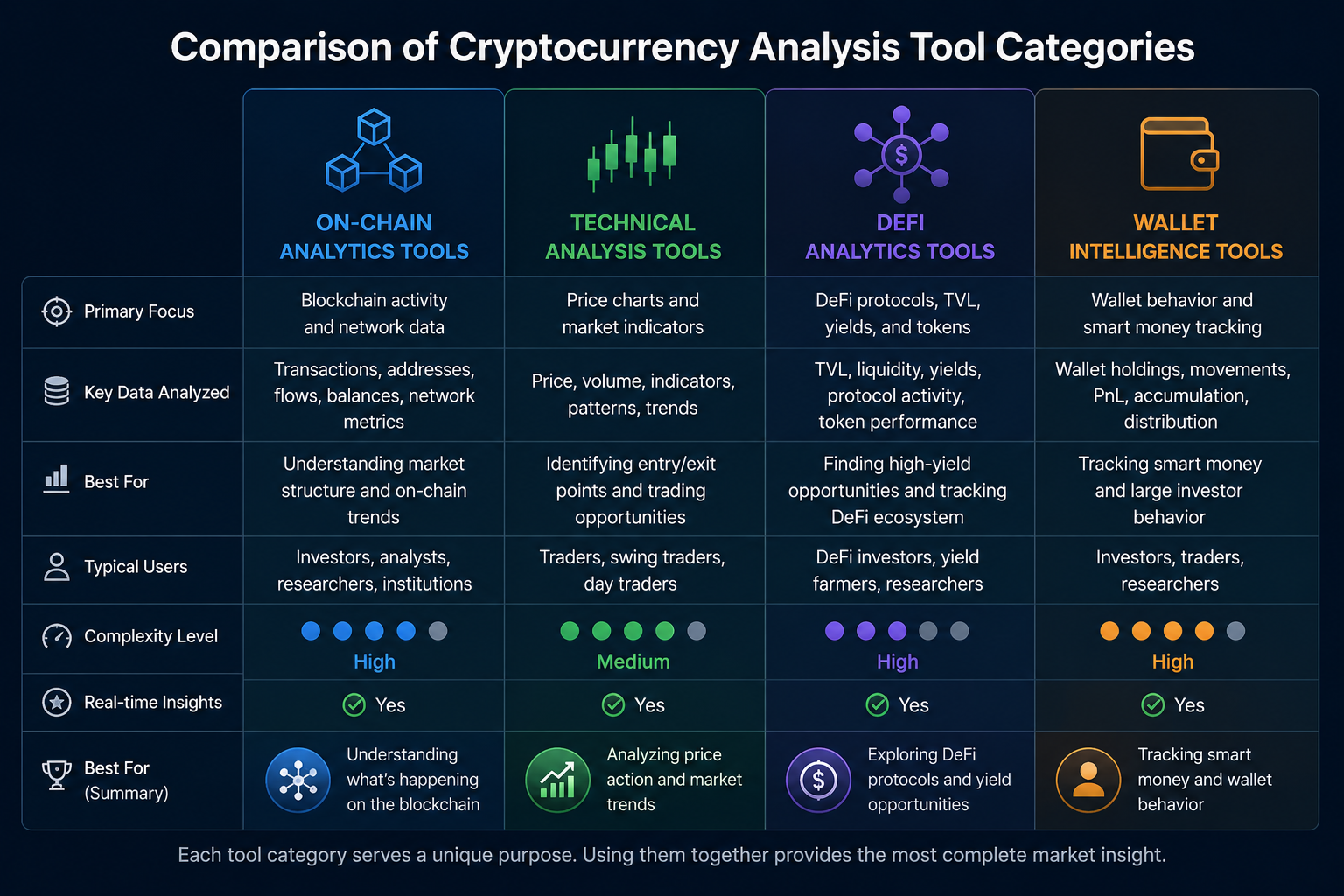
| Tool Category | Primary Focus | Typical Users |
|---|---|---|
| On-chain analytics | Wallet activity and blockchain metrics | Long-term investors |
| Technical analysis | Charts and indicators | Active traders |
| Wallet intelligence | Whale tracking and smart money | Analysts |
| DeFi analytics | Protocol growth and TVL | Researchers |
| Research platforms | Fundamentals and market data | Investors and institutions |
Why Top Tools for Analyzing Cryptocurrencies Matter
Unlike many traditional markets, blockchain networks publish an enormous amount of public information. Every transaction, token transfer, and smart contract interaction creates data that can be examined by investors and analysts.
However, access to information does not automatically produce insight. Without specialized platforms, identifying meaningful trends becomes difficult, time-consuming, and prone to human error.
Modern analytics tools solve this challenge by transforming raw blockchain records into visual dashboards and practical reports. In addition, many platforms offer alerts, historical comparisons, and customizable metrics that simplify ongoing research.
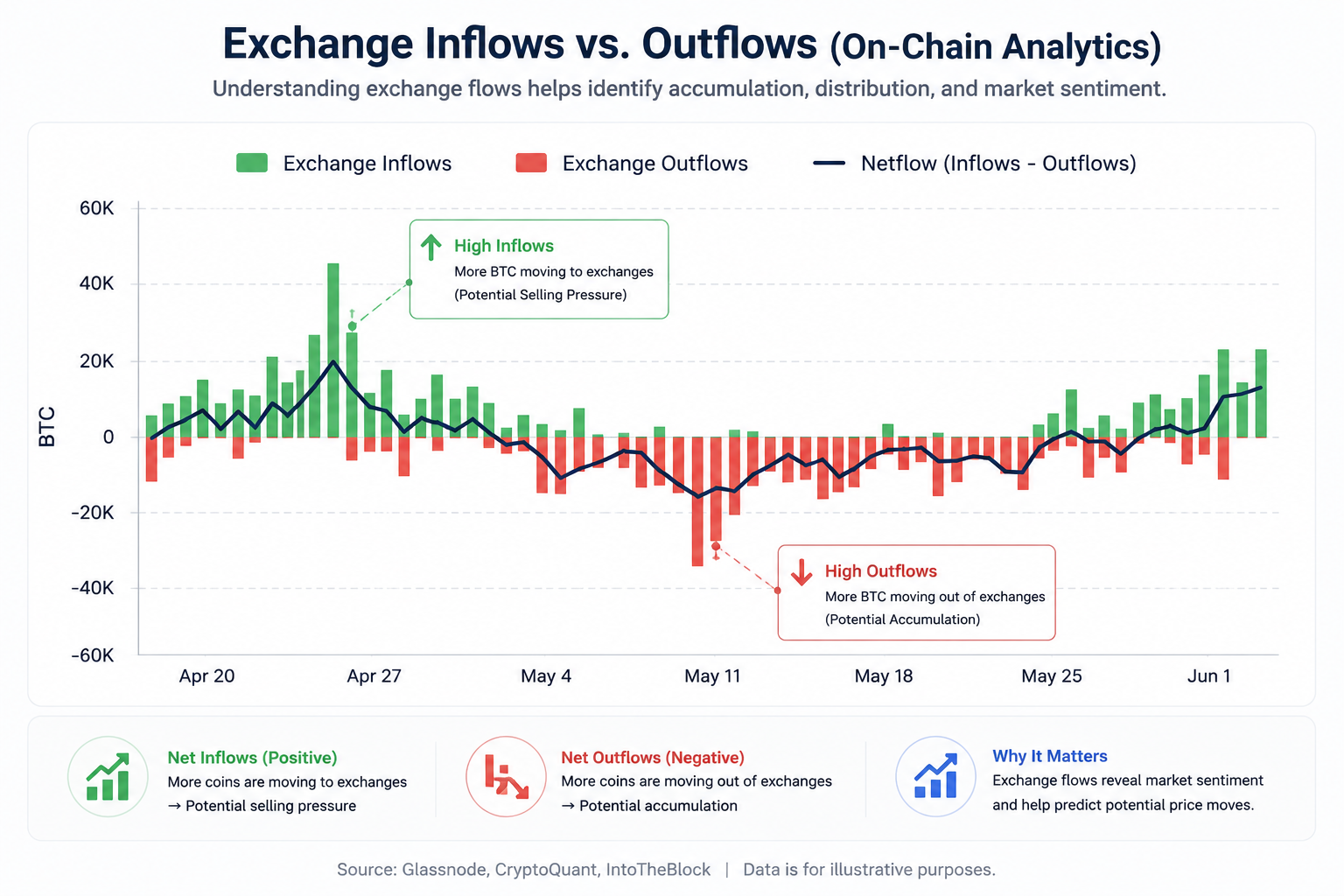
Consider a simple example. A cryptocurrency may experience a rapid price increase while exchange inflows simultaneously surge. At first glance, the rally appears bullish. However, rising deposits to exchanges could indicate that large holders are preparing to sell. Analytics platforms expose these hidden dynamics before they become obvious through price action alone.
Categories of Top Tools for Analyzing Cryptocurrencies
Not every platform performs the same function. Instead, each category specializes in a different aspect of cryptocurrency research.
On-Chain Analytics
These tools examine blockchain activity directly by tracking metrics such as active addresses, transaction volume, exchange flows, MVRV, SOPR, and realized capitalization. They are especially useful for evaluating long-term adoption and identifying shifts in market cycles.
Wallet Intelligence
Wallet intelligence platforms monitor large holders, labeled entities, and smart money movements across public blockchains. Advanced wallet labeling techniques help identify exchanges, institutions, and other known participants, giving analysts valuable context when interpreting transaction flows.
Technical Analysis
Charting platforms emphasize price action, trading volume, momentum indicators, and trend analysis. Therefore, traders can identify potential entry and exit opportunities based on market structure rather than blockchain data alone.
Research and DeFi Analytics
Other platforms specialize in protocol fundamentals, decentralized finance metrics, governance activity, ecosystem growth, and tokenomics. These resources provide valuable context when comparing projects that may appear similar based only on market capitalization.
Choosing the Right Tool Starts with the Right Goal
Ultimately, the best cryptocurrency analysis platform depends on your objectives. A beginner may benefit from straightforward dashboards, while an active trader often requires advanced charting capabilities. Likewise, researchers may prioritize on-chain metrics or protocol data, whereas institutions typically need enterprise-grade intelligence and comprehensive reporting.
Rather than searching for a single “perfect” solution, many experienced professionals combine multiple tools to build a more complete view of the market. By integrating blockchain analytics, technical indicators, and market sentiment, they can make more informed decisions and develop a deeper understanding of how cryptocurrencies actually behave.
How to Choose Top Tools for Analyzing Cryptocurrencies
Choosing the right analytics platform is often more valuable than selecting the most popular one. Every service is built for a specific purpose, so the ideal choice depends on your investment strategy, research objectives, and preferred data sources.
For example, a swing trader who relies on chart patterns needs different capabilities than a researcher studying blockchain adoption or a DeFi analyst evaluating tokenomics and protocol growth. Therefore, understanding your own workflow should come before comparing subscription plans or premium features.
A practical way to narrow the options is to match each platform with the questions you want to answer.
| Your Goal | Recommended Tool Category |
|---|---|
| Study blockchain activity | On-chain analytics |
| Find trading setups | Technical analysis |
| Monitor whale wallets | Wallet intelligence |
| Research DeFi protocols | DeFi analytics |
| Evaluate project fundamentals | Research platforms |
Many experienced investors also combine multiple platforms instead of relying on just one. For instance, they might use a charting solution for technical analysis while reviewing blockchain metrics on a separate dashboard. As a result, decisions are based on several independent signals rather than a single source of information.
Best On-Chain Analytics Platforms
On-chain analytics platforms focus on blockchain data instead of price movements alone. They monitor wallet activity, transaction volume, exchange reserves, active addresses, and other network metrics that provide valuable context for market behavior.
Among the most widely used platforms are Glassnode and CryptoQuant. These services allow users to track exchange inflows and outflows, long-term holder activity, realized capitalization, and cycle indicators. Consequently, they are popular among investors who want deeper insight into Bitcoin and Ethereum market dynamics.
If you want to better understand the concepts behind these metrics, consider reading our Understanding Blockchain Analysis guide. It explores how transaction data, wallet activity, and network behavior can be interpreted alongside on-chain indicators to provide deeper insights into cryptocurrency markets.
Historical blockchain data often reveals accumulation or distribution trends before they become obvious on price charts. Nevertheless, no single metric should be viewed in isolation. Combining several on-chain indicators generally leads to more balanced conclusions.
Best Wallet Tracking and Smart Money Platforms
Some analysts prefer to follow capital flows rather than candlestick patterns.
Wallet intelligence platforms specialize in identifying major holders, labeled entities, and notable transaction behavior across public blockchains. Instead of emphasizing technical indicators, these tools help users understand where significant amounts of capital are moving.
Nansen is particularly recognized for advanced wallet labeling and smart money monitoring, while Arkham focuses on blockchain entity analysis and transaction relationships. Together, these platforms make it easier to identify accumulation trends, monitor influential participants, and interpret ecosystem activity.
Even so, whale movements should always be viewed in context. Large transfers may reflect custody changes, internal restructuring, or operational requirements rather than genuine buying or selling pressure.
Best Technical Analysis and Charting Platforms
Technical analysis continues to play a central role in cryptocurrency trading because it helps users evaluate price behavior and market structure.
Platforms such as TradingView provide sophisticated charting features alongside indicators like RSI, MACD, moving averages, and volume analysis. Meanwhile, CoinMarketCap offers accessible market data and simplified charts that are especially useful for beginners.
Unlike blockchain analytics platforms, technical tools focus primarily on price action and momentum. Accordingly, traders use them to identify potential entry and exit points, confirm trends, and manage short-term positions.
Many experienced market participants strengthen their analysis by combining chart signals with on-chain metrics and broader market sentiment, reducing the risk of relying on only one perspective.
Research Platforms for Deeper Market Insights
Beyond charts and wallet tracking, dedicated research platforms help users evaluate the long-term health of cryptocurrency ecosystems.
Messari publishes protocol reports, market intelligence, and fundamental research that supports investment decisions. DefiLlama specializes in decentralized finance by tracking total value locked, liquidity, and protocol growth across multiple blockchains. Meanwhile, Dune Analytics enables users to create custom dashboards and explore blockchain datasets through community-built queries.
Although each platform serves a different purpose, they all contribute to a more comprehensive research process. By combining on-chain analytics, technical analysis, protocol research, tokenomics, and market context, investors can make decisions based on multiple sources of evidence instead of depending on a single metric or narrative.
Top Tools for Analyzing Cryptocurrencies Compared
This comparison of the Top Tools for Analyzing Cryptocurrencies highlights the strengths of each platform for different types of users. By evaluating these solutions side by side, investors, traders, researchers, and institutions can identify the tools that best match their objectives. Although many platforms offer overlapping capabilities, most excel in one or two specialized areas rather than covering every aspect of cryptocurrency analysis.
The table below provides a high-level overview of some of the most widely used crypto analytics platforms and their primary use cases.
| Tool | Primary Strength | Best For |
|---|---|---|
| Glassnode | On-chain metrics and market cycles | Long-term investors |
| CryptoQuant | Exchange flows and blockchain indicators | Traders and analysts |
| Nansen | Smart money and wallet labeling | Whale tracking |
| Arkham | Entity intelligence and wallet analysis | Blockchain researchers |
| Dune Analytics | Custom dashboards and SQL queries | Data analysts |
| DefiLlama | DeFi protocols and TVL tracking | DeFi researchers |
| Messari | Fundamental research and tokenomics insights | Investors |
| TradingView | Charting and technical analysis | Active traders |
| CoinMarketCap | Market data and token information | Beginners |
Rather than searching for a single “best” platform, experienced market participants often combine multiple tools to build a more comprehensive research workflow. For example, a trader might use TradingView for technical analysis, CryptoQuant to monitor exchange flows, and DefiLlama to evaluate DeFi liquidity trends. By integrating insights from several sources, users can make more informed decisions and reduce the risk of relying on a single dataset or indicator.
Common Mistakes When Choosing Top Tools for Analyzing Cryptocurrencies
Selecting a platform based only on popularity can lead to poor research habits. Instead, users should evaluate whether a service supports their goals and provides the type of data they actually need.
Some of the most common mistakes include:
- Paying for premium features that are rarely used.
- Making decisions based on a single metric or indicator.
- Confusing technical analysis with on-chain analytics.
- Ignoring blockchain activity while focusing only on price movements.
- Following whale wallets without understanding the context behind transfers.
- Overlooking market sentiment and macro conditions when interpreting data.
- Assuming free dashboards always provide complete or real-time information.
By avoiding these pitfalls, investors can improve their research process and reduce the risk of acting on misleading signals.
Building an Effective Crypto Research Workflow
Successful investors rarely depend on just one source of information. Instead, they combine several forms of analysis to validate ideas before making portfolio decisions.
A practical workflow could look like this:
- Review project fundamentals and tokenomics using a research platform.
- Analyze on-chain metrics to understand network activity and capital flows.
- Check wallet intelligence to monitor whale behavior and wallet labeling insights.
- Use technical analysis to identify potential entry or exit points.
- Evaluate broader market sentiment and current conditions before executing a trade.
Following this layered process provides a more balanced perspective than relying exclusively on charts or blockchain data.
Conclusion
The Top Tools for Analyzing Cryptocurrencies serve different purposes, yet they all aim to help users make smarter decisions through better data. Some platforms excel at blockchain analytics, others specialize in charting, while dedicated research tools provide valuable insight into DeFi activity, protocol fundamentals, and tokenomics.
Instead of searching for a universal solution, investors should build a toolkit that reflects their own objectives. A long-term holder may prioritize on-chain metrics, an active trader may focus on technical indicators, and a researcher may require detailed blockchain intelligence and protocol analysis.
Ultimately, the strongest investment decisions come from combining multiple perspectives. By integrating blockchain analytics, market research, technical analysis, and fundamental insights, users can gain a clearer understanding of cryptocurrency markets and navigate them with greater confidence. Once your research is complete, using a Crypto Portfolio Calculator can help you evaluate asset allocation, monitor portfolio performance, and make more informed long-term investment decisions.
A Minimal Research Stack by Question
- Identity: verify the token contract, network and official documentation.
- Market: compare price, liquidity and exchange coverage.
- On-chain: inspect flows and activity with a stated methodology.
- Fundamentals: verify supply, governance, fees and protocol dependencies.
- Security: check audits, incidents, permissions and upgrade controls.
- Portfolio: translate findings into exposure and review rules.
Start with public primary sources and add paid tools only when they answer a recurring question more reliably or efficiently.
Tool Red Flags
- Price predictions without methodology or validation
- Hidden exchange or chain coverage
- Entity labels presented as certain facts
- TVL, volume or revenue with no calculation definition
- Wallet connections or API permissions unrelated to the research feature
- No export, timestamp or link to underlying evidence
Keep the Research Roles Separate
This page covers the full research stack. For chart platforms only, use the technical-analysis tools comparison. For project and platform credibility, use the Trust Score factors guide. For news, follow the crypto news verification workflow; for portfolio impact, use Forvest’s portfolio tracker.