

A crypto trust score is a screening signal that summarizes selected evidence about a crypto asset or project. It can help an investor decide what to investigate first, but it cannot prove that a project is safe, predict returns, or replace due diligence.
For a useful reading, separate the number from the evidence behind it. Check the smart contract and security record, liquidity and market structure, token distribution, team transparency, governance, legal entity, and the freshness of the underlying data. A high score with weak or outdated evidence should not override a red flag.
Disclosure: Forvest publishes this educational guide and operates the Forvest Trust Score. This article describes the publicly visible interface and a separate evidence-checking framework. It does not disclose or claim access to an unpublished proprietary formula. Last reviewed: August 9, 2026.
What is a crypto trust score?
A crypto trust score converts several observations into a simpler rating, number, or signal. Its main value is prioritization: instead of reading every available document before forming a first view, an investor can use the score to identify areas that deserve immediate attention.
However, the phrase is not standardized. One provider may score an exchange, another a token, and another the software practices of an open-source repository. They may use different inputs, weights, update schedules, and peer groups. Two products called “Trust Score” can therefore answer different questions.
The correct first question is not “Is 80 a good score?” It is: What exactly is being scored, using which evidence, as of what date?
What a trust score does not tell you
No single score can certify a crypto investment. Even a well-designed model has limits.
- It cannot guarantee that a smart contract, bridge, wallet, custodian, or exchange will not fail.
- It cannot guarantee that you can sell at the displayed market price during stress.
- It cannot prove that a team will act honestly after the score is calculated.
- It cannot determine whether a product is legally available to you in your jurisdiction.
- It cannot predict price, profit, or portfolio suitability.
A score is also sensitive to missing data. If a project has little verifiable history, the absence of a known incident is not the same as evidence of safety. “Unknown” should remain unknown rather than being silently treated as positive.
How to read the Forvest Trust Score
The public Forvest interface presents supported assets with a score out of 100, a signal label, and access to additional details. Use those elements as a starting point:
- record the asset, score, signal, and date you viewed it;
- open the details rather than acting on the number alone;
- identify the strongest positive and negative factors;
- verify material claims against primary sources;
- decide whether the remaining uncertainty fits your risk limit.
At the date of this review, we did not verify a complete public methodology page specifying every factor weight and a fixed update cadence for the Forvest score. That makes the date and supporting detail especially important. Treat the output as a screening signal, not a certification or investment recommendation.
The evidence map behind a useful crypto trust assessment
| Area | Evidence to inspect | What can go wrong |
|---|---|---|
| Code and security | Verified contracts, privileged roles, audits, bug disclosures, incident history | Exploit, hidden control, unsafe upgrade, compromised key |
| Liquidity and markets | Depth, spread, venue quality, concentration by venue, withdrawal status | Slippage, manipulation, frozen withdrawal, false volume |
| Tokenomics | Supply schedule, unlocks, treasury, holder concentration, utility | Dilution, insider selling, governance capture |
| Team and transparency | Named legal entity, accountable contributors, documentation, disclosures | Unverifiable claims, conflicts, disappearing team |
| Governance | Admin keys, multisig signers, voting rules, upgrade process, timelocks | Unilateral change, rushed proposal, concentrated control |
| Legal and provider status | Exact entity, regulator register, permitted activities, user jurisdiction | Misleading license claim or activity outside authorization |
| Data quality | Source, timestamp, coverage, methodology, missing-data treatment | Stale or incomparable score |
This map is broader than a model output. It gives you a way to challenge the score: if one high-impact area is missing or stale, pause and investigate it directly.
1. Security and smart-contract risk
Start by confirming that the contract address comes from an official project source and that its deployed code is publicly verified. Ethereum’s guide to smart-contract verification explains how published source code can be matched to deployed bytecode. Verification improves inspectability; it is not the same as an independent audit and does not prove the contract is safe.
Then check privileged controls. Who can pause transfers, mint tokens, change fees, upgrade implementation code, move treasury assets, or alter an oracle? Are those powers held by one wallet, a multisignature wallet, a timelock, or decentralized governance? A clean audit cannot eliminate risks introduced by later upgrades or compromised administrator keys.
Review audit scope and date, unresolved findings, public incidents, and post-incident changes. Ethereum’s official smart-contract security guidance emphasizes development practices and recurring security checks rather than a one-time badge. For open-source repositories, automated projects such as the OpenSSF Scorecard can surface software-practice signals, but its maintainers also describe the checks as heuristics, not proof of security.
2. Liquidity and market-quality risk
Market capitalization alone does not tell you whether a position can be exited. Examine bid-ask spread, order-book depth near the current price, daily volume across credible venues, and how much trading depends on one exchange or liquidity pool.
A useful test is to estimate the price impact of the position size you might actually trade. Thin liquidity can turn a small displayed profit into a loss after slippage. Volume can also be misleading when it is self-reported, wash-traded, or concentrated on a venue with unreliable withdrawals.
For decentralized pools, inspect locked value, pool composition, liquidity-provider concentration, and whether liquidity can be removed quickly. For centralized venues, check deposit and withdrawal availability rather than assuming that a visible price means the asset is transferable.
3. Tokenomics, supply, and holder concentration
Tokenomics describes who owns the supply, how new tokens enter circulation, and which incentives affect future selling pressure. Compare circulating supply with maximum or fully diluted supply, then review vesting schedules, team and investor allocations, treasury holdings, emissions, burns, and major unlock dates.
Use a reputable block explorer to inspect large addresses, but interpret them carefully. An exchange wallet, bridge, staking contract, burn address, or treasury can look like a large individual holder until it is labeled and verified. Concentration matters most when a small number of controllable addresses can sell, vote, change liquidity, or alter the protocol.
Ask what creates durable demand for the token. A product may be useful while its token captures little value. Conversely, a reward program can create temporary activity that disappears when incentives fall.
4. Team, transparency, and governance
A public team is not automatically trustworthy, and an anonymous team is not automatically fraudulent. The practical question is whether important claims and actions are independently verifiable.
Look for a consistent legal entity, contributor history, clear documentation, conflict disclosures, treasury reporting, and a reachable security contact. Check whether roadmap claims match released products and on-chain activity. For partnerships, verify the announcement from both parties rather than relying on a logo.
Governance deserves its own review. Identify who can submit and execute proposals, whether voting power is concentrated, how delegates are compensated, and whether emergency changes bypass normal voting. A timelock can create a window to react, but only if users can see the change and withdraw safely.
5. Regulation and provider status
Regulatory status attaches to a specific legal entity and permitted activity—not automatically to every token listed on its website. In Dubai, excluding the Dubai International Financial Centre, confirm the exact entity and licensed activities in the VARA public register. Other UAE jurisdictions can have different regulators and rules.
A valid registration or license can be relevant evidence about a service provider, but it does not guarantee token value, liquidity, cybersecurity, or suitability. Investors should also check whether the product is permitted where they live and whether marketing language matches the provider’s authorized activities.
6. Freshness, missing data, and model limitations
Every trust score is a snapshot. A contract upgrade, exploit, token unlock, delisting, governance vote, or regulatory action can change the risk picture quickly.
| Question | Why it matters |
|---|---|
| When was each input updated? | A recent composite score may still contain stale components. |
| Are weights and definitions documented? | The same number can mean different things across providers. |
| How is missing data treated? | Unknown information should not automatically improve the result. |
| Is the score absolute or relative? | A high rank among weak peers is not an absolute safety guarantee. |
| Can one severe red flag override the average? | Averages can hide a critical contract or control risk. |
Save the date and material evidence used for your decision. If the position is meaningful, repeat the review after major events and before increasing it.
Worked example: how to challenge a high score
Consider a hypothetical project—not a real Forvest rating—with a score of 82/100. It has verified code, two audits, active development, and strong reported volume. That appears positive. A deeper review finds that one administrator wallet can upgrade the contract immediately, the team’s allocation begins unlocking next month, and most liquidity sits in one pool controlled by two addresses.
| Evidence | Initial interpretation | Investor response |
|---|---|---|
| Verified code and two audits | Better inspectability and prior review | Check audit scope, date, unresolved findings, and current implementation |
| Single upgrade key | Critical control concentration | Reduce exposure or wait for multisig and timelock controls |
| Large scheduled unlock | Potential dilution or selling pressure | Confirm size, date, recipients, and liquidity capacity |
| Concentrated liquidity | Exit and manipulation risk | Model slippage and verify who can remove liquidity |
The score remains useful because it directed the first review. But the investor’s decision should respond to the severity of the evidence, not the comfort of an average. A critical administrator-key risk may outweigh several positive indicators.
Crypto project score vs CoinGecko Trust Score
Do not assume that every Trust Score evaluates a token or project. CoinGecko’s current official Trust Score methodology ranks centralized exchanges. Its July 2026 methodology uses exchange-level factors including liquidity, cybersecurity, regulatory status, incidents, and proof of reserves, with weekly recalculation and a relative peer curve.
That can help compare trading venues, but it does not answer whether a token’s smart contract, supply schedule, governance, or project team is trustworthy. Match the score to the object being evaluated: exchange, token, protocol, repository, or service provider.
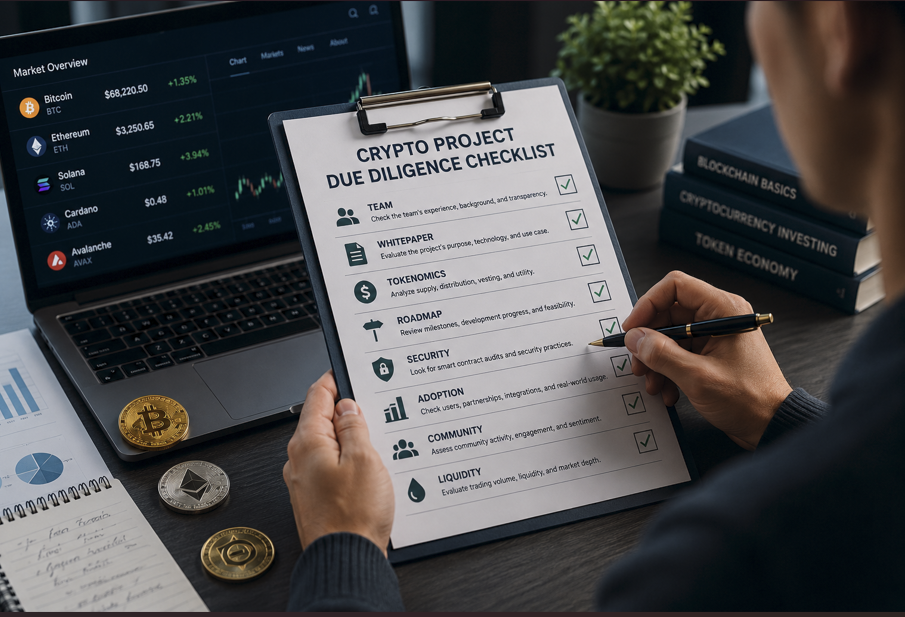
Step-by-step crypto trust score checklist
- Define the object: write down the exact asset, contract address, chain, project, and service provider.
- Record the score: save the score, signal, source, and date rather than relying on memory.
- Open the evidence: identify which factors support or reduce the score.
- Verify primary sources: use deployed contracts, block explorers, project documents, repositories, regulator registers, and direct announcements.
- Search for disconfirming evidence: look for incidents, privileged controls, unlocks, concentration, withdrawal problems, and inconsistent claims.
- Evaluate impact: distinguish a minor documentation gap from a critical control or liquidity risk.
- Set exposure rules: decide position size, exit conditions, and what would trigger a new review.
- Repeat after change: reassess after upgrades, incidents, major unlocks, listings, delistings, or regulatory developments.
For a broader process, use our crypto project due-diligence framework. Then connect the evidence to the controls in our beginner’s guide to crypto investment risks.
Common red flags a score should never hide
| Red flag | Evidence needed before proceeding |
|---|---|
| Guaranteed returns or “risk-free” language | Do not proceed on the promise; verify the entity and economics independently |
| Urgency, private-message support, or unexpected wallet request | Stop and use a separately verified official channel |
| Unverified or proxy contract with unclear controller | Verified implementation, documented privileges, responsible controls |
| Audit badge without report or scope | Original report, audited commit or address, date, findings, remediation |
| Large unlabeled holders or imminent unlock | Address attribution, vesting terms, recipient controls, liquidity analysis |
| License claim without exact entity and activity | Matching regulator-register entry and permitted service |
Investor.gov’s current fraud guidance highlights pressure, urgency, sophisticated-looking websites, and fashionable themes such as crypto or AI as common tactics—not proof of legitimacy. A polished interface or high displayed score should never cause you to share a seed phrase, private key, remote access, or funds under pressure.
Final takeaway
A crypto trust score is most valuable as the beginning of a question, not the end of a decision. Record what is being scored and when, inspect the supporting factors, verify the highest-impact claims with primary evidence, and let severe red flags override the convenience of an average.
Start with the Forvest Trust Score, open the available detail for the asset, and then work through the security, liquidity, tokenomics, transparency, governance, and legal checks above. If evidence is missing or stale, reduce confidence rather than inventing certainty.
Educational note: Trust scores and this framework provide general information only. They are not financial, legal, security, or investment advice, and no score can guarantee safety or returns.
Related reading: For a broader decision workflow, read Trust Score comparison of major crypto assets and Trust Score workflow for emerging coins.