
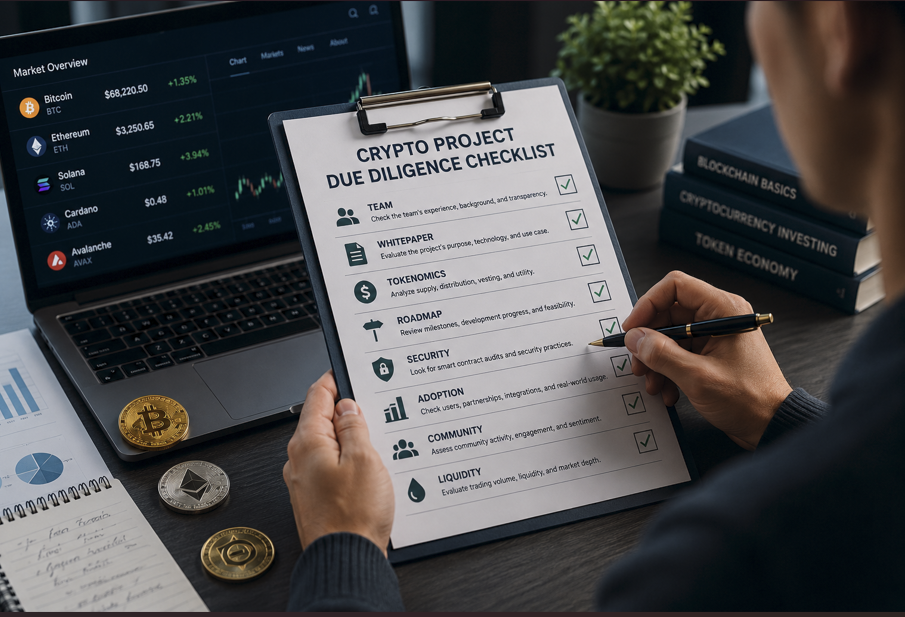
Crypto project due diligence is a structured process for testing a project’s claims before you commit capital. It examines the problem and product, team, tokenomics, security, adoption, liquidity, governance and legal or operational risks. The goal is not to predict the next price move; it is to identify what is verified, what remains uncertain and which risks could invalidate the investment case.
Short answer: start with the product and token’s real purpose, verify the people and entities behind it, map supply and unlocks, inspect security and control risks, confirm adoption with independent data, test whether you can enter and exit responsibly, and write down the conditions that would make you avoid or sell the asset. Never treat a whitepaper, audit, exchange listing or large community as proof on its own.
Crypto assets can be extremely volatile, less liquid than traditional investments and exposed to fraud, theft and limited investor protections. FINRA’s crypto-asset risk guidance warns that losing the full amount invested is possible. This framework is educational and is not personalized investment, legal or tax advice.
Crypto Due Diligence Checklist at a Glance
| Research layer | Evidence to collect | Core question |
|---|---|---|
| Problem and product | Working product, users, documentation, competitors | Does the project solve a real problem better than existing alternatives? |
| Team and entity | Founder history, legal entity, disclosures, communication | Can the responsible people be verified and held accountable? |
| Token utility | Required use, value flows, governance or fee role | Would the product still work without the token? |
| Supply and incentives | Circulating supply, FDV, allocations, vesting, unlocks | Who can sell, when, and how much dilution remains? |
| Security and control | Audits, admin keys, multisig, bug bounty, incident history | Who can change, pause or drain the system? |
| Adoption and development | Active users, transactions, fees, integrations, code activity | Does independent evidence support the growth narrative? |
| Market and liquidity | Venue quality, order-book depth, concentration, custody route | Can the intended position be entered and exited responsibly? |
| Governance and regulation | Voting power, treasury control, jurisdiction, disclosures | What rights exist, and what can change after purchase? |
| Portfolio fit | Position size, correlated exposure, loss limit, monitoring plan | What happens to the total portfolio if the thesis fails? |
No single row produces a reliable yes-or-no answer. Credibility is stronger when several independent signals agree. A polished whitepaper with no working product is weak evidence; a smart-contract audit does not solve poor token distribution; and high transaction counts are less meaningful if one incentive program or a few wallets create them.
1. Define the Investment Thesis Before Researching
Write a one-sentence thesis before collecting positive facts. It should state what the project does, who needs it, how usage creates demand or value for the token, and the time horizon over which the claim could be tested. Then write the strongest reason the thesis may be wrong.
| Weak thesis | Testable thesis |
|---|---|
| “The community is growing, so the token could rise.” | “The protocol reduces a specific user cost; sustained users and fees should grow without depending entirely on token incentives.” |
| “The team has major partnerships.” | “The named partners have independently confirmed integrations that produce measurable product usage.” |
| “Supply is limited.” | “Demand for a necessary token function can absorb scheduled emissions without relying only on new buyers.” |
This prevents confirmation bias. Research should try to falsify the thesis, not collect marketing statements that support it. Compare the project’s claims with its own earlier roadmaps, product releases, repository history and independent data.
2. Evaluate the Problem, Product and Competitive Advantage
Begin with the underlying product rather than the token price. Identify the exact problem, target user and current alternative. A blockchain is not automatically necessary simply because a project uses one. Ask whether decentralization, open settlement, programmable ownership or censorship resistance creates a measurable advantage.
- Can a new user access a working product, testnet or demonstrable service?
- Is the documentation current and consistent with what the product actually does?
- Who are the direct crypto and non-crypto competitors?
- What prevents a competitor from copying the feature or undercutting its fees?
- Does growth depend on subsidies that disappear when rewards fall?
- Which metric would demonstrate product-market fit: retained users, transactions, revenue, deposits, developers or integrations?
Separate product utility from token utility. A useful application can have a poorly designed token, and a token can trade actively without supporting a durable product. If the system can operate equally well without the token, the investment thesis needs a clear explanation of why token demand should persist.
3. Verify the Team, Legal Entity and Claims
Do not rely on biographies copied across project channels. Verify prior employment, projects, public code, publications and relevant operating experience using independent sources. Search for failed ventures, unresolved disputes, inconsistent dates and undisclosed conflicts. An anonymous team is not automatic proof of fraud, but it removes an accountability signal and requires stronger evidence elsewhere.
Identify the company, foundation, DAO or other entity that issues tokens, employs contributors, controls trademarks, signs partnerships and manages the treasury. Check its jurisdiction and available disclosures. If a partnership matters to the thesis, look for confirmation from the partner—not only the crypto project’s announcement.
The CFTC advises buyers to research the people and entities associated with a digital token and understand the rights attached to it. A whitepaper or business plan can describe an intention; it is not independent proof that the intention will be delivered.
4. Analyze Token Utility, Supply and Unlock Risk
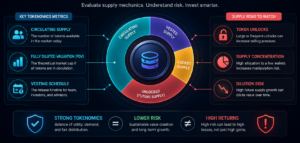
Tokenomics explains how tokens are created, distributed, used and released. Record the circulating supply, total or maximum supply, fully diluted valuation (FDV), allocation by stakeholder, emission schedule, burn rules, treasury holdings and the next major unlocks. Use primary project documentation, then reconcile it with blockchain explorers and reputable market data.
| Tokenomics check | Calculation or evidence | Risk signal |
|---|---|---|
| Circulating ratio | Circulating supply / total supply | A small float can hide substantial future dilution |
| FDV | Current token price × total supply | High FDV relative to usage or revenue needs strong justification |
| Unlock pressure | Tokens unlocking by date and recipient | Large insider or investor unlocks relative to trading liquidity |
| Concentration | Largest wallets, adjusted for known contracts and venues | Few holders can influence governance or market supply |
| Value capture | How product usage creates token demand or holder rights | Utility is optional, circular or based only on rewards |
Low circulating supply is not automatically bad, and a fixed maximum supply does not guarantee value. The important question is whether incentives align users, developers, validators, insiders and token holders over time. Model at least a base case and a downside case in which adoption grows more slowly while scheduled supply still enters the market.
5. Review Security, Admin Powers and Incident History
A published audit is evidence of a review at a particular time, not a guarantee. Confirm which contracts and commit hashes were audited, whether high-severity findings were fixed, whether the live deployment matches the reviewed code and whether upgrades occurred later.
- Admin keys: who can pause, upgrade, mint, blacklist or withdraw assets?
- Multisig: how many signers exist, who are they and how independent are they?
- Oracle and bridge dependency: what happens if a price feed, bridge or external protocol fails?
- Bug bounty: is there a funded disclosure program and a clear response process?
- Incident history: were exploits, outages or depegs disclosed promptly, and were users made whole?
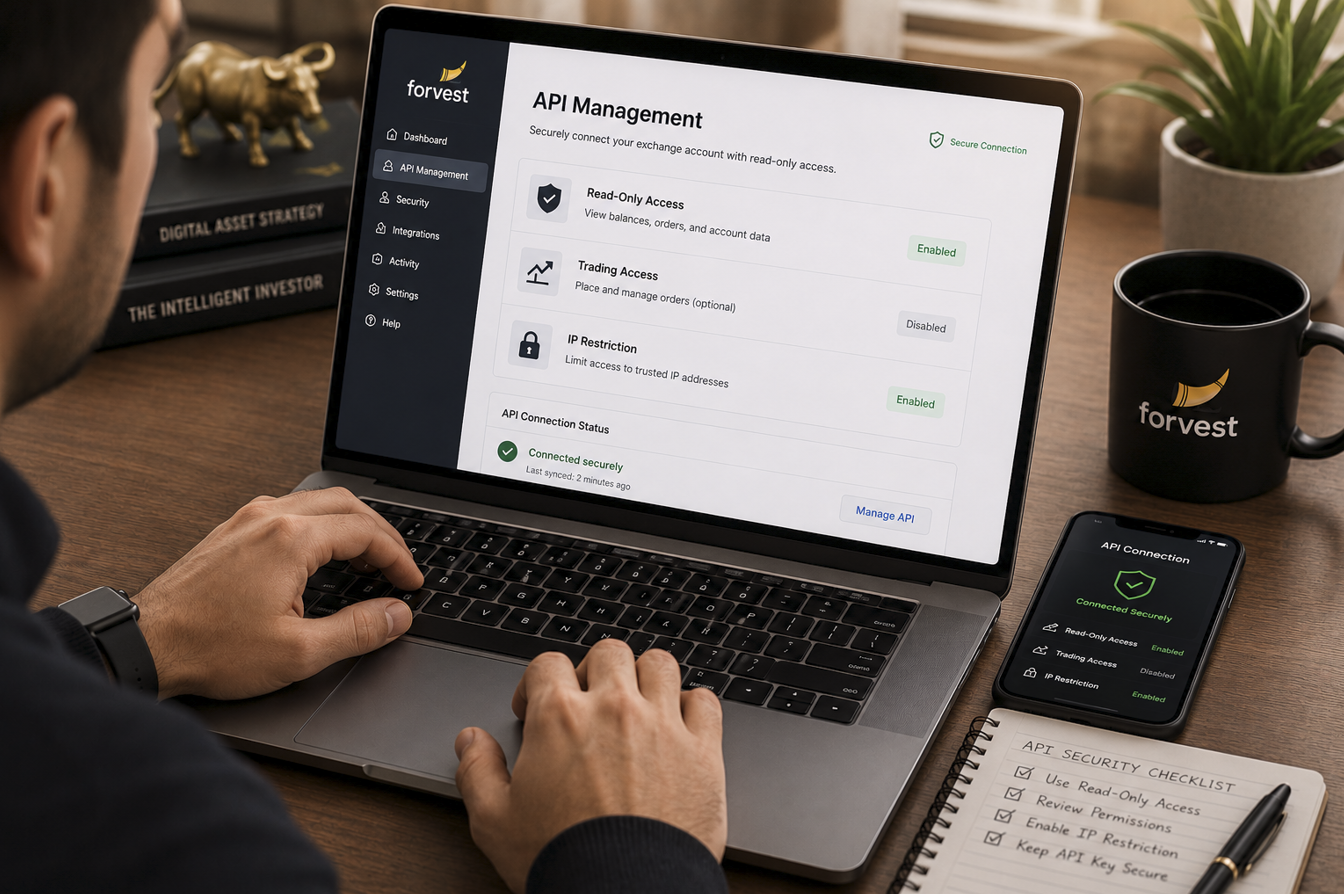
- Custody: what additional counterparty or wallet risks arise from acquiring and holding the token?
Read the audit summary and the technical scope, not only a logo on the project website. Treat unaudited upgrades, single-key control, unclear signers and unresolved critical findings as explicit risks in the decision record.
6. Distinguish Real Adoption From Manufactured Hype
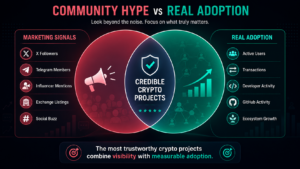
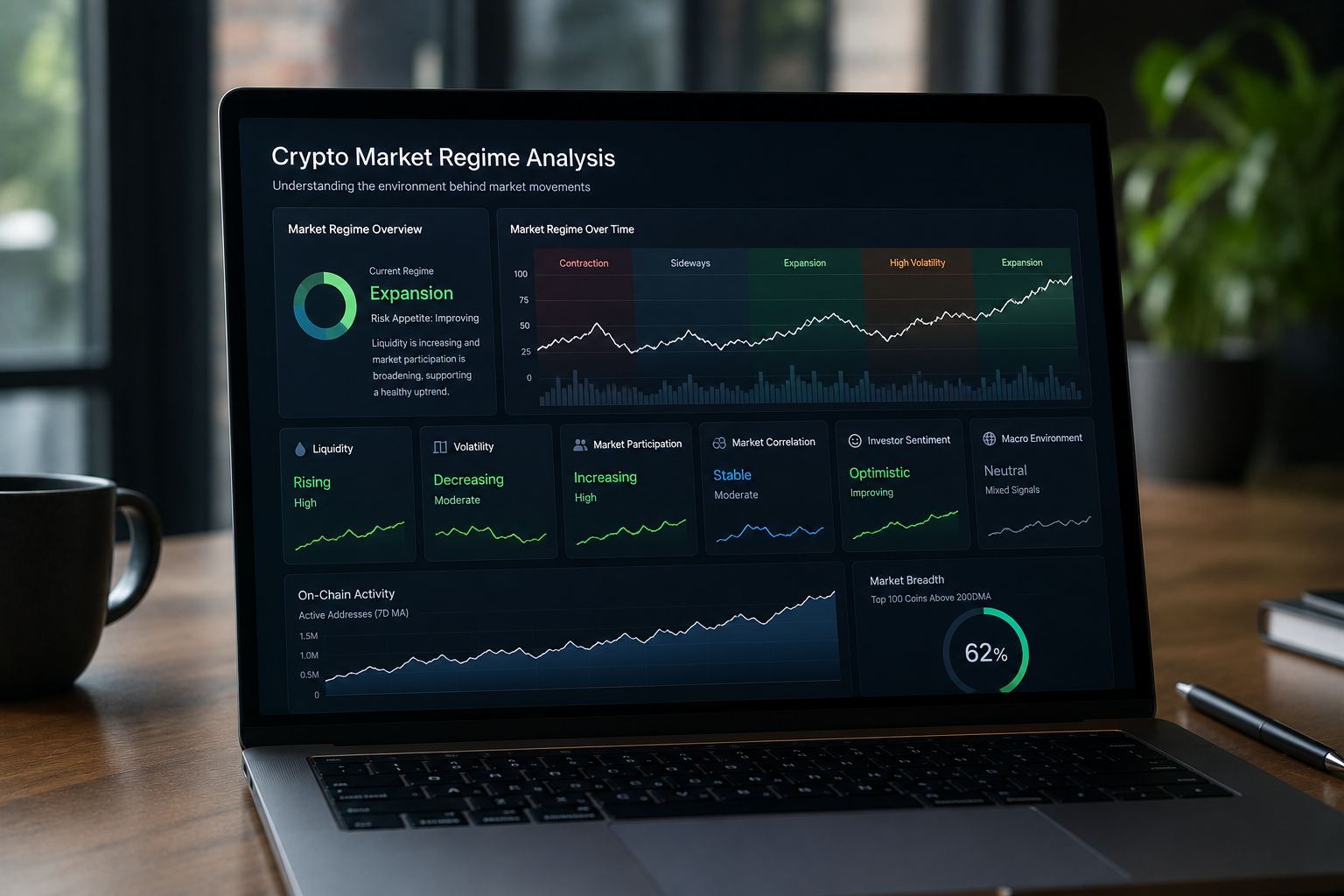
Follower counts, influencer mentions and exchange listings can be purchased or coordinated. Look for activity that leaves verifiable evidence: retained users, fees paid for a real service, transaction patterns, integrations confirmed by counterparties, governance participation and continued development.
| Claim | Better verification | Common distortion |
|---|---|---|
| “Millions of users” | Active and retained users over multiple periods | Wallets are not necessarily unique people |
| “Record transactions” | Economic activity, fees and repeat usage | Bots, spam or incentives can inflate counts |
| “Active development” | Meaningful releases, contributors and issue resolution | Commit count alone rewards small or automated changes |
| “Major partnerships” | Counterparty confirmation and live integration | A memorandum or announcement may produce no usage |
| “Growing TVL” | Source, durability and concentration of deposits | Borrowed or incentivized capital can leave quickly |
Use our guide to understanding blockchain analysis to interpret wallet and network evidence. Always compare several periods and check whether the metric remains healthy after incentives or a promotional campaign ends.
7. Test Liquidity, Market Structure and Exit Risk
A quoted price is not proof that your intended position can trade near that price. Inspect reputable venues, bid-ask spread, order-book depth, daily volume quality, withdrawal status and the position’s size relative to available liquidity. Avoid using reported volume alone; it can be inflated and says little about execution at your size.
Model an adverse exit: price falls, spreads widen and a venue pauses withdrawals. Decide whether the position can still be reduced without violating the loss limit. Thin liquidity, concentrated ownership and large upcoming unlocks can reinforce one another.
Also verify the exact contract address through multiple official channels. Impersonation tokens, fake websites and fraudulent service providers are common. Investor.gov’s crypto scam alert explains that fraudsters may use convincing websites, social accounts and communications to appear legitimate.
8. Examine Governance, Treasury and Legal Exposure
Governance determines who can change the rules after you buy. Map proposal rights, voting concentration, quorum, emergency powers, upgrade delays and treasury control. A token described as a governance asset may provide limited practical influence if insiders, delegates or a foundation control most votes.
Review what rights the token actually provides. It may not represent equity, a claim on revenue, legal ownership or creditor protection. Regulatory treatment depends on the asset, transaction and jurisdiction and can change access, disclosures, taxation and venue availability. Where the risk is material, use qualified legal and tax professionals rather than relying on community interpretations.
9. Record Red Flags and Apply Stop Rules
A red flag should change the decision, not become a note that is forgotten when price rises. Define stop rules before completing the research.
- Team or entity claims cannot be independently verified.
- Guaranteed returns, urgency or pressure to transfer funds.
- Token allocation, vesting or admin powers are undisclosed.
- The contract address or official distribution channel is ambiguous.
- A claimed audit cannot be matched to the deployed contracts.
- Partnerships are denied or not confirmed by the named counterparties.
- Reported adoption depends mainly on rewards, bots or circular activity.
- Liquidity is too thin for the planned position or is concentrated on one venue.
- The thesis depends on recruiting new buyers rather than product value.
- The required loss would exceed the investor’s written risk limit.
Not every unresolved issue proves fraud. It does mean the uncertainty should be reflected in a smaller position, additional verification, delayed action or a decision to avoid the asset.
10. Score the Evidence Without Hiding Critical Risk
A score can make research consistent, but a high average must not cancel a critical failure. Use a two-part decision: first apply non-negotiable gates; only then compare the remaining evidence.
| Gate | Example pass condition |
|---|---|
| Authenticity | Official channels, contract and core claims are verified |
| Security | No unresolved risk exceeds the investor’s written tolerance |
| Transparency | Supply, control and responsible entities are sufficiently disclosed |
| Liquidity | The intended position is executable under a downside scenario |
| Portfolio loss | A total loss would remain within the portfolio risk budget |
After the gates pass, score categories such as product, team, tokenomics, adoption and governance using the same rubric across projects. Attach every score to a source and date. Our crypto project trust-score framework explains how separate evidence becomes a transparent assessment, while Forvest’s Crypto Trust Score analysis can help organize multiple trust and risk signals. Both should support—not replace—independent verification and judgment.
Make the Position Fit the Portfolio
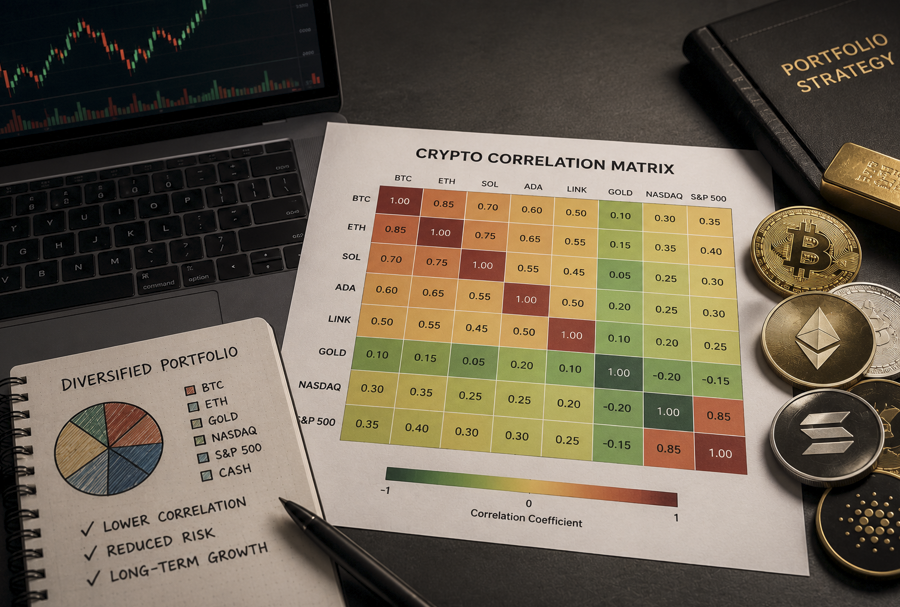
A credible project can still be an unsuitable investment if the position is too large or duplicates risks already present. Review exposure to the same blockchain, bridge, custodian, stablecoin, sector and market factor. Several token names do not necessarily provide meaningful diversification.
Use the crypto investment risk guide to define loss limits and the Forvest portfolio management tools to review allocation and concentration. Size the position from the amount you can afford to lose—not from the upside forecast.
Write a One-Page Due Diligence Decision
- State the project, token contract, research date and intended time horizon.
- Write the thesis in one sentence and the strongest counterargument.
- List primary sources, independent checks and any conflicts of interest.
- Summarize product, team, tokenomics, security, adoption, liquidity and governance evidence.
- Separate verified facts, project claims and analyst assumptions.
- Record unresolved questions and non-negotiable stop rules.
- Define maximum position size and total-loss impact on the portfolio.
- Set monitoring triggers: unlocks, incidents, governance changes, missed milestones or adoption decline.
- Choose: avoid, watch, research further or invest within the approved limit.
Date the decision because due diligence expires. A contract upgrade, exploit, token unlock, regulatory action, treasury movement or team departure can change the risk profile. Re-check the thesis on a schedule and whenever a material trigger occurs.
Related reading: Related Forvest guides: jurisdiction, tax and regulation checklist and factors behind Ethereum underperformance.
Frequently Asked Questions
How do you evaluate a crypto project before investing?
Evaluate the problem and working product, team and entity, token utility and supply, smart-contract security, admin controls, adoption, liquidity, governance and portfolio fit. Verify important claims with primary and independent evidence, then record unresolved risks and conditions that would invalidate the thesis.
What are the biggest crypto project red flags?
Major red flags include unverifiable people or partnerships, guaranteed returns, hidden token allocations or admin powers, unresolved audit findings, fake contract addresses, manufactured activity, thin liquidity and a thesis that depends mainly on recruiting new buyers.
Does a smart-contract audit make a crypto project safe?
No. An audit covers a defined scope and point in time. It does not eliminate economic, governance, custody, liquidity, legal or future-upgrade risk, and it does not guarantee that every vulnerability was found.
Why are token unlocks important?
Unlocks can increase circulating supply and allow insiders, investors or contributors to sell. Compare the size and timing of scheduled unlocks with current circulation, market liquidity, holder concentration and evidence of sustainable demand.
How can you tell whether a crypto project has real adoption?
Look for retained users, economically meaningful transactions, fees, independently confirmed integrations, governance participation and continued product development. Compare several periods and test whether activity persists after rewards or promotions decline.
Final Takeaway
Good crypto due diligence does not create certainty. It creates a traceable decision: which claims were verified, which risks remain, how much loss the portfolio can absorb and what future evidence would change the conclusion. If a project cannot be explained, verified, sized and monitored, the responsible decision is to wait or walk away.
Disclaimer: This article is for educational and informational purposes only. It is not financial, investment, legal or tax advice. Crypto assets involve substantial risk, including possible total loss. Conduct independent research and consult qualified professionals where appropriate.