
Crypto ROI Calculator: How to Calculate Return on Investment in Crypto (Short-Term and Long-Term Returns)

crypto ROI vs profit comparison showing investment efficiency
0
14 Minutes

A crypto ROI calculator is essential for understanding real investment performance in crypto markets. Most crypto investors assume that profit equals success. However, this assumption often breaks down under closer analysis. While profit reflects the outcome of an investment, it does not explain how efficiently capital was used to achieve that result. As a result, relying on profit alone can lead to misleading conclusions about performance.

For instance, earning $1,000 from a $2,000 investment reflects a fundamentally different level of efficiency compared to earning the same amount from a $10,000 position. Although the absolute gain is identical, the underlying capital efficiency is not. Therefore, focusing only on profit hides how effectively capital is being deployed.

This is precisely where a crypto ROI calculator becomes essential. Instead of measuring absolute gains, ROI evaluates performance relative to investment size. Consequently, it provides a more structured framework for comparing trades, portfolios, and strategies across different market conditions.

👉 To apply this in practice, you can use a crypto profit calculator to simulate real investment scenarios and measure returns more accurately before making decisions.

Moreover, in highly volatile environments like crypto, price movements alone do not define success. Timing, duration, and capital allocation play equally important roles. Therefore, understanding how to calculate ROI in crypto is not just useful—it is necessary for consistent and data-driven decision-making.

👉 Insight:
In most cases, profit shows what happened, but ROI explains how efficiently it happened.

What Is ROI in Crypto Investments and Why Profit Alone Can Be Misleading

Return on investment (ROI) measures the percentage gain or loss relative to your initial capital. At first glance, this may appear to be a simple metric. However, its real value lies in its ability to standardize performance across different investment sizes.

To understand this more clearly, consider the following scenario:

  • Profit = $500
  • Investment = $1,000 → ROI = 50%
  • Investment = $5,000 → ROI = 10%

Although the profit remains constant, the efficiency of capital usage changes significantly. Therefore, ROI becomes a more reliable metric when comparing different trades or evaluating portfolio performance.

In practice, this distinction becomes even more important when managing multiple positions. Without ROI, investors may overestimate the effectiveness of larger trades simply because they produce higher absolute gains.

ROI vs Profit: Understanding Investment Performance

Metric What It Represents Why It Matters Keywords
Profit Absolute gain Basic tracking crypto profit calculation
ROI Relative return Capital efficiency crypto ROI calculator
ROI % Percentage outcome Strategy comparison calculate ROI crypto

Source: Conceptual framework derived from standard ROI definitions in financial analysis (e.g., Investopedia).

As shown above, ROI allows investors to normalize performance across different scenarios. Consequently, it reduces the risk of overestimating success based on large but inefficient gains.

How to Calculate ROI in Crypto Investments (Step-by-Step Crypto ROI Calculator Method)

Although the ROI formula appears simple,

Applying it correctly requires precision, especially when multiple variables such as fees, position size, and entry points are involved. Even small mistakes in inputs—such as incorrect cost basis or ignoring additional entries—can significantly distort the final result.

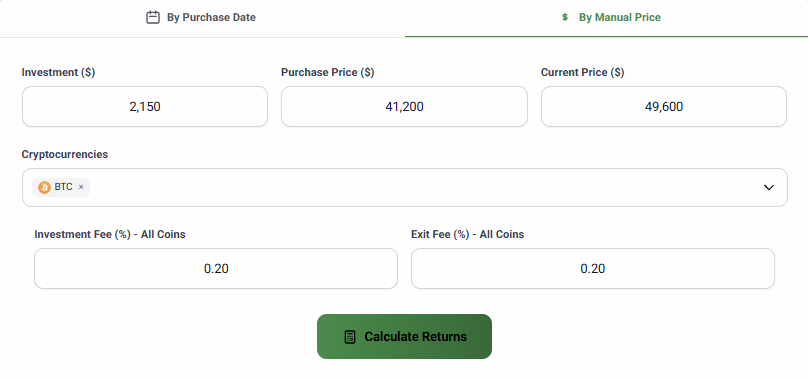
To better understand how ROI is calculated in practice, the following example shows how a crypto ROI calculator is used with real market inputs.

crypto ROI calculator input example showing bitcoin investment amount, purchase price, current price, and trading fees

Example input used to calculate crypto ROI with a bitcoin investment, including entry price, current price, and trading fees for accurate return estimation.

At a structural level, ROI is calculated through the following process:

  • Identify total capital invested
  • Determine current or exit value
  • Subtract investment from final value
  • Divide by initial investment
  • Convert to percentage

👉 ROI = (Final Value – Investment) / Investment × 100

However, this formula assumes a single entry point and no additional variables. In reality, crypto investments rarely follow such clean conditions. Therefore, understanding the limitations of the formula is just as important as applying it.

Bitcoin ROI Calculation Example (Short-Term Scenario)

To illustrate how ROI works in practice, consider a simple Bitcoin investment:

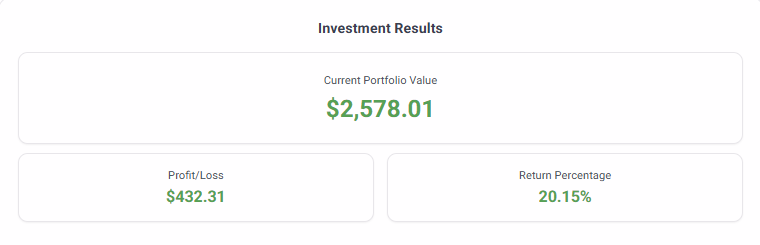
  • Investment: $2,150
    Final value: $2,583

👉 Profit = $433
👉 ROI ≈ 20.15%

At first glance, this appears straightforward. However, without considering time, this number can be misleading. For example, achieving a 50% return in one month reflects a very different level of performance compared to achieving the same return over one year.

The following output shows how a crypto ROI calculator converts these inputs into actual return percentage and profit.

crypto ROI calculator output showing bitcoin investment profit, ROI percentage, and current value after fees

Example output from a crypto ROI calculator showing bitcoin profit, ROI percentage, and real return after fees using actual market inputs.

👉 Insight:
Historically, high short-term ROI often reflects market volatility rather than repeatable performance (source: aggregated crypto market behavior analysis from CoinMarketCap trends).

How Multiple Buys Affect Your Cost Basis and Returns

In real market conditions, investors rarely enter positions once. Instead, they accumulate assets over time, often using strategies such as dollar-cost averaging (DCA). As a result, calculating ROI requires a more accurate understanding of cost basis.

Rather than relying on a single entry price, investors must calculate a weighted average across all purchases. Otherwise, ROI calculations become unreliable.

To properly evaluate ROI after multiple buys, the following factors must be considered:

  • Multiple entry prices over time
  • Weighted average buy price
  • Total capital invested
  • Current market value
  • Position size and allocation

Average Cost Calculation Table for Multiple Buys

Buy Price Amount Total Cost Keywords
$20,000 0.05 BTC $1,000 bitcoin ROI
$25,000 0.04 BTC $1,000 average price crypto
Total 0.09 BTC $2,000 ROI calculation crypto

👉 Average cost ≈ $22,222

Source: Weighted average cost calculation method based on standard portfolio accounting principles (as outlined by Investopedia).

Therefore, ROI must be calculated using this average—not individual entry points. Otherwise, performance evaluation becomes fragmented and misleading.

Short-Term vs Long-Term ROI in Crypto Investments (Why Time Context Matters)

ROI without time context can distort performance evaluation. At a surface level, a percentage return may appear impressive. However, without understanding the duration over which that return was achieved, the number lacks meaningful context.

For example, a 50% return achieved in one month reflects a very different level of performance compared to the same return achieved over two years. In the first case, the result is likely driven by volatility or short-term market conditions. In the second, it reflects sustained growth over time.

Therefore, time-adjusted thinking is essential when interpreting ROI in crypto markets.

To better understand this distinction, consider how ROI behaves across different time horizons:

Comparing Short-Term and Long-Term Investment Performance

Timeframe ROI Behavior Keywords
Short-Term Volatility-driven crypto short term ROI
Mid-Term Transitional crypto investment return
Long-Term Trend-based growth long term crypto ROI

Source: Observed market behavior patterns across crypto cycles, based on historical data aggregation from CoinMarketCap.

As shown above, short-term ROI is often influenced by price fluctuations and timing, while long-term ROI reflects broader market trends and consistency.

👉 Insight:
In volatile markets, short-term ROI often measures timing accuracy, whereas long-term ROI reflects strategic consistency.

Why Return Efficiency Matters More Than Profit in Investing

Profit shows outcome, but ROI shows efficiency. This distinction becomes critical when comparing multiple investment opportunities.

In practice, a larger profit does not necessarily indicate a better investment. For example, a $2,000 gain on a $20,000 investment (10% ROI) is less efficient than a $500 gain on a $2,000 investment (25% ROI). Therefore, ROI provides a more accurate basis for comparison.

Moreover, ROI enables investors to evaluate performance across different portfolio sizes and strategies. Without it, decision-making becomes biased toward absolute numbers rather than efficiency.

Why Measuring Investment Efficiency Improves Decision-Making

  • Enables comparison across different trades
  • Reflects true capital efficiency
  • Improves portfolio allocation decisions
  • Highlights consistency over time

👉 Insight:
In most cases, high profit without strong ROI indicates inefficient capital usage rather than effective strategy.

Common Mistakes in Investment Return Calculation (And Why They Matter)

Even experienced investors miscalculate ROI due to hidden assumptions or incomplete data. While the formula itself is simple, real-world application introduces complexity.

Inaccurate ROI calculations can lead to false confidence, which ultimately affects investment decisions.

Frequent Mistakes When Measuring Investment Performance

  • Ignoring fees and transaction costs
  • Using incorrect cost basis
  • Overlooking multiple entries
  • Mixing different timeframes
  • Ignoring unrealized vs realized returns

👉 Insight:
Inaccurate ROI is often more dangerous than no ROI, because it creates misleading confidence in performance.

How to Calculate Annualized ROI in Crypto (Time-Adjusted Return on Investment)

Standard ROI provides a percentage return, but it does not account for time. As a result, two investments with identical ROI can represent completely different performance levels.

Therefore, annualized ROI is used to standardize returns over a one-year period, allowing for more accurate comparisons.

Annualized ROI vs Standard ROI in Crypto Investment Analysis

Metric What It Measures Why It Matters Keywords
ROI Total return Basic evaluation crypto ROI calculator
Annualized ROI Yearly return rate Time-adjusted performance annualized return crypto
Time-Adjusted ROI Performance consistency Strategy comparison crypto investment return

Source: Standard financial performance metrics based on ROI annualization methods (as described by Investopedia).

How to Calculate Annualized ROI in Crypto (Step-by-Step Method)

  • Identify total ROI
  • Determine holding period in years
  • Apply annualization formula

👉 Annualized ROI = (1 + ROI)^(1 / Time) – 1

Example: Bitcoin Annualized ROI Calculation

  • Investment: $2,000
  • Final value: $3,000
  • ROI: 50%
  • Time: 6 months (0.5 years)

👉 Annualized ROI ≈ 125%

At first glance, this may appear highly attractive. However, such returns are rarely sustainable over long periods.

👉 Insight:
Historically, extremely high annualized ROI values tend to reflect short-term volatility rather than long-term consistency.

How Compounding Affects Crypto ROI (Compound Return vs Simple ROI)

Compounding plays a central role in long-term investing. Instead of measuring returns once, compounding assumes that profits are reinvested into new positions.

As a result, growth becomes exponential rather than linear.

However, compounding is not only about growth—it also amplifies the impact of losses. Therefore, consistency becomes more important than short-term gains.

Compound vs Simple ROI (Crypto Growth Comparison)

Return Type Growth Behavior Keywords
Simple ROI Linear growth ROI calculation crypto
Compound ROI Exponential growth compounded return crypto

👉 Insight:
Compounding rewards consistency more than volatility. Therefore, stable returns often outperform irregular high gains over time.

How Fees and Costs Impact Crypto ROI (Real Return vs Expected Return)

Many investors calculate ROI without considering costs. However, in practice,Fees can significantly reduce actual returns, especially in active trading strategies where transaction costs accumulate over time.

Even small transaction costs accumulate over time. Consequently, ignoring them leads to inflated ROI calculations.

Crypto ROI After Fees (Real vs Expected ROI Table)

Scenario ROI Before Fees ROI After Fees Keywords
Low Activity 50% 47% crypto ROI after fees
Moderate Trading 50% 42% trading cost crypto
High Frequency 50% 35% crypto fees impact

Source: Estimated impact ranges based on typical exchange fee structures (e.g., Binance and Coinbase fee models).

👉 Insight:
In many cases, strategies that appear profitable before fees lose efficiency after costs are included.

Advanced Crypto ROI Analysis: Risk-Adjusted Return and Portfolio-Level Performance

Standard ROI provides a useful starting point for evaluating performance. However, in real investment environments, it is not sufficient on its own. Two investments can produce identical ROI while carrying completely different levels of risk. Therefore, relying solely on ROI without considering risk can lead to misleading conclusions.

In practice, this becomes particularly important in crypto markets, where volatility is significantly higher than traditional asset classes. As a result, high ROI values often reflect increased exposure to risk rather than improved investment efficiency.

This is where risk-adjusted ROI in crypto becomes essential. Instead of focusing only on return, it evaluates how much return is generated relative to the level of risk taken.

👉 Insight:
In most cases, high ROI without risk context reflects exposure, not skill.

What Is Risk-Adjusted ROI in Crypto and Why It Matters

Risk-adjusted ROI measures the efficiency of returns by incorporating volatility and uncertainty. While standard ROI shows how much you gained, risk-adjusted ROI explains how stable and reliable that gain is.

To understand this distinction, consider the following comparison:

  • Strategy A: 50% ROI with high volatility
  • Strategy B: 40% ROI with low volatility

Although Strategy A appears superior at first glance, Strategy B may produce more consistent results over time. Therefore, lower but stable returns often outperform higher but unstable gains in long-term scenarios.

Risk vs Return Comparison (Crypto ROI Analysis)

Strategy ROI Risk Level Keywords
High Risk 50% High volatility crypto ROI risk
Moderate Risk 40% Medium volatility risk adjusted return crypto
Low Risk 25% Stable crypto investment performance

Source: Conceptual illustration based on standard risk–return frameworks used in financial analysis. Values are hypothetical for demonstration purposes.

👉 Insight:
Consistent returns with lower volatility tend to outperform irregular high ROI over extended periods.

How Volatility Affects Real ROI in Crypto Investments

Volatility plays a central role in crypto performance. While it creates opportunities for higher returns, it also introduces uncertainty that can distort ROI interpretation.

In highly volatile environments:

  • ROI fluctuates rapidly
  • Short-term gains may reverse quickly
  • Risk exposure increases significantly

Therefore, interpreting ROI without volatility context can lead to incorrect conclusions.

Volatility Impact on ROI (Crypto Investment Analysis)

Market Condition ROI Behavior Keywords
Low Volatility Stable returns crypto stability
Medium Volatility Fluctuating ROI crypto volatility
High Volatility Unpredictable ROI crypto market risk

Source: Conceptual summary based on observed volatility patterns in crypto markets, using publicly available market data (e.g., CoinMarketCap).

👉 Insight:
Volatility increases both opportunity and noise. As a result, ROI becomes less reliable in short timeframes.

How to Evaluate Portfolio-Level ROI in Crypto (Beyond Single Trades)

Most investors focus on individual trades when calculating ROI. However, real performance is determined at the portfolio level. A single profitable trade does not guarantee overall success if other positions underperform.

Therefore, evaluating ROI across all positions provides a more accurate picture of performance.

At a structural level, portfolio ROI requires:

  • Combining total invested capital
  • Calculating total portfolio value
  • Measuring overall ROI
  • Adjusting for asset allocation
  • Considering diversification impact

Portfolio ROI vs Single Trade ROI

Level Focus Keywords
Trade-Level ROI Individual positions crypto trade ROI
Portfolio ROI Total performance crypto portfolio ROI

👉 Insight:
A profitable trade does not guarantee a profitable portfolio.

How Asset Allocation Impacts Crypto ROI Performance

Asset allocation determines how capital is distributed across different investments. This directly influences both risk and return outcomes.

For example, a portfolio heavily concentrated in volatile assets may generate higher ROI in bullish conditions. However, it also becomes more vulnerable during market downturns. Conversely, a more balanced allocation tends to produce stable but moderate returns.

Allocation Impact on ROI (Crypto Portfolio Strategy)

Allocation Type Outcome Keywords
Concentrated High risk, high return crypto allocation
Diversified Balanced performance diversification crypto
Defensive Lower volatility crypto risk management

👉 Insight:
ROI should always be interpreted alongside allocation strategy, not in isolation.

Common Misinterpretations of ROI in Crypto Investments

Even when ROI is calculated correctly, it can still be misunderstood. This often leads to poor decision-making.

Common misconceptions include:

  • Assuming high ROI always indicates strong performance
  • Believing short-term ROI reflects skill
  • Comparing ROI across different timeframes without adjustment
  • Ignoring risk and volatility

👉 Insight:
ROI simplifies performance, but it does not capture complexity.

Crypto ROI Calculator: How to Use It for Smarter Investment Decisions

A structured ROI calculator is not just a measurement tool—it is a decision-support system. By using this tool to measure return on investment in crypto, investors can evaluate performance more accurately and compare different strategies under real market conditions. As a result, it helps improve the quality of investment decisions over time.

It enables you to:

  • Compare multiple strategies
  • Evaluate performance consistency
  • Adjust investment size
  • Analyze different scenarios
  • Reduce decision bias

👉 Insight:
Consistent measurement leads to consistent decision-making.

Final Comparison: Profit vs ROI vs Risk (Complete Decision Framework)

To fully understand performance, investors should combine multiple metrics rather than relying on a single one.

Crypto Performance Comparison Table

Metric What It Shows Limitation Keywords
Profit Absolute gain No efficiency context crypto profit
ROI Relative performance Ignores risk crypto ROI calculator
Risk-Adjusted ROI Efficiency vs risk More complex risk adjusted return crypto

👉 Insight:
No single metric defines success. However, combining them creates a more accurate decision framework.

Final Conclusion: How to Use ROI Correctly in Crypto Investing

ROI is one of the most widely used metrics in crypto investing. However, its true value lies not in the number itself, but in how it is interpreted.

In practice, ROI should never be viewed in isolation. Time, volatility, and risk all influence its meaning. Therefore, investors who rely solely on ROI without context are more likely to misinterpret performance.

A more effective approach is to combine ROI with risk awareness and portfolio-level analysis. By doing so, investors can move from simple measurement to structured decision-making.

👉 Final Insight:
ROI measures efficiency, but long-term success depends on how consistently that efficiency is applied under different market conditions.

Frequently Asked Questions About crypto ROI calculator

Mobina Ebrahimii

Mobina Ebrahimi contributes across Forvest’s SEO, analytics, and content strategy teams. She focuses on improving visibility, performance, and investor engagement through data-driven optimization.

Related blogs

crypto ROI vs profit comparison showing investment efficiency
5 May 2026 13 Minutes

Crypto ROI Calculator: How to Calculate Return on Investment in Crypto (Short-Term and Long-Term Returns)

📚 Table of content What Is ROI in Crypto Investments and Why Profit Alone Can Be Misleading ROI vs Profit: Understanding Investment Performance How to Calculate ROI in Crypto Investments (Step-by-Step Crypto ROI Calculator Method) Bitcoin ROI Calculation Example (Short-Term Scenario) How Multiple Buys Affect Your Cost Basis and Returns Average Cost Calculation Table for […]

crypto ROI vs profit comparison showing investment efficiency
5 May 2026 15 Minutes

Crypto ROI Calculator: How to Calculate Return on Investment in Crypto (Short-Term and Long-Term Returns)

📚 Table of content What Is ROI in Crypto Investments and Why Profit Alone Can Be Misleading ROI vs Profit: Understanding Investment Performance How to Calculate ROI in Crypto Investments (Step-by-Step Crypto ROI Calculator Method) Bitcoin ROI Calculation Example (Short-Term Scenario) How Multiple Buys Affect Your Cost Basis and Returns Average Cost Calculation Table for […]

Comments