


Crypto prices are most likely to react when credible, unexpected news changes liquidity, market access, security, supply, utility, or risk appetite. A confirmed headline still does not prove what caused a price move or predict its direction, size, or duration. The useful questions are: What changed, who is exposed, how could the change reach the market, and over which time window?
Key takeaways
- News matters most when it changes expectations, not simply when it sounds positive or negative.
- Verify the primary source, event state, affected scope, and timestamp before interpreting a move.
- Separate the catalyst from amplifiers such as leverage, liquidations, and thin liquidity.
- Match every explanation to a review window; a five-minute reaction and a monthly change answer different questions.
The Short Answer: What News Moves Crypto Prices?
Crypto news is most likely to matter when new information changes financial conditions or the assumptions investors use. Eight recurring catalyst families are macro decisions, regulation, ETP access and flows, security incidents, exchange or custody events, network and supply changes, stablecoin conditions, and geopolitical shocks. Their effects remain conditional on prior expectations, positioning, market depth, affected scope, and time horizon.
Eight Types of News That Move Crypto Markets
| Catalyst and states to separate | Plausible channel | Exposed scope | First evidence and review window |
|---|---|---|---|
| Macroeconomic data and central banks: actual result vs consensus; policy decision vs guidance | Rates, liquidity, the dollar, and risk appetite | Often market-wide | Start with the BLS release calendar or Federal Reserve; review from daily to monthly |
| Regulation and legal decisions: proposal, approval, effective date, or appeal; identify jurisdiction | Access, compliance costs, and legal uncertainty | Asset, sector, jurisdiction, or market | Read the order, filing, or court record; review from daily to structural |
| ETPs and institutional flows: application, approval, launch, and net flow are separate events | Access, demand, liquidity, and positioning | Major assets and related sectors | Use regulator statements, issuer records, and fund data; review daily to monthly |
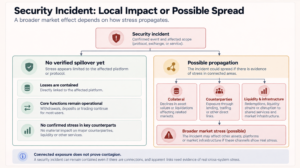
| Hacks and security incidents: suspicious transfer, confirmed exploit, loss estimate, and containment | Trust, collateral, liquidity, and counterparty risk | Asset, protocol, shared dependency, or market | Use incident reports and reproducible on-chain evidence; review immediately to weekly |
| Exchange and custody events: maintenance, outage, withdrawal pause, and insolvency are not equivalent | Access to funds, price discovery, liquidity, and counterparty risk | Platform first; broader only if stress spreads | Use status notices, legal records, and audited information; review immediately to monthly |
| Network upgrades and token supply: proposal, approval, activation; headline unlock vs liquid amount | Utility, costs, security, issuance, and possible sell pressure | Asset and ecosystem | Use specifications such as the Ethereum roadmap, governance records, and explorers; review weekly to structural |
| Stablecoins and on-chain liquidity: minting, net circulation, exchange buying power; peg and redemption state | Settlement, collateral, liquidity, and confidence | Ecosystem-specific or market-wide | Use issuer records, attestations, several venues, and scoped BIS research; review immediately to monthly |
| Geopolitical and cross-asset shocks: confirmed event vs speculation or escalation | The dollar, yields, equities, energy, and risk appetite | Often broad, sometimes narrative-specific | Confirm the event and compare timestamped cross-asset moves; use scoped IMF research for context; review daily to monthly |
Why a Headline Does Not Guarantee a Price Move
The table maps possible channels, not price forecasts. An official decision, technical release, or security notice may change access or expectations without immediately changing measured demand, adoption, or market-wide risk.
The event state matters as much as the headline. Approval of a spot-bitcoin ETP is not the same as its launch or measured fund inflows. A temporary exchange withdrawal pause does not by itself establish insolvency. A token unlock makes assets available but does not prove they were sold. More stablecoins issued does not automatically mean fresh buying demand on exchanges. Likewise, a network upgrade does not guarantee user adoption or a higher token price.
A news event can shift expected supply, demand, access, or investors’ willingness to trade. Whether prices move also depends on available buyers and sellers, order-book depth, and broader market conditions. Thin liquidity, leverage, forced liquidations, and sentiment can amplify or reverse the initial response. Bitcoin sometimes transmits shocks to other assets through shared trading markets and sentiment, but that relationship is neither constant nor universal.
Three Quick Checks Before Interpreting Crypto News
- Hack or exchange: verify losses and withdrawal status. Proof of Reserves alone does not establish complete liabilities, liquidity, or solvency.
- Token unlock: identify the recipient and sellable amount, then compare it with circulating supply and normal volume.
- Stablecoin or macro: compare several venues and related markets; one price or asset move is not enough.
Why Crypto Can Fall After Good News
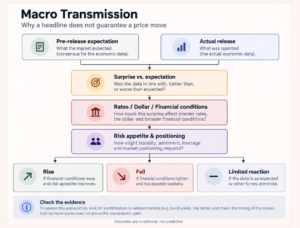
Markets react to the difference between new information and prior expectations. A seemingly positive event may already be priced in, arrive with narrower scope than expected, or be followed by profit-taking.
Two cases illustrate different parts of this method. The CPI release shows why an actual figure must be compared with an expectation recorded before the announcement. The January 2024 SEC account incident shows why the official status of a claim and the chosen observation window need separate checks.
Inflation illustrates the problem. The official release should be read against a timestamped expectation, not only against the previous reading. In one recorded example, the BLS reported that the U.S. Consumer Price Index for All Urban Consumers rose 8.3% over the 12 months through August 2022; the release was issued on September 13, 2022. That result was 0.3 percentage points above the 8.0% consensus in a dated Scotiabank Daily Points table. The comparison shows why the benchmark and capture time must be named; it does not establish the complete market expectation or prove a price cause.
Leverage, liquidations, thin order books, and repeated coverage may intensify an initial move. Describe the surprise, affected market, mechanism, and review period before giving the move a bullish or bearish label.
A generalized path from expectations to financial conditions and positioning; direction and magnitude are conditional.
Five Tests for Whether News Is Market-Moving
Before connecting a headline to a market move, apply five tests:
- Newness: Did the underlying fact change, or was an old story republished?
- Confirmation: Is there an original release, filing, transaction, status notice, or named report?
- Transmission mechanism: How could the event change liquidity, access, security, supply, utility, or risk appetite?
- Breadth and timing: Did the move follow the information, and did related assets, volume, derivatives, or other markets support the interpretation?
- Persistence: Did flows, adoption, liquidity, legal status, or network data change after the first session?
Timing can support an explanation, but it cannot establish causality by itself. For a fuller verification process, use How to Analyze Crypto News. If a move has already happened, Why Is the Crypto Market Up or Down Today? separates a possible catalyst from positioning and market reaction.
Worked Example: A Post Is Not the Same as Official Action
On January 9, 2024, an unauthorized post at 4:11 p.m. ET on the SEC’s compromised @SECGov X account falsely claimed spot-bitcoin ETF approval. At 4:26 p.m. ET, SEC staff used the separate @garygensler account to warn that the post was unauthorized and no approval had been granted. At 4:42 p.m. ET, staff posted an account-compromise notice on @SECGov. The SEC documented this sequence in its account-incident statement.
A message from an authentic-looking official account is not a Commission order. The false January 9 post must be distinguished from the SEC’s actual approval of spot-bitcoin exchange-traded products on January 10, 2024. Blockworks reported that an apparent approval order briefly appeared on the SEC website shortly before 4 p.m. ET on January 10, within the window beginning at 4:11 p.m. ET on January 9. The SEC’s approval statement confirms the January 10 decision but does not timestamp that first appearance. Approval itself neither endorses bitcoin nor guarantees fund inflows or a particular price response.
What Did Bitcoin’s Price Reaction Show?
The size of a price move depends on how it is measured. A later U.S. Department of Justice account reported that bitcoin rose by more than $1,000 immediately after the unauthorized post and fell by more than $2,000 after the correction. Those swings are not a venue-specific, reproducible five-minute, one-hour, or 24-hour series. A numerical return study must publish the trading venue, raw timestamped observations, reference price, and sampling rule. Point-to-point returns can miss intraperiod swings. Blockworks reported the official approval at 4:33 p.m. ET, after the window ended at 4:11 p.m. ET. The earlier disclosure and other developments prevent attributing the return solely to the false post.
Record Four Things Before You Explain a Move
- Source: Where did the claim originate, and was the content itself verified?
- Event state: Was it a rumor, proposal, approval, implementation, correction, or denial?
- Affected scope: Which asset, venue, jurisdiction, or user group was directly covered?
- Observation window and unknowns: Which interval was examined, and what alternative explanations remain?
This is a compact decision aid, not a complete worksheet or a human-tested trading tool.
Match the Catalyst to the Right Review Horizon
The same event can support different conclusions at different horizons. Choose the window before describing the effect.
Daily Review: What Changed Now?
Use the Daily Crypto News Review for timely developments, but do not turn an initial reaction into a lasting trend.
Weekly Review: Did the Story Persist?
The Weekly Crypto News Review helps distinguish a durable development from one-day noise.
Monthly Review: Did Market Structure Change?
The Monthly Crypto Market Review should update broader assumptions, not explain every candle.
A Practical Workflow When Breaking News Appears
- Find the original event. Locate the filing, release, transaction, status update, or official statement.
- Classify the catalyst and event state. Identify both what changed and whether it is proposed, approved, active, corrected, or still unconfirmed.
- Map the exposure. Decide whether the scope is market-wide, sector-specific, platform-specific, jurisdiction-specific, or limited to one asset.
- Compare with prior expectations. Record the relevant consensus or previously announced milestone and its timestamp.
- Choose the review horizon before checking the move. Set the observation window in advance so the explanation is not shaped by a selectively chosen endpoint.
- Check timing, breadth, and amplifiers. Review related assets and markets within the chosen window, separate the catalyst from leverage, liquidations, and thin liquidity, and revisit the event weekly or monthly only when evidence of persistence appears.
For a low-noise source routine, see How to Stay Updated on Crypto News. That monitoring task is separate from deciding what a catalyst means.
Method and Limits
The CPI illustration is a comparison of an official historical release with one dated consensus benchmark; it is not a complete measure of market expectations. The SEC example is grounded in the agency’s account-incident record and separate approval statement. Neither historical example isolates the causal effect of news on crypto prices. Any future quantitative price case should provide a named venue, time-indexed raw observations, a precise sampling rule, a calculation method, and a publicly accessible source before reporting specific returns. Crypto assets are volatile, and this article is educational rather than personalized financial, legal, or tax advice.
Final Takeaway: A Verified Headline Is Not a Price Forecast
A verified catalyst tells you what happened, not how far or how long crypto prices will move. Before drawing a conclusion, consider prior expectations, the transmission mechanism, affected markets, and the observation window. Use market-regime context and a crypto risk framework to put the evidence in perspective.