
- 1. What a “crypto profit calculator” should calculate (and what most miss)
- Step 1) Define your scenario: Spot profit vs Futures PnL
- Step 2) The clean spot-profit formula (net, not marketing)
- Spot profit percentage (the version that won’t trick you)
- Inputs you need for calculating crypto profits (and where they come from)
- Step 3) How to calculate profit with multiple buys (DCA / average price)
- Bullet checklist — DCA profit calculation (spot)
- Step 4) Fees: the silent reason your profit is off
- Fee types that impact crypto profit and PnL
- Step 5) Quick “profit calculator” sanity checks (so you trust the output)
- 2. Crypto PnL Calculator Logic (Futures + Leverage) and Break-Even With Fees
- Why “crypto PnL calculator” is not the same as “crypto profit calculator”
- Step 1) Define the contract type: linear vs inverse (keep it simple)
- Step 2) The simplest futures PnL formula (linear contracts)
- What leverage actually changes
- Futures PnL terms people confuse (and how to read them)
- Step 3) Fees in futures: you pay to enter and exit
- Step 4) Break-even price with fees (the most practical calculation)
- Spot break-even (simple)
- Futures break-even (simple, linear)
- What pushes your break-even away from entry
- Step 5) Profit percentage vs ROI (don’t mix these)
- Step 6) Practical examples (written like a calculator “sanity test”)
- Example A — Spot profit with fees (simple)
- Example B — Futures PnL (linear, long)
- Step 7) What to look for in a “best crypto profit calculator” (selection criteria)
- 3. A Practical Profit-Tracking Workflow (Investor-Safe) + Common Mistakes (and Fixes)
- A repeatable workflow to calculate crypto profit (without fooling yourself)
- Step 1) Choose the “profit type” (spot vs futures)
- Step 2) Lock the time window
- Step 3) Define your cost basis method (FIFO vs average cost)
- Step 4) Enter fees as a “default,” not an afterthought
- Step 5) Keep one standard output set
- The investor-safe profit calculation checklist
- How to handle real portfolio situations (the ones calculators mess up)
- Scenario A — DCA entries (average price)
- Scenario B — Partial sells (realized vs remaining)
- Scenario C — Multiple coins and mixed timelines
- Real-world inputs that improve accuracy (and SEO intent)
- Common mistakes in crypto profit calculation (and the fix)
- Mistake 1: Ignoring fees (or counting only one side)
- Mistake 2: Using the wrong denominator for profit %
- Mistake 3: Treating DCA like a single entry
- Mistake 4: Confusing realized and unrealized PnL
- Mistake 5: Letting one good exit rewrite the story
- Mistake 6: Mixing coins without converting consistently
- Mistake 7: Overconfidence from calculator outputs
- A short “how to use a crypto profit calculator” section (high click intent)
- Conclusion: what a good crypto profit calculator should actually do
Most people think calculating crypto profits is simple: sell price minus buy price. In reality, that shortcut is exactly why many traders and investors misread their results—especially when fees, partial fills, multiple buys (DCA), and futures PnL are involved.
This guide is built for clean, investor-safe decision-making: not signals, not predictions—just a repeatable way to calculate profit, profit percentage, and PnL in a way that matches how exchanges actually charge you.
If you want to skip the math and run the numbers directly, you can use our profit calculator here:
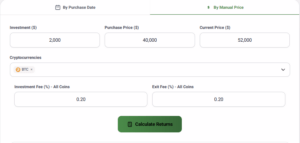
Figure 1 — Enter your investment amount, entry price, current price, and trading fees to calculate net crypto profit and return percentage.
If you’re choosing a tool, start here: our roundup of the best crypto profit calculators explains what matters most (fees, DCA, partial sells) before you run the numbers.
If you’re tracking a full portfolio (not a single trade), use this profit + portfolio workflow to avoid misleading ROI and inconsistent cost basis.
1. What a “crypto profit calculator” should calculate (and what most miss)
A solid crypto profit calculator with fees should handle three things:
Net profit (after fees, not before fees)
Profit percentage (based on your actual cost basis)
PnL logic for different situations (spot vs futures, single entry vs multiple entries)
A lot of pages ranking for “crypto profit calculator” only cover a one-buy, one-sell scenario. That’s fine for a quick estimate, but it’s not reliable once you introduce real execution details.
Step 1) Define your scenario: Spot profit vs Futures PnL
Before formulas, decide what you’re calculating:
Spot (investing): you buy the asset and later sell it.
Futures (PnL): you’re trading a contract, and leverage changes how gains/losses behave.
This matters because a crypto PnL calculator for futures must account for leverage mechanics and extra costs (like funding). A spot profit calculator typically focuses on entry/exit price, size, and fees.
Step 2) The clean spot-profit formula (net, not marketing)
For a spot trade, the clean approach is:
Gross proceeds = Sell price × Quantity
Gross cost = Buy price × Quantity
Fees = Trading fees (and sometimes spread/slippage if you want realism)
Net profit = Gross proceeds − Gross cost − Fees
Spot profit percentage (the version that won’t trick you)
Profit % should be based on what you actually paid:
Profit % = (Net profit ÷ Gross cost) × 100
If you calculate profit percent before fees, you’ll overestimate performance—especially if you trade frequently or with small moves.
Inputs you need for calculating crypto profits (and where they come from)
| Input | What it means | Where to find it fast | Common mistake |
|---|---|---|---|
| Buy price | Your average entry price | Exchange trade history / portfolio | Using the first buy instead of average |
| Sell price | Your execution price | Exchange trade history | Using a chart price, not fill price |
| Quantity | Units bought/sold | Trade history | Forgetting partial sells |
| Trading fee | Exchange taker/maker fee | Fee schedule + trade receipt | Ignoring fee on both sides |
| Cost basis method | How you average entries | DCA log / portfolio tool | Mixing buys without averaging |
| Extra costs (optional) | Spread, slippage | Estimate from order book | Assuming perfect fills |
If your entries were spread across multiple buys, you need an average entry (cost basis). Otherwise “profit calculator” results will be meaningless.
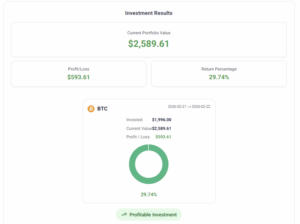
Figure 2 — Example output: current portfolio value, net profit/loss, and return percentage after fees.
Step 3) How to calculate profit with multiple buys (DCA / average price)
If you bought the same coin multiple times, don’t average the prices casually. Use a weighted average:
Total cost = Σ (Buy price × Quantity)
Average entry price = Total cost ÷ Total quantity
This is exactly why “average price calculator crypto” is a useful secondary keyword and section inside a profit calculator article: most users are buying in multiple chunks, not one clean entry.
Bullet checklist — DCA profit calculation (spot)
Add up all buy quantities → Total quantity
Add up (buy price × quantity) for each buy → Total cost
Divide total cost by total quantity → Average entry
Use the average entry to calculate gross cost and profit
This alone removes a big chunk of confusion around “why my profit % looks wrong.”
Step 4) Fees: the silent reason your profit is off
Fees are not just a small detail. They change your break-even price and can flip a small win into a loss.
Most exchanges charge fees on both sides:
a fee when you buy
a fee when you sell
Some platforms also have:
withdrawal fees (network costs)
funding fees (futures)
hidden costs like spread (difference between bid/ask)
Fee types that impact crypto profit and PnL
| Fee / cost | Applies to | What it does | When it matters most |
|---|---|---|---|
| Trading fee (maker/taker) | Spot + futures | Reduces net profit on entry/exit | Frequent trading, small targets |
| Spread | Spot | You buy higher, sell lower than mid-price | Low liquidity pairs |
| Slippage | Spot + futures | Worse fill than expected | Market orders, volatility spikes |
| Funding fee | Futures | Ongoing cost/benefit while holding | Leverage positions held longer |
| Withdrawal/network fee | Spot | Reduces realized profit after moving funds | Moving coins between wallets/exchanges |
A “crypto profit calculator with fees” should at least cover trading fees. A more advanced calculator (or a well-written guide) also explains which costs are optional and when they become important.
Step 5) Quick “profit calculator” sanity checks (so you trust the output)
Before you rely on the number, run these checks:
Did you include fees on both buy and sell?
Are you using average entry price if you DCA’d?
Are you mixing spot and futures logic by mistake?
If it’s futures, did you consider funding (if relevant)?
2. Crypto PnL Calculator Logic (Futures + Leverage) and Break-Even With Fees
Part 1 covered spot profit math and why “profit %” is often wrong when you ignore fees or cost basis. In Part 2, we’ll handle the tougher (and more searched) side of the topic: crypto PnL calculator logic for futures, leverage, and break-even—without turning it into trading advice.
Why “crypto PnL calculator” is not the same as “crypto profit calculator”
Search intent splits into two groups:
Profit calculator = usually spot investing (buy → sell).
PnL calculator = often futures/perps (long/short, leverage, funding).
On futures, your profit depends on more variables than spot. Many pages ignore the parts that actually move the final number:
direction (long vs short)
leverage (amplifies PnL on margin, not on notional)
fees (open + close, sometimes more)
funding (periodic cost/credit)
position size in contracts vs asset units
A good article should clarify the logic before showing numbers—otherwise people plug in inputs and “feel” confident while being wrong.
Step 1) Define the contract type: linear vs inverse (keep it simple)
Most retail crypto futures (like USDT-margined perps) are linear: PnL behaves like normal price difference multiplied by size.
Some BTC-margined contracts are inverse (PnL in BTC). That’s where confusion starts.
Investor-safe move:
Focus your guide on linear (USDT-margined) PnL, then mention inverse briefly as an edge case. That matches the highest-intent audience and keeps your content clean.
Step 2) The simplest futures PnL formula (linear contracts)
For linear futures/perps:
PnL (USDT) ≈ (Exit price − Entry price) × Position size (in coin units)
For a short, flip the direction:
PnL (USDT) ≈ (Entry price − Exit price) × Position size
That’s the “raw” PnL before fees and funding.
What leverage actually changes
Leverage does not change raw PnL on notional. It changes:
your margin (capital used)
your ROI on margin (PnL ÷ margin)
your liquidation risk (buffer shrinks)
So the correct way to talk about leverage inside a calculator blog is:
PnL is driven by price move × size
Leverage changes the % return on the margin and the risk of getting forced out
Futures PnL terms people confuse (and how to read them)
| Term | Meaning | What it affects | Common confusion |
|---|---|---|---|
| Notional | Position value (size × price) | Fee base, exposure | People think it equals margin |
| Margin | Capital posted for the position | ROI on margin | Confused with notional |
| Leverage | Notional ÷ margin | Liquidation sensitivity | Treated like “profit multiplier” |
| PnL (unrealized) | Open position profit/loss | Equity while holding | Mistaken as realized profit |
| PnL (realized) | Closed position profit/loss | Final result | Ignoring fees/funding |
Step 3) Fees in futures: you pay to enter and exit
A “crypto profit calculator with fees” becomes much more useful when it explains that futures fees often hit twice:
entry fee (open)
exit fee (close)
Some exchanges use maker/taker rates, and your fee base is usually notional.
A clean simplified approach for education:
Total trading fees ≈ Notional × fee rate (entry) + Notional × fee rate (exit)
If your platform charges different fees for entry and exit (maker vs taker), you can estimate using the more conservative rate (typically taker), then improve later.
Step 4) Break-even price with fees (the most practical calculation)
“Break-even” is high-intent search. People search it when they’re unsure why a trade that “moved in my direction” still didn’t make money.
Spot break-even (simple)
If fees exist, you need a slightly better exit price than your entry.
Futures break-even (simple, linear)
Break-even move must cover:
entry fee
exit fee
funding (if held long enough)
So you can express it like this:
Required profit to break even = Entry fee + Exit fee + (Funding paid)
Then convert that required profit into a price move:
Break-even price move ≈ Required profit ÷ Position size
This is the cleanest way to explain it without drowning in exchange-specific complexity.
What pushes your break-even away from entry
| Factor | Pushes break-even | Why it matters |
|---|---|---|
| Entry fee | Away from entry immediately | You start slightly negative |
| Exit fee | Needs extra move to cover | Paid when you close |
| Funding | Drifts break-even over time | Small costs add up |
| Slippage/spread | Adds hidden cost | Worse fills vs expected |
| Partial closes | Changes average exit | Makes realized PnL non-obvious |
Step 5) Profit percentage vs ROI (don’t mix these)
A lot of “PnL calculator” content accidentally mixes two different percentages:
Profit % on notional
PnL ÷ notional
Useful to compare “how much the position moved” relative to exposure.
ROI on margin (what most futures traders care about)
PnL ÷ margin
This is where leverage matters.
A simple investor-safe explanation:
A 2% move on price might be a 2% move on notional, but a much larger % on margin if you used leverage—while risk rises too.
You don’t need to moralize it. Just define it clearly.
Step 6) Practical examples (written like a calculator “sanity test”)
Example A — Spot profit with fees (simple)
Buy: 1 ETH at $2,000
Sell: 1 ETH at $2,100
Fees total: $6
Net profit: $100 − $6 = $94
Profit %: $94 ÷ $2,000 = 4.7%
Example B — Futures PnL (linear, long)
Entry: $2,000
Exit: $2,050
Size: 1 ETH
Raw PnL: $50
Fees: $4 (entry+exit combined estimate)
Funding: $2
Net PnL: $50 − $6 = $44
Now you can show how ROI changes if margin changes—without implying anyone should use leverage.
Step 7) What to look for in a “best crypto profit calculator” (selection criteria)
Competitor pages often rank because they have a tool, not because the content is trustworthy. Your edge is credibility + clarity.
A high-integrity calculator page (and blog) should:
Let users include fees
Support average entry price (DCA)
Separate spot profit from futures PnL
Explain break-even clearly
Avoid “guarantee” language and unrealistic claims
3. A Practical Profit-Tracking Workflow (Investor-Safe) + Common Mistakes (and Fixes)
Part 1 explained spot profit math and why cost basis matters. Part 2 covered crypto PnL calculator logic for futures, leverage, and break-even with fees. Now we’ll finish the blog with something most “best crypto profit calculator” pages skip: a repeatable workflow you can apply to real portfolios—plus the mistakes that quietly destroy accuracy.
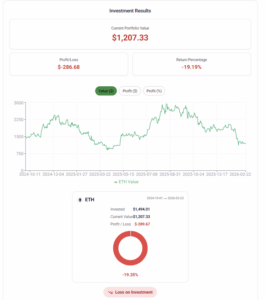
Example output from the Forvest Crypto Profit Calculator: portfolio value, net profit/loss, and return percentage for ETH over a selected date range (fees applied).
A repeatable workflow to calculate crypto profit (without fooling yourself)
A reliable crypto profit calculation has one job: turn a messy trade/portfolio history into a consistent result. The easiest way to do that is to always calculate in the same order.
Step 1) Choose the “profit type” (spot vs futures)
Start by classifying the position:
Spot investing (buy/sell the asset): profit = (sell proceeds − cost basis − fees)
Futures / perp PnL (long/short on margin): profit = (price move × size) − fees − funding
Mixing these two is the most common source of wrong outputs. Even if you’re not a trader, people will search “PnL calculator” and then apply those ideas to spot. Make the separation explicit.
Step 2) Lock the time window
Pick a window before you calculate:
single trade
last 7/30/90 days
year-to-date
“since first buy”
This matters because cost basis and fees compound over time. If you keep changing the window, your result becomes storytelling, not tracking.
Step 3) Define your cost basis method (FIFO vs average cost)
For investor-style content, keep it practical:
Average cost is easiest for people who DCA.
FIFO (first-in-first-out) is common for accounting/tax contexts.
You don’t need to go deep into tax rules. You just need to state: your profit number depends on cost-basis method. A good calculator blog acknowledges that.
Step 4) Enter fees as a “default,” not an afterthought
Fees are not optional. Fees are the difference between a clean example and real life:
exchange fee (maker/taker)
on-chain network fee (withdrawals/bridges)
funding (if perps)
When fees aren’t tracked, people think they’re making money while their net result is flat.
Step 5) Keep one standard output set
Instead of dumping random metrics, keep one consistent output set for every calculation:
Net profit ($)
Net profit (%)
Break-even (or “required move to break even”)
Notes (fees included? DCA? partial sells?)
That’s how strong finance tools keep users grounded.
The investor-safe profit calculation checklist
| Step | What you decide | Why it matters |
|---|---|---|
| 1 | Spot vs futures/PnL | Different math, different risks |
| 2 | Time window | Prevents cherry-picking |
| 3 | Cost basis method | Changes profit % materially |
| 4 | Fee model | Converts “paper gains” into net reality |
| 5 | Output format | Keeps tracking consistent and comparable |
How to handle real portfolio situations (the ones calculators mess up)
Scenario A — DCA entries (average price)
If you bought multiple times, your entry is not “the first price.” A serious crypto profit calculator should let you calculate using:
total cost
total units
average entry price
Even if you don’t show the full math, explain the principle clearly:
Profit should be computed from the weighted cost of your accumulated position.
Scenario B — Partial sells (realized vs remaining)
If you sell only part of the position, your “profit” splits into:
Realized profit on the sold amount
Unrealized profit on what remains
Most competitor pages either ignore this or blur it. Your blog should name it plainly and explain:
A portfolio can be “up overall” while your realized PnL is negative (or vice versa).
A good workflow tracks both, not just one.
Scenario C — Multiple coins and mixed timelines
People often ask: “How much profit did my portfolio make?” That’s different from “How much profit did this trade make?”
Investor-safe approach:
Calculate each asset individually first.
Then sum net profit in your base currency.
That prevents one asset’s wins from hiding another asset’s losses.
Real-world inputs that improve accuracy (and SEO intent)
| Input | Why users search it | What you should support/explain |
|---|---|---|
| “with fees” | Break-even confusion | Entry + exit fees, optional funding |
| Average entry price | DCA investors | Weighted average cost basis |
| Profit percentage | Comparison across trades | Net profit % based on cost basis |
| PnL vs profit | Futures vs spot confusion | Separate sections + definitions |
| Partial sells | “Why my PnL looks wrong” | Realized vs unrealized logic |
Common mistakes in crypto profit calculation (and the fix)
These match “question-style” search intent and increase credibility.
Mistake 1: Ignoring fees (or counting only one side)
Fix: include fees at entry and exit. For perps, mention funding as a separate line item.
Mistake 2: Using the wrong denominator for profit %
People compute profit % using the wrong base (especially on futures).
Fix: state clearly:
profit % on spot is typically net profit ÷ cost basis
ROI on margin is net PnL ÷ margin (if futures)
Mistake 3: Treating DCA like a single entry
Fix: use average entry price or total cost/total units.
Mistake 4: Confusing realized and unrealized PnL
Fix: track both. If you sold part, don’t report the remaining position as “profit taken.”
Mistake 5: Letting one good exit rewrite the story
People “forget” earlier losses by resetting the timeline.
Fix: define the window first (7D/30D/YTD/since inception) and stick to it.
Mistake 6: Mixing coins without converting consistently
A portfolio result must be denominated consistently (USD, EUR, etc.).
Fix: calculate per asset, then sum in one base currency.
Mistake 7: Overconfidence from calculator outputs
A calculator gives numbers; it doesn’t validate a decision.
Fix: treat it as tracking + planning (break-even, sizing awareness), not prediction.
A short “how to use a crypto profit calculator” section (high click intent)
If you want a compact user flow that reads well and avoids hype:
Enter your asset and position size
Add entry price (or average entry if DCA)
Add exit price (or current price for unrealized)
Include fees (entry + exit; funding if applicable)
Review net profit, profit %, and break-even
Save the result as a single line in your tracking note/spreadsheet
Conclusion: what a good crypto profit calculator should actually do
A useful profit calculator doesn’t promise smarter investing. It does something more valuable:
It makes your results measurable.
It makes fees visible.
It keeps your tracking consistent.
Once your profit and break-even are computed correctly, decisions become calmer because you’re no longer guessing what “up” or “down” really means.
