


What Does It Mean to Analyze Cryptocurrencies with AI?
The ability to Analyze Cryptocurrencies with AI has changed how investors and researchers process market information. Instead of manually reviewing charts, blockchain activity, news updates, and market sentiment one source at a time, artificial intelligence can organize large datasets and highlight patterns that deserve closer attention. At the same time, meaningful decisions still depend on a structured market analysis process that explains how technical, fundamental, sentiment, and on-chain perspectives work together.
However, AI is often misunderstood. Many people assume it can accurately predict Bitcoin or automatically identify the next profitable trade. In reality, modern AI works best as a research assistant rather than a prediction engine. It helps users filter noise, summarize information, compare multiple signals, and speed up analysis, but it should not replace critical thinking or disciplined risk management.
For news specifically, a structured crypto news analysis framework helps verify sources, separate facts from claims, and decide which events deserve deeper review before AI summaries influence an investment decision.
How AI Supports Cryptocurrency Analysis
AI-powered research systems combine information from different sources to create a broader market perspective. Instead of relying on price action alone, they can process structured and unstructured data simultaneously.
Common inputs include:
- Historical price movements and volatility
- Trading volume and liquidity changes
- Blockchain and on-chain activity
- Financial news and market events
- Investor sentiment and public narratives
- Macroeconomic developments that influence digital assets
This multi-source approach helps analysts understand why markets are moving instead of simply observing that they moved.
| AI Data Source | Example Use in Crypto Research |
|---|---|
| Market data | Evaluate trends and volatility |
| On-chain metrics | Monitor network activity and fund flows |
| News content | Detect event-driven market reactions |
| Sentiment data | Measure changes in investor confidence |
| Historical datasets | Compare current conditions with past cycles |
Can AI Predict Cryptocurrency Prices?
This is one of the most common questions users ask, but the answer is more nuanced than a simple yes or no.
AI can identify recurring patterns, detect anomalies, and process information much faster than humans. Nevertheless, cryptocurrency markets are influenced by regulation, liquidity, global events, investor psychology, and unexpected news that no model can anticipate perfectly.
For that reason, experienced analysts use AI to support research and validate hypotheses, not to generate guaranteed buy or sell signals.
Why More Investors Are Using AI for Crypto Research
The cryptocurrency market operates 24 hours a day and produces enormous amounts of data. Reviewing every chart, headline, wallet movement, and discussion manually is unrealistic for most investors.
AI helps reduce this complexity by:
- Organizing large volumes of information.
- Identifying recurring market patterns.
- Summarizing news and research quickly.
- Highlighting unusual activity that deserves further review.
- Supporting faster and more consistent research workflows.
The greatest value of AI is not replacing analysts but helping them make sense of increasingly complex information. When combined with technical analysis, sentiment research, and blockchain data, AI becomes a powerful layer for building a more complete view of the cryptocurrency market.
How AI Analyzes Cryptocurrencies: From Market Data to Actionable Insights
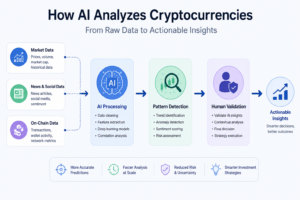
When people search “How does AI analyze cryptocurrencies?”, they often expect a secret algorithm that predicts the next Bitcoin rally. In reality, AI works differently. Understanding the fundamentals of artificial intelligence helps explain how it analyzes large datasets, identifies relationships, and supports researchers in spotting patterns that would be difficult to detect manually.
Instead of replacing traditional research, AI acts as an intelligent assistant that processes data faster and presents it in a more structured way. The final interpretation—and any investment decision—should still come from human judgment.
What Data Does AI Use to Analyze Crypto?
The quality of AI analysis depends on the quality of the data it receives. A model trained on incomplete or outdated information may produce misleading conclusions, while diverse and reliable datasets create a stronger foundation for research.
Most AI-driven crypto analysis combines several information sources:
- Market data: price history, trading volume, and volatility.
- On-chain activity: wallet movements, transaction counts, and exchange flows.
- News coverage: announcements, regulations, and macroeconomic events.
- Market sentiment: investor discussions and public narratives.
- Historical trends: previous market cycles and recurring behaviors.
By combining these sources, AI can evaluate market conditions from multiple perspectives instead of relying on a single signal.
If you want to understand why a cryptocurrency moved—not just that it moved—reviewing a structured crypto news analysis provides essential context that raw market data alone may miss.
| Data Source | Why It Matters |
|---|---|
| Price and volume | Identifies trends and momentum |
| Blockchain activity | Reveals network participation and fund movement |
| News and events | Explains sudden market reactions |
| Sentiment data | Measures shifts in investor confidence |
| Historical records | Compares current conditions with past cycles |
Can AI Find Patterns That Humans Miss?
One of AI’s biggest strengths is pattern recognition. Machine learning models can review years of historical data and compare it with current market conditions in seconds. This allows researchers to detect recurring behaviors, unusual correlations, or sudden anomalies that might otherwise go unnoticed.
For example, AI may discover that increasing trading volume, improving sentiment, and rising blockchain activity have appeared together during previous periods of market expansion. That observation does not guarantee a similar outcome in the future, but it gives analysts another layer of evidence to investigate.
At the same time, markets are influenced by unpredictable factors such as regulation, geopolitical events, or security incidents. AI cannot foresee every catalyst, which is why experienced investors avoid treating model outputs as guaranteed forecasts.
Why Combining AI with Human Judgment Produces Better Results
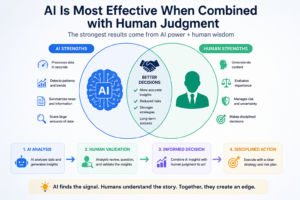
The most effective research workflows use AI to process information and humans to evaluate context. AI excels at speed, consistency, and large-scale analysis, while people provide critical thinking, experience, and risk assessment.
A practical workflow often looks like this:
- Gather market, blockchain, and news data.
- Use AI to summarize information and identify potential signals.
- Compare those findings with technical or on-chain analysis.
- Validate conclusions using independent sources.
- Make decisions only after considering risk and market context.
This balanced approach helps reduce emotional bias without creating overconfidence in automation. Rather than asking AI to predict the future, successful researchers use it to organize information, challenge assumptions, and support more informed cryptocurrency analysis.
AI Is Most Effective When Combined with Human Judgment
One of the biggest misconceptions about AI crypto analysis is that it can replace human expertise. In practice, the opposite is true. The most reliable results come from combining artificial intelligence with independent research, critical thinking, and disciplined risk management.
AI excels at processing information quickly, but it cannot fully understand context. A model may identify an unusual pattern or summarize breaking news, yet it cannot determine whether that signal reflects a lasting market shift or a short-lived reaction. Experienced analysts fill that gap by validating AI-generated insights before acting on them.
This is especially important in cryptocurrency markets, where prices can react sharply to regulation, exchange incidents, macroeconomic events, or sudden changes in investor sentiment.
A Simple Framework for Validating AI Crypto Analysis
Before using AI-generated insights to support research, ask the following questions:
- Does recent price action support the conclusion?
- Do trading volume and liquidity show similar signals?
- Does blockchain activity reinforce or contradict the finding?
- Has recent news changed the broader market narrative?
- Could the result be influenced by incomplete or outdated data?
If several independent sources point in the same direction, confidence in the research generally improves. If they conflict, additional investigation is usually a better approach than rushing to conclusions. For investors who want to monitor important developments without constantly watching the market, using real-time crypto alerts can make it easier to spot significant changes as they happen and review them before making decisions.
| Validation Check | Purpose |
|---|---|
| Price action | Confirms market direction |
| Trading volume | Measures participation |
| On-chain metrics | Reviews blockchain activity |
| News developments | Adds real-world context |
| AI output | Highlights patterns for review |
Common Mistakes When Using AI for Cryptocurrency Analysis
AI can make research more efficient, but misuse often leads to poor decisions. Many mistakes come from unrealistic expectations rather than limitations in the technology itself.
1. Expecting AI to predict exact prices
Machine learning models identify probabilities and patterns. They cannot guarantee future market movements.
2. Relying on a single data source
Research improves when market data, blockchain metrics, sentiment, and news are considered together.
3. Ignoring changing market conditions
Historical relationships may weaken during periods of extreme volatility or unexpected events.
4. Treating AI-generated text as verified fact
Language models can produce inaccurate or outdated information. Important claims should always be confirmed independently.
5. Skipping risk management
Even well-supported analysis can be wrong. Position sizing and risk controls remain essential.
When Does AI Add the Most Value?
AI tends to be most useful when markets generate more information than a person can reasonably review.
It can help:
- Summarize large amounts of crypto news.
- Organize research across multiple assets.
- Compare historical market behavior.
- Detect unusual patterns or anomalies.
- Monitor ongoing developments more efficiently.
However, AI should support research—not replace it. Strong decisions usually come from combining automated insights with technical analysis, on-chain observations, sentiment evaluation, and human experience.
Conclusion
Analyzing cryptocurrencies with AI is not about replacing experience or finding a shortcut to guaranteed profits. It is about improving the research process by processing information faster, recognizing meaningful patterns, and organizing complex datasets into actionable insights.
The strongest approach combines AI with technical analysis, on-chain research, market sentiment, and human judgment. When these layers work together, investors gain a more balanced understanding of market conditions and reduce the risk of relying on any single signal.