Crypto Sentiment Analysis: Signals, Limits and Workflow
Crypto sentiment analysis measures market mood across news, social data, derivatives and behavior. Use it as context and confirm it with price, liquidity, on-chain and risk evidence.
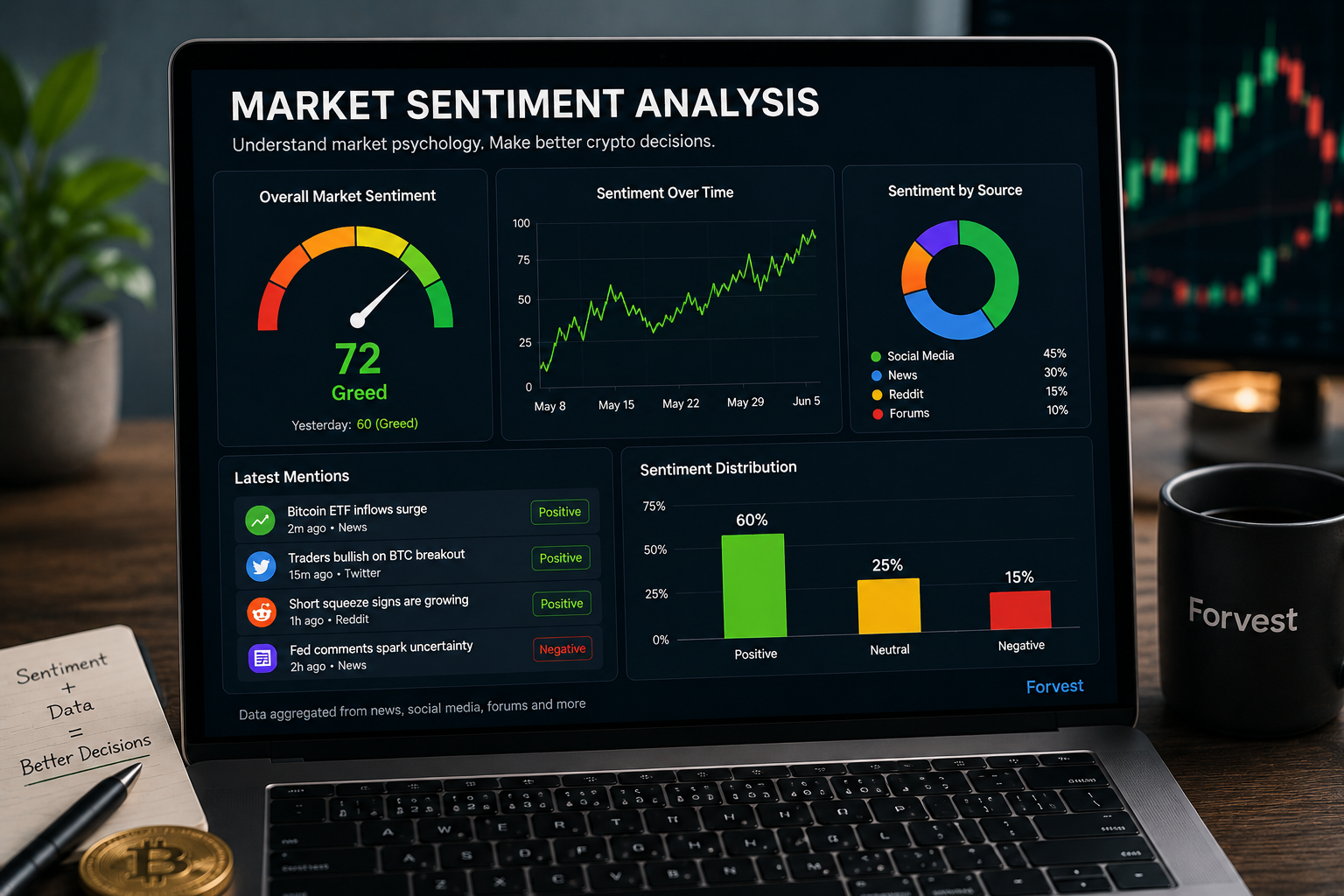
A visual representation of crypto market sentiment analysis, combining investor psychology, news sentiment, social signals, and behavioral trends to support informed market research and decision-making.
Key takeaways
Sentiment measures crowd mood; it does not predict price by itself.
Different Fear & Greed providers can produce different readings.
Social volume is noisy and can be distorted by bots or coordinated campaigns.
Funding and open interest add positioning context but vary by exchange.
Confirm sentiment with primary news, price, liquidity, on-chain and risk evidence.
Short answer: Crypto sentiment analysis measures how optimistic, fearful or crowded market participants appear across news, social activity, derivatives and behavior. It is context—not a standalone buy or sell signal.
Source
Useful for
Main distortion
Confirmation
Fear & Greed index
Broad mood
Method differs by provider
Price trend and volatility
News
Event narrative
Old or duplicated stories
Primary source and timestamp
Social posts
Attention and narratives
Bots, paid campaigns, sampling bias
Unique authors and engagement quality
Funding/open interest
Positioning and crowding
Exchange-specific data
Spot price and liquidation data
Search interest
Public attention
Curiosity is not demand
Volume and wallet activity
What Is Sentiment Analysis in Market Analysis?
Sentiment analysis evaluates opinions, emotions, and attitudes expressed through news articles, financial publications, and online conversations. In cryptocurrency markets, it estimates whether investors feel bullish, bearish, or neutral by analyzing the language and tone found in public information.
Unlike technical analysis, sentiment analysis studies how people think and react instead of focusing only on historical price movements. Modern systems often use artificial intelligence, natural language processing (NLP), and machine learning to process large amounts of text. Analysts then interpret those results within the broader market context. Human judgment remains important because sarcasm, misinformation, and coordinated campaigns can distort automated scores.
The following table compares sentiment analysis with other common research methods:
Analysis Method
Primary Data Source
Main Purpose
Sentiment Analysis
News, social media, investor discussions
Measures market psychology and emotional trends
Technical Analysis
Price charts and trading volume
Identifies patterns, momentum, and support or resistance levels
On-Chain Analysis
Blockchain transactions and wallet activity
Evaluates network behavior and participant activity
Fundamental Analysis
Adoption metrics, macroeconomic data, project information
Assesses long-term value and economic drivers
Each method contributes a different perspective. Professional researchers usually combine behavioral insights with price action and blockchain data instead of relying on a single signal.
Why Sentiment Matters in Crypto and Financial Markets
Financial markets respond to expectations as much as they respond to facts. In cryptocurrency, investor emotion often spreads rapidly through online communities and influences short-term volatility.
Unexpected regulations, exchange announcements, or influential public comments can shift sentiment within minutes. Positive narratives may create FOMO (Fear of Missing Out) and attract new buyers. Negative stories can increase uncertainty and encourage panic selling. These reactions often amplify price movements before technical indicators fully reflect the change.
For this reason, sentiment analysis has become a valuable research layer. It provides context that traditional charts cannot always capture. However, analysts should avoid treating sentiment as a prediction engine. Market mood changes quickly, and emotional signals can reverse without warning. The best practice is to combine sentiment with technical indicators, blockchain data, macroeconomic analysis, and sound risk management to build a balanced view of market conditions.
How Sentiment Analysis Works
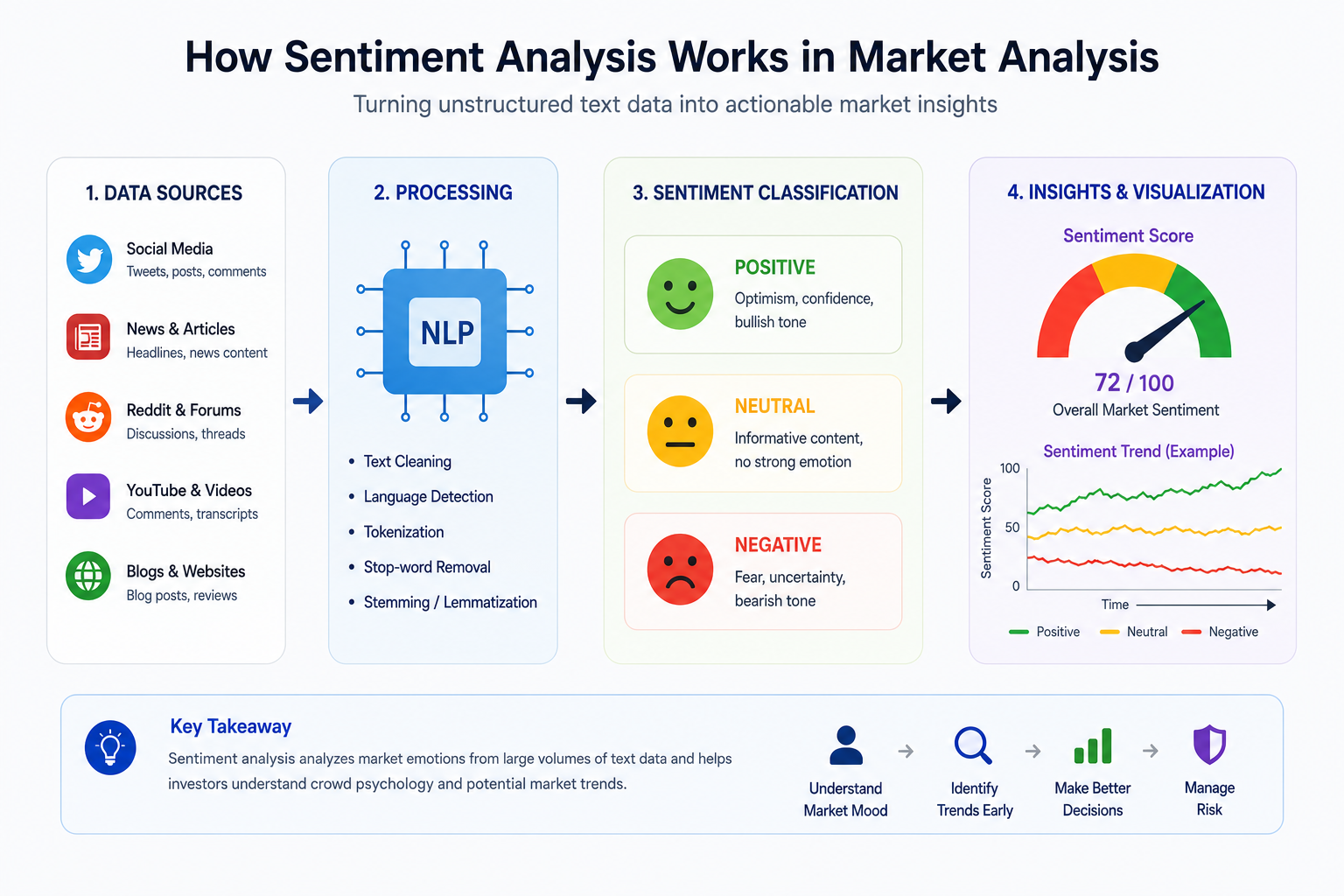
Sentiment analysis transforms unstructured information into meaningful market insights by evaluating the emotional tone behind written content. Instead of examining price charts alone, it analyzes how people discuss assets, react to events, and express confidence or concern. In cryptocurrency markets, this approach helps researchers understand whether public opinion supports or contradicts current market behavior.
This infographic illustrates how sentiment analysis transforms news, social media, and online discussions into actionable market insights, helping investors understand market psychology and evaluate cryptocurrency trends.
The process usually begins with data collection. Analysts gather information from financial news websites, official announcements, blogs, social media platforms, discussion forums, and search trends. Advanced systems may process thousands of posts or articles within minutes, while individual researchers often focus on carefully selected sources.
Next, natural language processing (NLP) and machine learning algorithms classify the text. They identify positive, negative, or neutral language and assign sentiment scores based on keywords, context, and writing patterns. For example, headlines about institutional adoption or successful network upgrades often generate positive sentiment, while security breaches or regulatory uncertainty may create negative reactions.
However, automated analysis is not perfect. Internet discussions frequently include sarcasm, jokes, rumors, or coordinated campaigns that algorithms may misinterpret. A sudden wave of positive comments could reflect genuine enthusiasm, but it could also result from marketing efforts or bot activity. Therefore, experienced analysts review sentiment results alongside other evidence instead of accepting them at face value.
The final step involves interpretation. Researchers compare sentiment trends with market conditions, trading volume, volatility, and price action to determine whether emotions align with broader market signals. This balanced approach reduces the risk of making decisions based solely on public opinion.
Search interest data from tools such as Google Trends can provide additional context when evaluating shifts in public attention and market sentiment.
Common Sentiment Data Sources
Reliable sentiment analysis depends on diverse and credible information sources. Each source reflects a different perspective and contributes unique insights into investor behavior.
Data Source
What It Reveals
Typical Use
Financial News
Reactions to regulations, partnerships, and macro events
Tracks event-driven sentiment
Social Media Platforms
Public discussions and community opinion
Measures retail investor mood
Online Forums
In-depth conversations and narratives
Identifies emerging themes
Search Trends
Changes in public interest
Detects growing attention or declining interest
Market Commentary
Professional opinions and research
Adds expert context to sentiment signals
No single source provides a complete picture. News organizations often react after major events occur, while social media may spread information more quickly but with greater noise. Search behavior can indicate rising curiosity, yet it does not always translate into investment activity.
Because of these differences, professional analysts aggregate multiple data sources before drawing conclusions. They also evaluate source credibility and verify whether sentiment aligns with objective market evidence.
News Sentiment in Market Analysis
News plays a significant role in shaping investor expectations. Regulatory announcements, exchange developments, institutional investments, and macroeconomic events often trigger immediate reactions across cryptocurrency markets.
Positive headlines can strengthen confidence and encourage buying activity, especially when they involve adoption or technological progress. Conversely, reports about security incidents, legal disputes, or economic uncertainty may weaken sentiment and increase volatility.
Despite its importance, news sentiment has limitations. Media outlets sometimes emphasize dramatic events because they attract attention, which can exaggerate perceived risks or opportunities. Analysts should therefore evaluate multiple publications and compare headlines with underlying facts before changing their market outlook.
For readers interested in monitoring developments systematically, integrating a crypto news review process into regular market research can help distinguish meaningful events from short-lived narratives.
Social Sentiment from X, Reddit, and Online Communities
Online communities often react to market events faster than traditional media. Discussions on platforms such as X, Reddit, Telegram, and specialized crypto forums reveal changing expectations, rumors, and investor emotions in near real time.
These conversations frequently influence short-term price behavior, particularly for highly speculative assets. Viral posts, influential personalities, or rapidly spreading narratives can create optimism or fear long before formal analysis becomes available.
At the same time, social sentiment requires careful interpretation. Bots, coordinated campaigns, and misinformation can distort public perception and generate misleading signals. A trending topic does not necessarily reflect genuine market conviction or long-term value.
Professional researchers treat social sentiment as supporting evidence rather than definitive proof. They compare community discussions with technical indicators, blockchain activity, and verified news before making investment decisions.
Fear and Greed in Crypto Markets
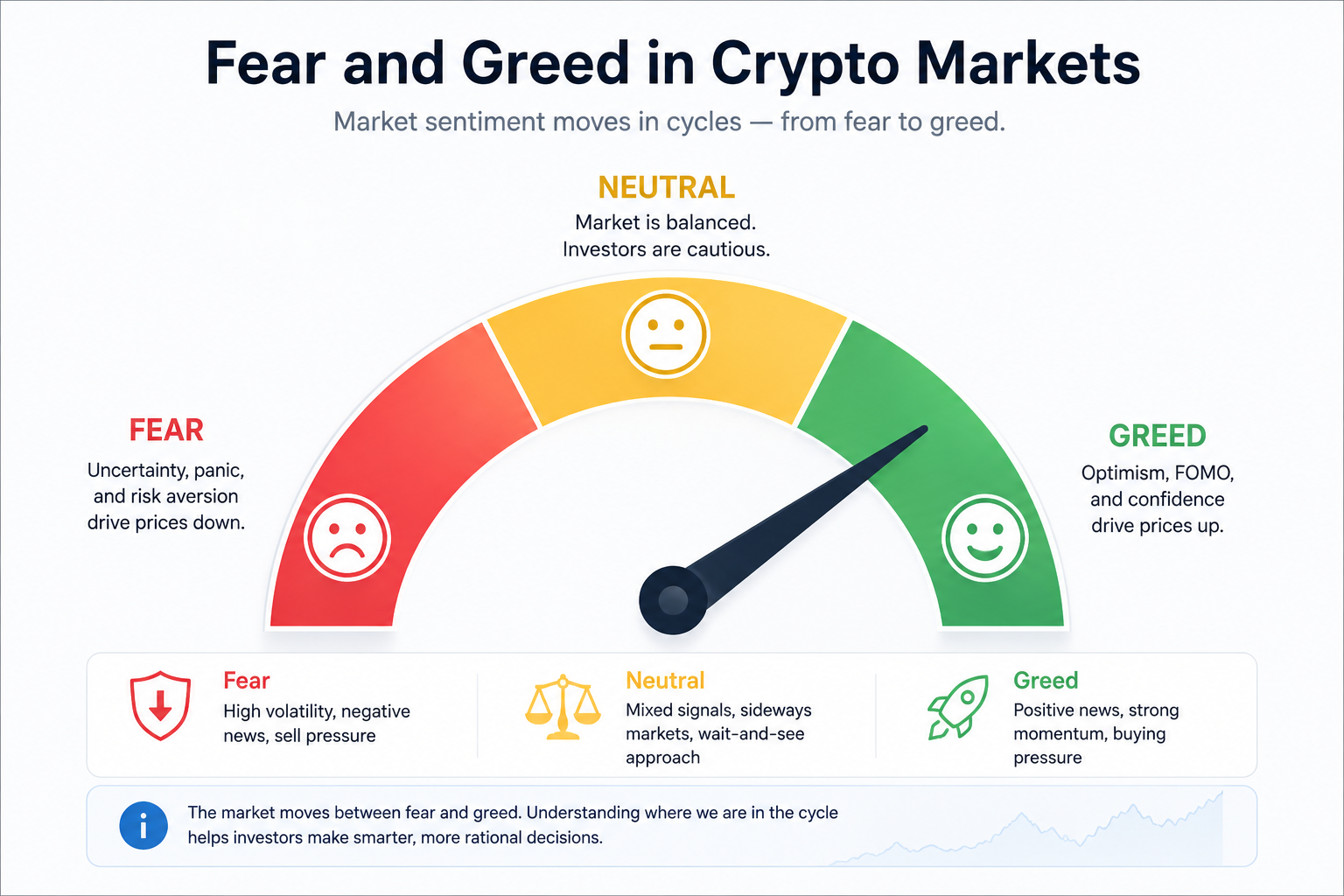
One of the most recognizable applications of sentiment analysis is measuring fear and greed. These emotional extremes often influence market cycles by affecting how investors respond to uncertainty or opportunity.
During periods of extreme fear, participants may sell assets rapidly because they expect further declines. In contrast, extreme greed can encourage excessive risk-taking and speculative buying as investors chase rising prices.
Neither condition guarantees a reversal or continuation of the trend. Instead, these readings provide context about prevailing emotions. Analysts often use them as warning signs that market behavior may have become disconnected from objective evidence.
The most effective approach combines fear-and-greed observations with broader research, including technical analysis, blockchain data, and macroeconomic developments. This helps investors avoid emotional decisions while maintaining a disciplined and evidence-based strategy.
A visual guide to the Fear and Greed cycle in cryptocurrency markets, explaining how investor emotions and market sentiment can influence volatility, buying pressure, and selling behavior.
Sentiment Analysis vs Technical Analysis
Sentiment analysis and technical analysis examine markets from different perspectives. Technical analysis studies historical price action, chart patterns, and trading volume to identify potential trends or momentum. Sentiment analysis, by contrast, evaluates investor emotions, public narratives, and market psychology.
Sentiment Analysis
Technical Analysis
Focuses on investor behavior and emotions
Focuses on price action and chart patterns
Uses news, social media, and discussions
Uses indicators, candlesticks, and volume
Measures bullish or bearish sentiment
Measures trend strength and momentum
Can detect narrative shifts
Can identify support and resistance levels
Neither approach is universally superior. Many professional researchers use both methods together because they answer different questions. Sentiment may explain why traders behave a certain way, while technical analysis helps determine where important price levels and market structures exist.
Sentiment Analysis vs On-Chain Analysis
Although both methods contribute valuable insights, they rely on different datasets.
Sentiment analysis examines human behavior by tracking news coverage, public discussions, and investor psychology. On-chain analysis studies blockchain activity, including wallet movements, transaction volume, exchange flows, and network participation.
For example, highly positive sentiment across social media may suggest growing optimism. However, if on-chain metrics show large transfers to exchanges or declining network activity, analysts may question whether that optimism reflects sustainable demand.
Combining behavioral signals with blockchain evidence provides a more balanced framework for evaluating cryptocurrency markets.
Benefits of Using Sentiment Analysis
When applied responsibly, sentiment analysis offers several practical advantages:
Detects changes in market mood before they become obvious in price charts.
Adds behavioral context to technical and fundamental research.
Helps identify fear- or hype-driven market conditions.
Supports risk awareness during periods of extreme optimism or pessimism.
Improves understanding of narrative-driven volatility in cryptocurrency markets.
Encourages analysts to monitor external events rather than relying only on historical prices.
Most importantly, sentiment analysis reminds investors that markets reflect human decisions as much as numerical data.
Limitations and False Sentiment Signals
Despite its usefulness, sentiment analysis has significant limitations.
Online discussions may contain misinformation, automated bot activity, coordinated promotions, or emotionally charged reactions that do not reflect broader market conditions. News headlines can also exaggerate events to attract attention, creating temporary spikes in optimism or fear.
Another challenge involves interpreting sarcasm, humor, and cultural context. Even sophisticated natural language processing models occasionally classify these expressions incorrectly.
Analysts should also recognize that strong sentiment does not guarantee future price direction. Markets can continue rising despite negative headlines or decline during periods of apparent optimism.
For these reasons, sentiment analysis works best as a supporting research layer rather than a standalone forecasting system.
When evaluating emotional market narratives, verifying the credibility of information sources through a trust score analysis can help reduce the impact of misinformation and coordinated campaigns.
Practical Sentiment Analysis Workflow for Analysts
A structured workflow improves consistency and reduces emotional decision-making.
Monitor financial news and major market events.
Review social discussions across relevant communities.
Identify whether sentiment appears predominantly bullish, bearish, or neutral.
Compare emotional signals with price action and trading volume.
Validate observations using blockchain and macroeconomic data.
Reassess conclusions if new information contradicts the original narrative.
Apply disciplined risk management before acting on any market view.
This process encourages evidence-based analysis instead of reactive trading based on headlines or viral posts.
Common Mistakes When Reading Market Sentiment
Many investors misuse sentiment analysis by assuming that positive discussions automatically predict higher prices or that fear always creates buying opportunities.
Common mistakes include:
Following social media trends without verification.
Ignoring technical or on-chain confirmation.
Overreacting to sensational news headlines.
Confusing popularity with long-term value.
Allowing FOMO or panic to influence decisions.
Trusting a single data source instead of multiple independent inputs.
Avoiding these errors helps maintain a balanced research process and improves decision quality over time.
Conclusion
Using sentiment analysis in market analysis helps investors understand the emotional and psychological forces that influence cryptocurrency markets. By examining news coverage, social discussions, and investor behavior, analysts gain insights that price charts alone may not reveal.
However, sentiment should never be viewed as a standalone predictor of market direction. The strongest research combines behavioral signals with technical analysis, on-chain metrics, macroeconomic context, and disciplined risk management. This multi-layer approach reduces bias, improves decision-making, and provides a more complete understanding of rapidly changing financial markets.
How to Detect Fake or Distorted Sentiment
Compare unique authors with total post volume; repeated messages may be coordinated.
Check account age, posting patterns and engagement quality.
Trace news to the original announcement, filing or regulator notice.
Separate spot demand from leveraged positioning.
Compare providers because sentiment indexes use different inputs.
Practical Four-Layer Confirmation
Event: verify the primary source and timestamp.
Sentiment: record direction, magnitude and methodology.
Market: check price, volume, liquidity, funding and open interest.
Risk: define what evidence invalidates the interpretation.
Frequently Asked Questions About Crypto Sentiment Analysis
What is crypto sentiment analysis?+
It is the process of measuring market mood from sources such as news, social activity, sentiment indexes, funding rates, open interest and search behavior.
Is extreme fear a buy signal?+
No. Fear can persist while prices continue falling. Treat an extreme reading as context and confirm it with market structure, liquidity and risk limits.
Which crypto sentiment indicator is best?+
No single indicator is best. Compare provider methodology and combine broad mood, news quality, social integrity and derivatives positioning.
How do bots affect social sentiment?+
Bots and coordinated accounts can inflate post volume, repeat narratives and create fake engagement. Check unique authors, account history and engagement quality.
Can AI sentiment analysis predict crypto prices?+
AI can classify text and summarize narratives, but results depend on data quality and can miss sarcasm, manipulation or regime changes. It cannot guarantee price predictions.
How this guide was prepared
Sources, review and methodology
Claims should be supported by the primary or authoritative sources linked in the article. Analysis and uncertainty are identified separately from established facts.
The Forvest Research Team combines human expertise and AI-driven analysis to deliver reliable, data-backed insights. Each article is reviewed collaboratively to help investors understand market trends and manage risk more effectively.
A crypto exchange trust score is a screening signal—not a safety guarantee. Before depositing funds on an exchange, broker, lending service, or crypto platform, use the score to…
A crypto profit calculator should show net profit after fees—not just the difference between buy and sell prices. The correct workflow depends on whether you are calculating a…
AI crypto tools can speed research, monitoring, pattern detection and portfolio summaries, but they require source checks, validation, minimum permissions and human risk controls.