

Understanding Modern Bitcoin Analysis
A Bitcoin Analyst evaluates market conditions by combining technical analysis, blockchain data, macroeconomic trends, and investor sentiment to build a comprehensive view of Bitcoin. Instead of relying on a single chart or indicator, a Bitcoin Analyst reviews multiple sources of information to estimate probabilities, identify risks, and support informed investment decisions.
Many professionals also consider a Bitcoin trust score to evaluate the credibility and overall strength of market signals before incorporating them into broader investment research.
As Bitcoin has become a globally recognized financial asset, analyzing its market behavior requires more than watching price charts. Institutional demand, exchange activity, liquidity conditions, regulatory developments, and blockchain metrics all shape market performance. Because of these factors, professional research follows a structured process rather than intuition or speculation.
The objective is not to predict the future with certainty but to evaluate possible outcomes using reliable evidence. For that reason, experienced analysts continuously update their assumptions as new information becomes available.
That process also includes verifying crypto news and market context before treating regulatory, institutional, or macro headlines as evidence.
Core Responsibilities of a Bitcoin Analyst
A professional Bitcoin Analyst combines different forms of research before reaching a conclusion. Instead of focusing on one signal, the goal is to confirm market conditions from several perspectives.
| Responsibility | Purpose |
|---|---|
| Monitor price action | Identify trends, momentum shifts, and key support or resistance levels. |
| Review on-chain metrics | Evaluate wallet activity, exchange flows, and blockchain participation. |
| Analyze technical indicators | Confirm market structure using RSI, MACD, moving averages, and similar tools. |
| Assess macroeconomic conditions | Understand how inflation, interest rates, and liquidity may affect Bitcoin. |
| Track market sentiment | Measure investor behavior and interpret important news developments. |
| Evaluate risk factors | Identify downside scenarios before making strategic conclusions. |
Rather than trusting a single indicator, a Bitcoin Analyst compares evidence from multiple datasets to build a balanced and objective market outlook.
Skills Needed for Bitcoin Market Research
Effective market research requires both technical knowledge and critical thinking. Analysts must understand how different variables interact and recognize when changing conditions require a revised interpretation.
Important skills include:
- Technical chart analysis.
- Understanding blockchain metrics and network activity.
- Knowledge of market cycles and volatility.
- Awareness of macroeconomic developments.
- Risk management and probability-based planning.
- Objective reasoning and analytical discipline.
- Clear communication of research findings.
An experienced Bitcoin Analyst also remains flexible. Instead of defending previous assumptions, successful professionals adjust their outlook when new evidence contradicts earlier conclusions.
Bitcoin Analyst vs. Crypto Trader
Although the two roles often overlap, they serve different purposes.
| Bitcoin Analyst | Crypto Trader |
|---|---|
| Focuses on research and market evaluation | Focuses on executing buy and sell decisions |
| Studies technical, on-chain, and fundamental data | Prioritizes trade timing and position management |
| Builds probability-based scenarios | Applies predefined trading strategies |
| Produces market insights and reports | Manages active positions |
| Supports informed decision-making | Seeks opportunities through market execution |
A Bitcoin Analyst concentrates on understanding market conditions before capital is committed, while a trader uses that research to decide when and how to enter or exit positions. In practice, both roles complement each other, but neither can eliminate uncertainty from financial markets. Disciplined analysis and sound risk management remain essential for long-term success.
How a Bitcoin Analyst Evaluates Market Conditions
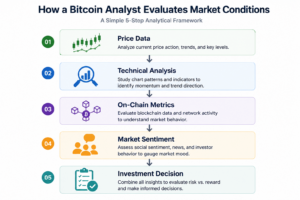
A successful Bitcoin Analyst rarely depends on a single source of information. Instead, the research process combines several layers of analysis to understand whether market signals support or contradict each other. This approach reduces bias and helps build a more balanced investment thesis.
The first step usually involves reviewing price action and market structure. Analysts examine trends, support and resistance levels, and momentum to understand how buyers and sellers are behaving. However, charts alone cannot explain why the market is moving.
The second step focuses on blockchain activity. Wallet behavior, exchange flows, transaction volume, and network participation often provide additional context that traditional charts cannot reveal. These metrics help analysts determine whether market activity reflects accumulation, distribution, or changing investor confidence.
Macroeconomic conditions also play an important role. Interest rate decisions, inflation expectations, liquidity, and regulatory developments can influence demand for Bitcoin across global markets. As a result, many professionals review economic events alongside technical and blockchain data before updating their outlook.
Finally, market sentiment helps explain how participants react to news and uncertainty. Social discussions, media coverage, and investor positioning can amplify trends or create short-term volatility even when underlying fundamentals remain unchanged.
Comparing the Main Sources of Bitcoin Analysis
| Analysis Type | Primary Focus | Typical Insights |
|---|---|---|
| Technical Analysis | Price action and chart patterns | Trends, momentum, and key market levels |
| On-Chain Analysis | Blockchain activity | Wallet behavior, exchange flows, and network participation |
| Fundamental Analysis | Adoption and long-term drivers | Scarcity, utility, and ecosystem growth |
| Macroeconomic Analysis | Economic conditions | Liquidity, inflation, interest rates, and policy changes |
| Sentiment Analysis | Investor psychology | Market expectations, narratives, and emotional reactions |
Professional research becomes more reliable when these perspectives support the same conclusion instead of being evaluated in isolation.
Why On-Chain Metrics Matter in Bitcoin Research
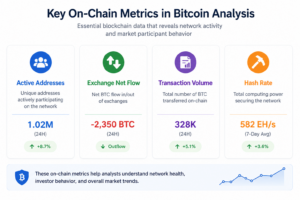
Unlike many traditional assets, Bitcoin provides transparent blockchain data that anyone can examine. This transparency gives analysts access to information that would not normally be available in conventional financial markets.
These insights become even more valuable when combined with blockchain analysis, which helps researchers interpret wallet activity, transaction patterns, and network behavior beyond price movements.
Common observations include wallet activity, exchange inflows and outflows, miner behavior, and transaction patterns. Together, these metrics help explain how participants interact with the network beyond simple price changes.
When interpreted carefully, blockchain data may reveal shifts in market participation before they become obvious on price charts. Even so, experienced researchers avoid drawing conclusions from a single metric and instead compare multiple indicators before updating their analysis.
The Influence of Macroeconomic Events and Market Sentiment
Bitcoin does not operate in isolation. Global economic developments frequently affect investor behavior and capital flows.
Changes in monetary policy, inflation expectations, and financial market liquidity can alter demand for risk assets, including digital currencies. At the same time, major headlines, regulatory announcements, and institutional adoption may quickly influence sentiment across the market.
For this reason, a Bitcoin Analyst often reviews economic calendars and significant news events alongside blockchain metrics and technical signals. Combining these perspectives helps create a more complete understanding of market conditions while reducing the likelihood of reacting to temporary noise.
A Structured Daily Workflow for Bitcoin Research
Maintaining a consistent routine allows analysts to evaluate markets objectively instead of reacting emotionally.
A typical workflow may include:
- Review overnight price movements and overall market structure.
- Examine blockchain activity and notable changes in network behavior.
- Check macroeconomic news and scheduled economic events.
- Evaluate investor sentiment and major industry developments.
- Compare findings across multiple datasets before updating conclusions.
- Document observations and reassess risk rather than relying on assumptions.
This disciplined process helps transform raw information into actionable insights while supporting long-term consistency in market evaluation. Rather than chasing every short-term movement, experienced professionals focus on evidence, probability, and continuous review before making strategic decisions.
Common Mistakes That Can Mislead Bitcoin Analysis
Even experienced professionals can reach incorrect conclusions if they rely too heavily on one source of information. A skilled Bitcoin Analyst understands that every dataset has limitations and that meaningful insights usually come from comparing multiple perspectives rather than following a single signal.
One common mistake is placing too much emphasis on short-term price movements. A sudden breakout or decline may attract attention, but without confirmation from volume, blockchain activity, or broader market conditions, the move may prove temporary. Reacting too quickly often leads to poor decision-making.
Another frequent error is ignoring the broader economic environment. Bitcoin does not exist in isolation. Inflation expectations, interest rate decisions, liquidity conditions, and regulatory announcements can influence investor behavior and reshape market sentiment within hours.
Confirmation bias also affects research quality. Analysts sometimes search only for information that supports their existing opinion while overlooking contradictory evidence. Maintaining objectivity and challenging assumptions are essential habits for producing balanced market analysis.
Finally, many beginners confuse probability with certainty. Even when several indicators align, uncertainty always remains. The role of a Bitcoin Analyst is to improve decision quality through evidence-based research, not to guarantee future outcomes.
Best Practices for Reliable Bitcoin Analysis
Developing a structured methodology is more important than finding the perfect indicator. Analysts who follow consistent processes often make better long-term decisions than those who constantly switch strategies.
The following practices help improve research quality:
- Combine technical, on-chain, and macroeconomic perspectives before drawing conclusions.
- Review market conditions across different timeframes instead of focusing only on intraday movements.
- Validate technical signals with blockchain activity whenever possible.
- Monitor news and regulatory developments that could change investor expectations.
- Document assumptions and revisit them as new information emerges.
- Apply disciplined risk management regardless of market confidence.
- Remain flexible and update conclusions when evidence changes.
These habits encourage objective thinking and reduce emotional reactions during periods of high volatility.
Decision Framework Used by a Bitcoin Analyst
Instead of relying on intuition, many professionals follow a repeatable framework that organizes research into logical steps.
| Research Area | Key Question | Purpose |
|---|---|---|
| Price Structure | Is the market trending or consolidating? | Understand overall direction. |
| Technical Signals | Do indicators confirm momentum? | Validate price action. |
| On-Chain Activity | Are wallets and exchange flows supportive? | Measure blockchain behavior. |
| Macroeconomic Conditions | Could external events affect demand? | Evaluate broader financial context. |
| Market Sentiment | Are investors becoming optimistic or cautious? | Identify emotional extremes. |
| Risk Assessment | What could invalidate the current thesis? | Prepare for uncertainty. |
Following a structured framework encourages consistency and reduces the temptation to react emotionally to short-term volatility.
How Bitcoin Analysis Continues to Evolve
The responsibilities of a Bitcoin Analyst continue to expand as the digital asset ecosystem matures. Modern research increasingly incorporates institutional participation, exchange-traded products, blockchain transparency, quantitative models, and alternative data sources alongside traditional market analysis.
Artificial intelligence, machine learning, and predictive analytics may also assist research by identifying recurring patterns within large datasets. However, these technologies should complement human judgment rather than replace it. Context, experience, and critical thinking remain essential when interpreting market conditions. Readers interested in the underlying principles of machine learning can explore educational resources from MIT OpenCourseWare to better understand how data-driven models recognize patterns and improve over time.
At the same time, growing institutional adoption has increased the importance of liquidity analysis, portfolio allocation strategies, and macroeconomic monitoring. Analysts now evaluate Bitcoin not only as a technology-driven asset but also as part of the broader global financial landscape.
Conclusion
The role of a Bitcoin Analyst extends far beyond reading charts or following market headlines. Effective analysis combines technical research, blockchain data, macroeconomic developments, and investor sentiment into a structured decision-making process that emphasizes evidence over emotion.
No single model or indicator can predict future market movements with certainty. Instead, the strongest analytical frameworks rely on confirmation across multiple data sources, disciplined risk management, and continuous reassessment as conditions evolve.
Whether you are an investor, researcher, or active trader, understanding how a Bitcoin Analyst approaches the market can help you evaluate information more critically and make more informed decisions in an increasingly complex digital asset landscape.