What Machine Learning Backtesting Means in AI Trading

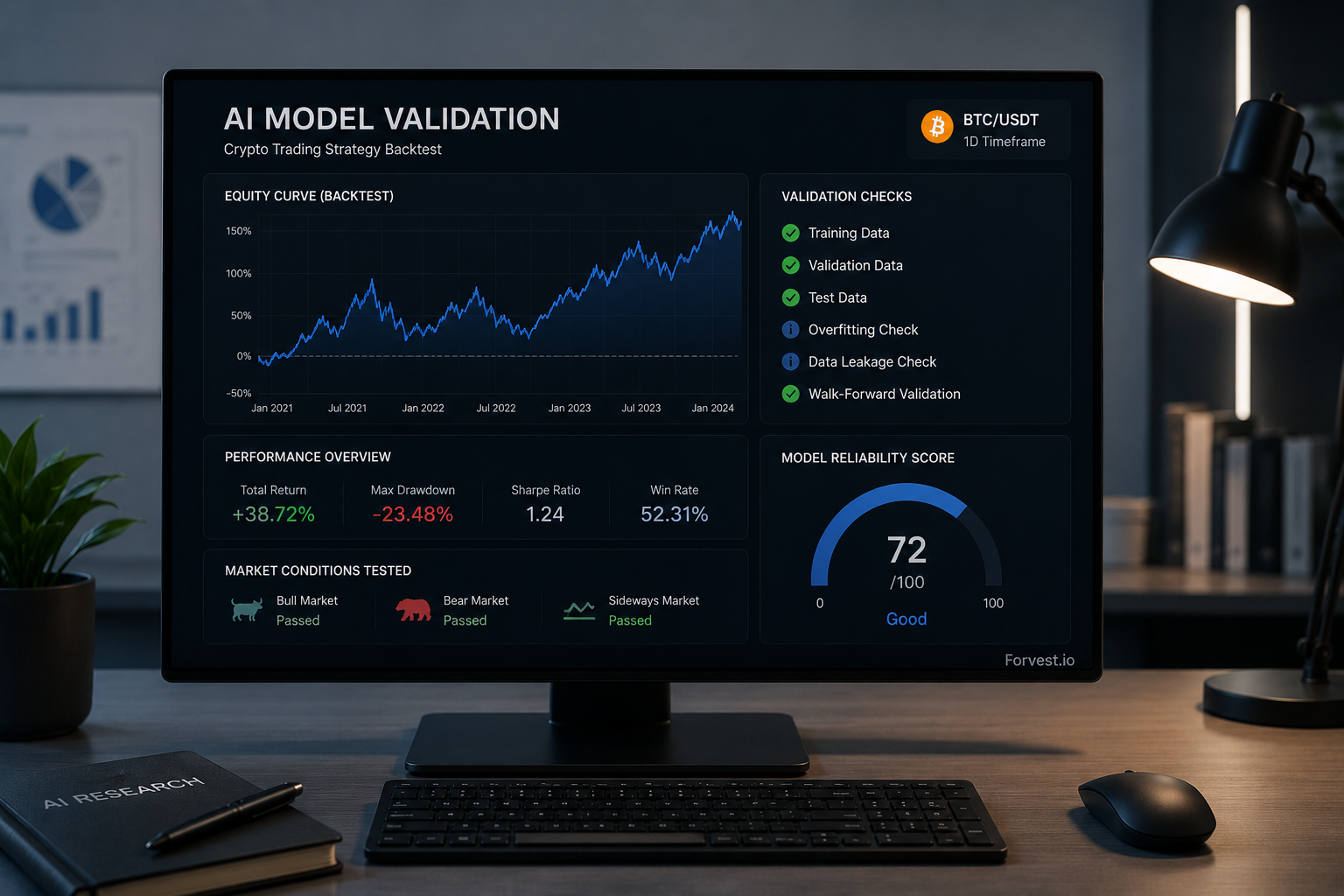
Machine learning backtesting dashboard showing AI trading model validation, overfitting checks, data leakage detection, walk-forward validation, and cryptocurrency market testing results.
0
13 Minutes

Machine learning backtesting can be dangerous when traders mistake historical success for real-world reliability. A profitable backtest may look convincing on paper, but it can still fail when a crypto trading model faces live volatility, shifting liquidity, slippage, fees, and sudden market regime changes.

That is the central challenge with validating AI trading models.

Machine learning backtesting is the process of testing an AI trading model against historical market data to evaluate how its signals might have performed in the past. In cryptocurrency markets, this may include Bitcoin price history, Ethereum volatility, trading volume, technical indicators, on-chain data, sentiment signals, and broader market conditions. While many traders rely on popular technical indicators to generate trading signals, historical validation is still necessary to determine whether those signals remain reliable across different market environments.

Machine learning backtesting is the process of evaluating an AI trading model using historical market data to estimate how its signals might have performed under past market conditions.

The goal is not to prove that the model will make money.

The goal is to discover whether the model has learned something useful—or whether it has simply memorized the past.

Why Historical Success Can Be Misleading

This distinction matters because machine learning models can create false confidence. A model may appear intelligent because it identifies complex relationships within historical data, yet some of those relationships may simply reflect random market noise rather than repeatable behavior.

Overfitting is one of the most common reasons why a profitable backtest fails in live markets. Instead of learning durable market patterns, an overfit model learns the unique characteristics of a specific historical dataset.

How Overfitting and Data Bias Distort Results

Common problems such as overfitting, data leakage, and look-ahead bias often make AI trading models appear far more reliable than they really are. These issues can inflate performance metrics, hide weaknesses, and create unrealistic expectations before a model ever reaches live markets.

That is where traders often fool themselves.

A model may rely on future information without the developer realizing it. Another may perform well only because hundreds of parameter combinations were tested before selecting the strongest historical result. Some models also ignore real-world trading realities such as exchange liquidity, commissions, spreads, execution delays, and sharp crypto market crashes.

In other words, a backtest can make a weak AI trading model look stronger than it really is.

AI Validation Challenges in Cryptocurrency Markets

Platforms that use AI-driven crypto analysis, including predictive and risk-monitoring systems such as Fortuna, face the same validation challenge: historical performance should be examined carefully before investors place trust in model outputs.

For readers exploring different testing approaches, understanding the difference between backtesting vs forward testing is especially important because historical validation and real-time simulation answer different questions. Likewise, learning how machine learning improves backtesting and strategy optimization can provide additional context on how models learn from data without turning historical patterns into false certainty.

Why Backtesting Is Validation, Not Proof

Backtesting should function as a stress test, not a victory lap. The objective is not to confirm that a model works. The objective is to discover where it might fail.

This approach aligns with established model validation principles in quantitative finance research, where historical testing is used to evaluate robustness rather than guarantee future performance.

Backtesting Question Why It Matters
Did the model work only on historical data? Strong past results may not generalize.
Was future information accidentally included? Data leakage can create fake accuracy.
Did the test include fees and slippage? Live results often weaken after real costs.
Did the model survive different market regimes? Bull, bear, and sideways markets behave differently.
Was performance checked on unseen data? Out-of-sample testing reduces false confidence.
Did the model experience crypto market crashes? Stress periods reveal hidden weaknesses.
Did the model perform across multiple market cycles? Robust models survive changing conditions.
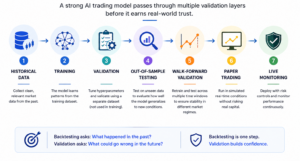
AI trading model validation framework infographic showing historical data, training, validation, out-of-sample testing, walk-forward validation, paper trading, and live monitoring in the machine learning backtesting process.

Machine learning backtesting is only one stage of AI trading model validation. Robust models must also pass out-of-sample testing, walk-forward validation, paper trading, and live monitoring before investors can trust their performance.

Looking Beyond Backtest Performance

This framework matters because AI trading models do not fail only when predictions are wrong. They also fail when the validation process is weak.

A strong validation process tests whether a model can handle uncertainty. It separates genuine signals from historical coincidence and encourages traders to look beyond headline statistics such as profit, accuracy, or win rate.

The most important insight is simple:

Backtesting does not answer, “Will this model make money?” It answers, “What could go wrong if I trust this model?”

That mindset helps traders avoid one of the biggest risks in AI-driven investing: overconfidence built on historical results alone.

The First Step, Not the Final Answer

Machine learning backtesting becomes valuable when traders treat it as the first layer of validation rather than the final answer. After that, they still need out-of-sample testing, walk-forward validation, forward testing, live monitoring, and risk management.

Only then can investors begin to understand whether an AI trading model has practical value beyond historical performance.

To understand why even strong-looking results can fail under real market conditions, the next step is to examine the biggest trap in AI model validation: why profitable backtests often mislead traders before live markets expose the weakness.
Why Profitable Backtests Can Mislead Traders

A profitable backtest is often where problems begin.

Most traders assume that strong historical performance is evidence that an AI trading model works. The logic seems reasonable. If a model generated profitable signals across years of historical data, it should continue performing well when deployed in live markets.

Unfortunately, that assumption has destroyed countless trading strategies.

This often happens due to overfitting, where a model performs well on historical data but fails to generalize to new market conditions. The model appears robust because it has learned historical patterns extremely well. In reality, some of those patterns may never appear again once market conditions change.

The issue is not that backtesting is useless. The issue is that historical profitability and real-world reliability are not the same thing. A model can generate impressive results in a controlled testing environment while remaining fragile when market conditions evolve.

This is especially true in cryptocurrency markets, where volatility, liquidity, and market structure change far more rapidly than many traditional financial markets.

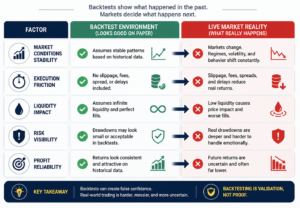
Comparison of AI trading backtest assumptions versus real market conditions showing differences in execution friction, liquidity, risk visibility, and profit reliability in machine learning backtesting.

Profitable backtests often fail in real markets because they ignore execution friction, liquidity constraints, and changing market regimes, leading to overestimated performance in AI trading models.

The Problem With Looking Only at Returns

Profit alone is a misleading metric in machine learning backtesting because it ignores risk, market context, and the stability of performance across different market conditions.

One of the most common mistakes traders make is focusing exclusively on returns.

A backtest shows a strategy generated a 200% return.

The model appears successful.

The strategy gets deployed.

Months later, performance collapses.

The problem is that profit alone reveals very little about the quality of an AI trading model.

Two trading systems may produce similar returns while carrying completely different levels of risk. One may achieve those returns through stable performance across multiple market environments. Another may depend entirely on a single bull market or a handful of unusually profitable trades.

Without deeper validation, both models can appear equally attractive.

This creates a dangerous illusion.

Historical returns often become the headline metric, while more important questions remain unanswered.

What Backtests Often Hide

A backtest can show what happened.

It cannot automatically explain why it happened.

For example, an AI trading model may appear highly accurate because it learned patterns from a period when Bitcoin experienced a powerful upward trend. During those conditions, many trading strategies perform well simply because the market environment is supportive.

The challenge emerges when conditions change.

A model that looked impressive during a bull market may struggle during prolonged consolidation, declining liquidity, elevated uncertainty, or sharp risk-off conditions.

This is why experienced quantitative researchers rarely evaluate performance using profit alone. As emphasized in quantitative finance research and CFA Institute model validation frameworks, historical returns represent only one part of a much larger validation process.

Context matters.

The Backtest Reality Check Framework

Question Why It Matters False Interpretation
Did performance rely on one market cycle? Results may disappear when conditions change. The model works in every market environment.
Did returns come from a small number of trades? A few outliers can distort results. The strategy is consistently profitable.
Did drawdowns remain manageable? High returns often hide excessive risk. Higher returns automatically mean a better model.
Did the model perform across bull and bear markets? Robust systems survive changing regimes. Success in one market cycle proves reliability.
Did performance remain consistent over time? Consistency matters more than isolated success. Short-term success guarantees future performance.

The purpose of this framework is simple:

A profitable backtest should trigger more questions, not more confidence.

Why AI Models Create a Unique Validation Problem

Traditional rule-based strategies typically follow transparent logic.

Machine learning models operate differently.

They analyze large amounts of data simultaneously and identify relationships that may not be obvious to human analysts.

This capability creates opportunities.

It also creates risk.

As model complexity increases, understanding why a prediction occurs becomes more difficult. A machine learning model may discover relationships that appear meaningful but have little or no predictive value outside the historical dataset used during training.

In other words, the model can become extremely good at explaining the past without improving its ability to navigate the future.

This is one of the most common consequences of overfitting.

Developers often optimize for historical performance while unintentionally reducing a model’s ability to adapt to changing market conditions.

The Most Dangerous Outcome: False Confidence

The greatest risk in machine learning backtesting is not necessarily losing money.

The greater risk is developing confidence in a model that has not been properly validated.

A strong backtest can create the illusion that uncertainty has disappeared. Investors may increase position sizes, loosen risk controls, or trust model outputs without sufficient verification.

That behavior often creates larger losses when market conditions eventually change.

The irony is that the better a backtest looks, the more cautious investors should become.

Exceptional historical performance deserves deeper investigation, not automatic trust.

An Insight Most Traders Miss

Many traders believe poor backtests are dangerous.

In reality, exceptionally good backtests can be even more dangerous.

Weak results encourage skepticism.

Outstanding results encourage belief.

And belief is where validation mistakes begin.

The purpose of machine learning backtesting is not to prove that an AI trading model is profitable. The purpose is to determine whether the model remains reliable when market conditions inevitably change.

Understanding why strong results can be misleading leads directly to the next challenge: identifying how overfitting causes AI trading models to learn historical noise instead of durable market behavior. That distinction sits at the heart of reliable model validation and becomes the focus of the next section.

How AI Trading Models Become Overfit

If profitable backtests can be misleading, overfitting is often the reason why.

Overfitting occurs when a machine learning model learns the historical dataset too well. Instead of identifying durable market behavior, it begins to memorize noise, random events, and patterns that existed only in a specific period.

At first glance, this looks impressive.

The model produces strong historical returns, high prediction accuracy, and attractive performance metrics. The backtest appears successful because the model has adapted perfectly to the data it has already seen.

The problem emerges when the model encounters new market conditions.

A model that performs exceptionally well on historical data may struggle immediately when volatility changes, liquidity shifts, or market participants behave differently than they did during the training period.

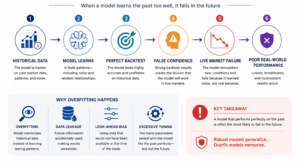
Infographic showing how AI trading models become overfit through historical data learning, perfect backtest results, false confidence, and eventual failure in live cryptocurrency markets.

Overfitting occurs when an AI trading model learns historical market noise instead of durable patterns, creating strong backtest results that often fail under real-world trading conditions.

Why Overfitting Is So Common in AI Trading

Financial markets generate enormous amounts of data.

Machine learning models can analyze thousands of variables simultaneously, including price action, technical indicators, sentiment signals, on-chain activity, and macroeconomic information.

This flexibility creates a hidden danger.

The more variables a model examines, the easier it becomes to discover patterns that appear meaningful but exist only by chance.

Overfitting is not the only source of misleading results. Data leakage can also create false confidence by allowing future information to influence historical predictions. Even a small leak in the validation process can make a trading model appear far more accurate than it would be in live markets. This is why professional quantitative researchers separate training, validation, and testing datasets carefully and avoid using information that would not have been available at the time of a trade.

In cryptocurrency markets, where price behavior changes rapidly and market regimes evolve frequently, this risk becomes even greater.

A pattern that worked during a Bitcoin bull market may completely disappear during a prolonged bear market or a low-volatility environment.

As a result, historical accuracy often creates a false sense of security.

The Overfitting Reality Check

Warning Sign Why It Matters
Extremely high historical accuracy Real markets rarely behave so predictably.
Performance drops sharply on unseen data The model may have memorized the training dataset.
Results depend on one market cycle The strategy may not generalize.
Small parameter changes destroy performance Robust models should remain relatively stable.
Strong backtests but weak paper trading results Historical success may not reflect current conditions.

The key insight is simple:

A model that performs slightly worse during testing may actually be more reliable than a model that appears perfect.

Robust models survive uncertainty. Overfit models survive only the past.

Another important safeguard is walk-forward validation. Instead of testing a model on a single historical period, walk-forward validation repeatedly retrains and evaluates the model across different market environments. This approach helps reveal whether a strategy remains stable when conditions change and reduces the risk of trusting a model that only performed well during one market cycle.

Final Takeaway

Machine learning backtesting provides valuable information, but only when traders understand its limitations. Strong historical performance does not guarantee future success, profitable backtests can create false confidence, and overfitting can make weak models appear far more reliable than they truly are.

The most effective validation process combines backtesting, out-of-sample testing, walk-forward validation, paper trading, risk management, and ongoing monitoring. Rather than asking whether an AI trading model can predict the future, investors should focus on whether the model remains reliable when market conditions inevitably change.

Disclaimer

The information in this article is provided for educational and informational purposes only and should not be considered financial, investment, legal, or tax advice. Machine learning backtesting, AI trading models, and historical performance analysis cannot guarantee future results. All investments involve risk, including the possible loss of capital. Investors should conduct their own research, evaluate their risk tolerance, and consult qualified financial professionals before making investment decisions.

Frequently Asked Questions

Mobina Ebrahimii

Mobina Ebrahimi contributes across Forvest’s SEO, analytics, and content strategy teams. She focuses on improving visibility, performance, and investor engagement through data-driven optimization.

Related blogs

Machine learning backtesting dashboard showing AI trading model validation, overfitting checks, data leakage detection, walk-forward validation, and cryptocurrency market testing results.
1 July 2026 16 Minutes

What Machine Learning Backtesting Means in AI Trading

📚 Table of content Why Historical Success Can Be Misleading How Overfitting and Data Bias Distort Results AI Validation Challenges in Cryptocurrency Markets Why Backtesting Is Validation, Not Proof Looking Beyond Backtest Performance The First Step, Not the Final Answer Why Profitable Backtests Can Mislead Traders The Problem With Looking Only at Returns What Backtests […]

Machine learning backtesting dashboard showing AI trading model validation, overfitting checks, data leakage detection, walk-forward validation, and cryptocurrency market testing results.
1 July 2026 9 Minutes

What Machine Learning Backtesting Means in AI Trading

📚 Table of content Why Historical Success Can Be Misleading How Overfitting and Data Bias Distort Results AI Validation Challenges in Cryptocurrency Markets Why Backtesting Is Validation, Not Proof Looking Beyond Backtest Performance The First Step, Not the Final Answer Why Profitable Backtests Can Mislead Traders The Problem With Looking Only at Returns What Backtests […]

Machine learning backtesting dashboard showing AI trading model validation, overfitting checks, data leakage detection, walk-forward validation, and cryptocurrency market testing results.
1 July 2026 9 Minutes

What Machine Learning Backtesting Means in AI Trading

📚 Table of content Why Historical Success Can Be Misleading How Overfitting and Data Bias Distort Results AI Validation Challenges in Cryptocurrency Markets Why Backtesting Is Validation, Not Proof Looking Beyond Backtest Performance The First Step, Not the Final Answer Why Profitable Backtests Can Mislead Traders The Problem With Looking Only at Returns What Backtests […]

Comments