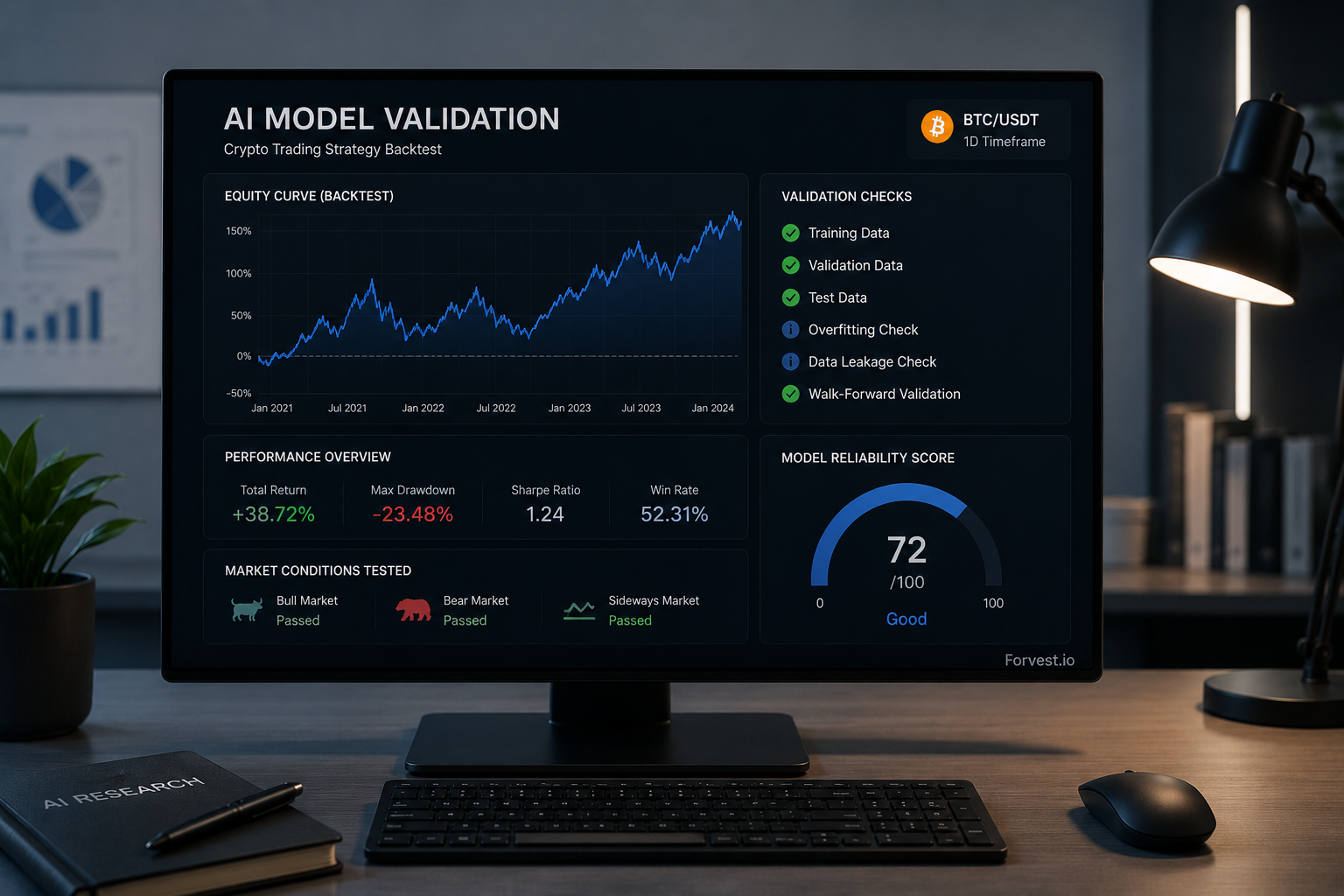


Backtesting vs forward testing is not a choice between two competing methods. A backtest asks how a fixed strategy would have behaved on historical data. A forward test asks how that same frozen strategy behaves on data and execution conditions that were not available when it was designed.
Short answer: use backtesting first to reject weak logic, expose data errors and estimate historical behavior. Then use out-of-sample and forward testing to evaluate stability, costs and execution without repeatedly changing the rules. A strategy should not receive live capital because one historical simulation looks profitable.
Neither method predicts future returns or removes trading risk. Crypto markets can change quickly, liquidity can disappear and automated systems can fail. This article is an educational testing framework—not trading or investment advice.
Backtesting vs Forward Testing at a Glance
| Question | Backtesting | Forward testing |
|---|---|---|
| Data | Historical data | New data arriving after the strategy is frozen |
| Main purpose | Test logic and historical behavior | Test robustness and realistic execution |
| Speed | Fast; many years may be simulated quickly | Slow; evidence accumulates in real time |
| Capital | None | Paper trading or tightly limited live capital |
| Main weakness | Overfitting, leakage and unrealistic assumptions | Small samples, regime dependence and operational differences |
| Best use | Filter and diagnose candidate strategies | Verify behavior before wider deployment |
A complete process usually adds an out-of-sample historical stage between them. This preserves more unseen evidence before the clock-time forward test begins.
What Is Backtesting?
Backtesting applies strategy rules to historical market data and simulates the trades that would have occurred. A reproducible backtest should define:
- the eligible assets and data sources;
- the exact signal and execution timing;
- position sizing, portfolio constraints and risk limits;
- fees, spread, slippage, funding and borrow assumptions;
- delisting, missing-data and corporate or token-event treatment;
- the benchmark and evaluation metrics;
- which data were used for design and which were held out.
The output is a conditional simulation: what would have happened if the dataset were correct, the rules had existed at the time and the modeled orders could have executed as assumed. It is not a record of trades that actually occurred.
What a Backtest Can Show
A good backtest can identify obvious logical failures, estimate turnover and drawdown, compare rules under consistent assumptions and reveal which market regimes supported or damaged the strategy. It can also test sensitivity to fees, delays and parameter changes.
What a Backtest Cannot Prove
A profitable backtest cannot prove that the strategy has a durable edge, that future market structure will resemble the sample or that orders will execute at simulated prices. Past performance remains hypothetical even when the code is correct.
What Is Forward Testing?
Forward testing evaluates a strategy after its rules and parameters have been frozen. Signals are generated as new market data arrive. Orders may be recorded in a paper account or placed with tightly limited live capital.
A forward test can expose problems that historical simulation often hides:
- signal and order latency;
- spread, slippage and partial fills;
- exchange outages, rate limits and rejected orders;
- funding, borrow availability and changing fees;
- time-zone, timestamp and candle-completion errors;
- monitoring, alert and recovery failures;
- the operator’s ability to follow the strategy without intervention.
Paper trading tests live data flow and order logic without market risk, but it may still use idealized fills. Limited live testing adds real execution evidence but also introduces the possibility of loss. Capital should therefore remain subordinate to a written risk limit.
Forward Testing, Out-of-Sample Testing and Walk-Forward Analysis
These terms are related but not identical:
| Method | How it works | Primary question |
|---|---|---|
| Holdout out-of-sample test | Reserve a later historical period that is not used for design | Does the frozen strategy generalize to unseen historical data? |
| Walk-forward analysis | Train or select parameters on one window and test on the next, then roll forward | Does a repeatable development process survive multiple chronological tests? |
| Paper forward test | Generate signals and simulated orders as new data arrive | Does the strategy behave correctly in a live operational environment? |
| Limited live test | Trade small real positions under strict limits | Do real fills, costs and controls remain acceptable? |
Do not call a historical holdout “forward testing†without explaining the distinction. A true clock-time forward test cannot be accelerated.
Why Backtests Become Overfit
Overfitting occurs when a strategy captures noise or sample-specific patterns rather than a relationship likely to persist. The more variations a researcher tries, the easier it becomes to find one that looks successful by chance.
Bailey, Borwein, López de Prado and Zhu’s paper on the probability of backtest overfitting explains why ordinary holdout techniques can be unreliable when many investment backtests are used to select a winner. The practical lesson is to record every trial, not only the final strategy.
| Bias or error | How it inflates results | Control |
|---|---|---|
| Look-ahead bias | The model uses information unavailable at the decision time | Enforce event timestamps and next-tradable-price execution |
| Data leakage | Training receives information from validation or test periods | Split chronologically and fit transformations on training data only |
| Survivorship bias | Failed or delisted assets disappear from the universe | Use point-in-time membership and delisting treatment |
| Multiple testing | The best of many trials looks significant by luck | Log all experiments and adjust expectations for selection |
| Parameter overfitting | Narrow settings are tuned to one historical path | Test neighboring values and prefer stable regions |
| Ideal execution | Trades fill at prices or sizes unavailable in reality | Model spread, slippage, latency, liquidity and rejected orders |
Our guide to machine-learning backtesting covers leakage, time-aware validation and model-specific overfitting in more detail.
A 5-Step Backtest-to-Forward-Test Workflow
1. Write and Freeze the Research Protocol
Before seeing final results, document the hypothesis, rules, assets, sample periods, costs, benchmark, metrics and rejection criteria. Give the strategy and code a version identifier. If the rules change later, create a new candidate rather than quietly editing the old one.
2. Build a Point-in-Time Backtest
Use data that reflect what would have been known at each decision time. Test accounting identities and manually verify several trades. Include realistic execution assumptions and run cost sensitivity rather than a single optimistic estimate.
3. Evaluate Robustness, Not Only Return
Compare performance across assets, subperiods, volatility regimes and nearby parameter values. A strategy that depends on one token, one month or one exact threshold is fragile even if the aggregate curve looks smooth.
Use our crypto market-regime analysis guide to define regimes without using future information.
4. Run an Untouched Out-of-Sample Test
Apply the final frozen rules once to the reserved period. Do not repeatedly adjust the strategy after viewing each holdout result; that converts the holdout into training data. A failed test should normally reject the candidate or require a new documented research cycle.
5. Forward-Test in Stages
- Shadow signals without orders to verify timing and data flow.
- Paper trade using realistic fill and rejection logic.
- Use limited live capital only if predefined gates pass.
- Increase exposure only after enough trades and regimes support the operating assumptions.
- Return to research when a rule or code change is material.
FINRA states that software testing and system validation before production are essential components of effective algorithmic-trading controls. Retail testing is not the same as a regulated firm’s program, but the principle—test code and controls before wider deployment—is still useful.
Define Acceptance Gates Before Seeing Results
A test needs a decision rule. Otherwise every disappointing result can be explained away after the fact. Define both performance and operational gates.
| Gate | Evidence to review | Example rejection reason |
|---|---|---|
| Data integrity | Missing bars, timestamps, symbol changes and duplicates | The sample cannot be reproduced |
| Execution | Fill rate, slippage, latency and rejected orders | Realistic costs remove the expected edge |
| Risk | Drawdown, tail loss, exposure and liquidation conditions | Loss exceeds the written limit |
| Stability | Subperiod, asset, regime and parameter sensitivity | Results depend on one narrow setting |
| Sample adequacy | Number of independent trades and market conditions | Evidence is too small for the decision |
| Operations | Monitoring, alerts, reconciliation and recovery | A failure cannot be detected or stopped safely |
There is no universal minimum number of forward-test days or trades. A high-frequency strategy can generate many correlated trades in a short period, while a slow strategy may need a long time to encounter different regimes. Sample quality matters more than a calendar shortcut.
Compare Backtest and Forward-Test Results Correctly
Do not compare only total return. Reconcile the trade path:
- Were the same signals generated at the same timestamps?
- Did the forward test miss trades because of data or system failures?
- How much difference came from spread, slippage, latency and fees?
- Did position sizes and risk limits match the specification?
- Did market regime and opportunity frequency differ from the backtest?
- Were manual interventions recorded?
The goal is not to force live results to match the historical equity curve. It is to determine whether differences are explainable and whether the strategy still meets the original acceptance gates.
When Backtesting and Forward Testing Disagree
| Pattern | Likely investigation | Response |
|---|---|---|
| Signals differ | Data versions, timestamps, candle completion or code mismatch | Pause and reconcile before interpreting performance |
| Signals match but fills differ | Latency, liquidity, spread, order type or rejection logic | Revise the execution model and re-evaluate viability |
| Costs are much higher | Turnover, funding, borrow or market impact | Reject, resize or redesign under a new version |
| Behavior differs by regime | Structural change or narrow historical dependence | Continue only if regime rules were predefined |
| Forward sample is noisy | Too few independent observations | Continue the frozen test; do not optimize on noise |
Changing rules during the forward test contaminates it. If a material change is necessary, close the current experiment, document the reason and begin a new version with fresh evidence.
Crypto-Specific Testing Costs and Risks
Crypto operates continuously across fragmented venues. A credible test should account for:
- venue-specific prices, depth, fees and outages;
- funding rates, borrow costs and liquidation mechanics;
- token listings, delistings, migrations and supply events;
- stablecoin, bridge, oracle and custody dependencies;
- 24/7 monitoring and stale-data detection;
- minimum order sizes, rate limits and API failures;
- market impact when volume is concentrated or unreliable.
The CFTC has highlighted design, testing, supervision and risk controls as important issues for automated trading systems. Its automated-trading risk-control concept release is directed at derivatives-market environments, not a retail crypto strategy, but it illustrates why system safeguards belong beside performance testing.
Worked Example: A Simple Moving-Average Rule
Suppose a researcher tests a daily rule that holds an asset when a short moving average is above a long moving average and otherwise holds cash. This is an illustration, not a recommended strategy.
- Protocol: define the asset universe, data source, moving-average windows, decision time, next executable price, fee model and benchmark.
- Training: use an early period to form the hypothesis and choose a small, justified parameter set.
- Robustness: compare neighboring windows, higher costs, delayed execution and different regimes.
- Holdout: run the frozen version once on a later untouched historical period.
- Forward test: generate daily signals, record paper orders and compare expected with observed fills.
- Decision: deploy only if risk, cost, stability and operational gates pass—not merely because return is positive.
If ten different moving-average pairs were tried, the experiment log must preserve all ten. Reporting only the best pair hides the selection process and exaggerates confidence.
Use Alerts as Monitoring, Not Validation
Price or condition alerts can help operators observe when a rule triggers during a forward test. Forvest’s Crypto Price Alerts can support threshold monitoring, but an alert does not validate a strategy, place a risk limit or guarantee execution. Every signal should remain tied to the frozen specification and experiment log.
Final Takeaway
Backtesting is a fast way to falsify weak ideas and understand historical behavior. Forward testing is a slower test of robustness, execution and operations on genuinely new information. The defensible workflow uses both, separates research from evaluation, records every trial and gives risk controls the power to reject a profitable-looking strategy.
Disclaimer: This article is for educational and informational purposes only and does not constitute financial, investment or trading advice. Crypto trading involves substantial risk, including possible total loss. Historical and simulated results do not guarantee future performance.