

What Does Predicting Crypto Prices with AI Mean?
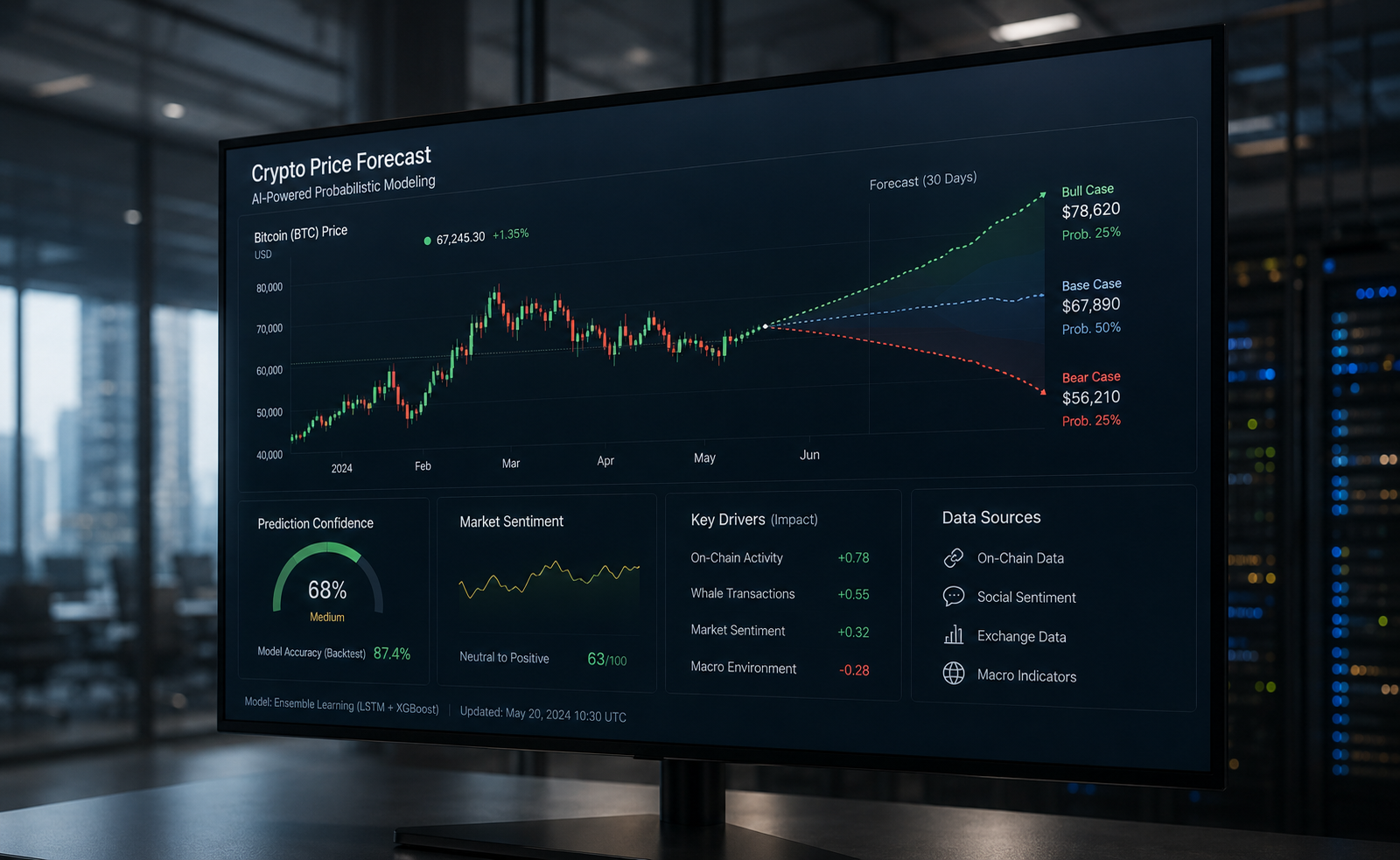
Predicting Crypto Prices with AI means using artificial intelligence to study market data, historical patterns, sentiment, and blockchain activity to estimate possible price scenarios. It does not mean AI can know the future or guarantee the next Bitcoin, Ethereum, or altcoin move.
This distinction matters. Many investors hear “AI crypto prediction” and expect a tool that gives exact price targets. In reality, responsible AI forecasting works more like a research assistant. It helps organize large amounts of information, detect patterns, compare signals, and estimate probabilities.
Crypto markets move fast. Prices can react to news, liquidity, regulations, investor sentiment, exchange activity, and sudden market shocks. No model can fully control or predict all of these factors. However, AI can help researchers process more information in less time and build a more structured view of the market.
A strong AI forecasting process usually looks at:
- Historical price behavior
- Trading volume and volatility
- Market sentiment and news trends
- On-chain activity and wallet movement
- Technical indicators and market structure
- Macroeconomic events and liquidity conditions
The goal is not to ask, “What exact price will Bitcoin reach tomorrow?” A better question is, “What scenarios are more likely based on the available data, and how strong is the evidence?”
Can AI Really Predict Cryptocurrency Prices?
AI can support cryptocurrency price forecasting, but it cannot predict prices with certainty. This is one of the most important points for investors to understand.
AI models can review past data and detect patterns that humans may miss. For example, a model may find that similar combinations of volume, volatility, sentiment, and on-chain activity appeared before previous market moves. That insight can be useful, but it still does not prove the same outcome will happen again.
Crypto markets are affected by many unpredictable events. A regulatory announcement, exchange issue, security breach, large whale movement, or macroeconomic shift can quickly change market direction. Even the best AI model may fail when market conditions change faster than historical data can explain.
| AI Can Help With | AI Cannot Guarantee |
|---|---|
| Finding historical patterns | Exact future prices |
| Estimating possible scenarios | Risk-free decisions |
| Processing large datasets | Perfect timing |
| Comparing market signals | Guaranteed profits |
| Highlighting unusual activity | Protection from sudden shocks |
This is why professional researchers treat AI forecasts as probability-based insights, not final answers. A forecast may suggest a bullish, neutral, or bearish scenario, but the user still needs to validate it with other research methods.
Why Probability Matters More Than Price Targets
Many low-quality crypto prediction pages focus on exact price targets. They may claim that AI expects Bitcoin or another cryptocurrency to reach a specific number by a specific date. This format looks attractive, but it can mislead readers.
A better approach focuses on probability, confidence, and context.
For example, instead of saying:
“AI predicts Bitcoin will reach $X.”
A responsible forecast would say:
“Based on current data, AI identifies a possible bullish scenario, but confidence depends on volume, sentiment, on-chain activity, and broader market conditions.”
This style is more useful because it explains the reasoning behind the forecast. It also helps investors avoid blind trust in a single prediction.
AI forecasting becomes stronger when users ask:
- What data supports this forecast?
- Is the model using current information?
- Does market sentiment confirm the scenario?
- Do technical indicators agree?
- Does on-chain data support or challenge the result?
- What could invalidate this prediction?
These questions turn AI from a hype tool into a practical research layer.
How AI Forecasting Fits Into Crypto Research
AI works best when it supports a broader research process. It should not replace technical analysis, sentiment analysis, on-chain research, or risk management. Instead, it can connect these layers and help users interpret them faster.
For example, AI may detect a rising price trend. Sentiment analysis may show stronger investor confidence. On-chain data may reveal lower exchange inflows, which could suggest reduced selling pressure. If several signals support the same direction, the forecast may become more useful.
Still, users should stay careful. When signals conflict, AI output should trigger deeper research rather than immediate action.
In simple terms, AI forecasting should answer this:
“What does the available evidence suggest?”
It should not answer this:
“What trade should I take right now?”
That difference protects users from overconfidence and keeps the research process more balanced.
The strongest way to use AI is not to chase perfect predictions. It is to understand market scenarios, compare evidence, and make better-informed decisions with clear risk controls.
How AI Forecasting Models Work
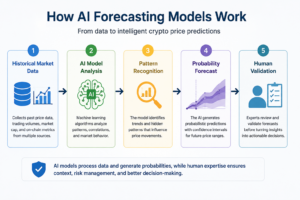
Understanding how AI predicts cryptocurrency prices starts with one simple idea: AI learns from data, not intuition. Instead of making guesses, forecasting models analyze large datasets, identify recurring relationships, and estimate what could happen under similar market conditions. For readers who want a broader understanding of the technology behind these models, IBM’s guide to artificial intelligence offers a helpful overview of the core concepts used in modern AI systems.
Most AI systems begin by collecting information from multiple sources. Historical price charts reveal long-term trends, trading volume shows market participation, and volatility measures the speed of price changes. More advanced models may also examine on-chain activity, macroeconomic events, or investor sentiment to gain additional context.
Rather than relying on a single indicator, AI combines these inputs to create a broader market perspective. This multi-source approach often produces more balanced forecasts than looking at one chart pattern alone.
If you want to explore how artificial intelligence processes market data, sentiment, and blockchain activity beyond forecasting, learning how to Analyze Cryptocurrencies with AI provides the broader research framework behind these predictive models.
Key Data Sources Used in AI Forecasting
| Data Source | How It Supports Forecasting |
|---|---|
| Historical prices | Identifies recurring market patterns |
| Trading volume | Measures buying and selling activity |
| Volatility | Estimates the strength of market fluctuations |
| Technical indicators | Adds momentum and trend signals |
| On-chain metrics | Tracks blockchain behavior and wallet activity |
| Market sentiment | Reflects investor psychology and narratives |
Even with access to rich datasets, AI cannot predict unexpected events. Sudden regulatory announcements, exchange disruptions, geopolitical developments, or major liquidity shifts may quickly invalidate previously reliable patterns.
AI Finds Patterns, Not Certainties
One of the biggest misconceptions is that AI knows where prices will go next. In reality, forecasting models identify statistical relationships between variables and estimate potential outcomes based on historical evidence.
For instance, a model may detect that similar combinations of volume growth, positive sentiment, and declining exchange balances preceded previous rallies. That observation can strengthen a bullish scenario, but it does not guarantee history will repeat itself.
This is why experienced researchers interpret AI forecasts as decision-support signals rather than trading instructions.
Why Combining AI with Other Analysis Matters
The most effective forecasting process does not rely on AI alone. Strong research combines AI-generated insights with technical analysis, market sentiment, on-chain data, and broader market context.
If multiple independent methods point in the same direction, confidence in the overall assessment generally improves. When those methods disagree, investors should investigate further instead of assuming the AI output is correct.
By treating AI as one component of a broader analytical framework, researchers can reduce overconfidence and build more resilient market assessments in rapidly changing cryptocurrency environments.
Limitations of AI Crypto Forecasting and Best Practices for Investors
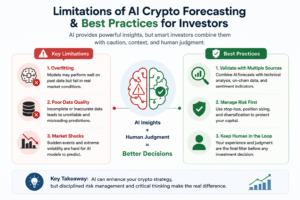
Artificial intelligence can improve research efficiency, but it cannot eliminate uncertainty from cryptocurrency markets. Even the most advanced forecasting model depends on the quality of its data and the assumptions built into it. As markets evolve, those assumptions may no longer hold true, leading to inaccurate predictions.
One common challenge is overfitting. A model may perform extremely well when tested on historical data but struggle when faced with new market conditions. Cryptocurrency markets are dynamic, influenced by innovation, regulation, macroeconomic trends, and unexpected events that cannot always be captured by past patterns.
Another limitation is data quality. Missing information, delayed updates, or biased datasets can reduce forecast reliability. AI systems also have difficulty accounting for rare events such as exchange failures, geopolitical crises, or sudden shifts in investor confidence. These situations can trigger rapid price movements that differ significantly from historical behavior.
When unexpected events reshape market conditions, understanding the underlying news becomes just as important as analyzing price charts. Reviewing structured crypto news analysis can provide the context needed to interpret sudden market reactions and reassess AI-generated forecasts.
Common Challenges in AI Price Forecasting
| Limitation | Potential Impact |
|---|---|
| Overfitting | Strong historical performance but weak future predictions |
| Poor data quality | Misleading or incomplete forecasts |
| Sudden market events | Unexpected price movements beyond model expectations |
| Rapid sentiment shifts | Forecasts become outdated quickly |
| Model drift | Accuracy declines as market conditions change |
Because of these limitations, investors should avoid making decisions based solely on a single AI-generated forecast.
A Practical Framework for Evaluating AI Predictions
The most effective approach is to treat AI as one component of a broader research process rather than the final decision-maker.
Before relying on an AI forecast, consider the following checklist:
- ✅ Review whether technical indicators support the projected scenario.
- ✅ Check if market sentiment aligns with the forecast.
- ✅ Examine relevant on-chain activity and blockchain metrics.
- ✅ Consider recent news, macroeconomic developments, and regulatory changes.
- ✅ Evaluate whether current market conditions differ significantly from historical patterns.
- ✅ Apply appropriate risk management before entering any position.
Because crypto markets can change within minutes, monitoring new developments is just as important as evaluating historical data. If you want to stay informed when significant market events occur, using real-time crypto alerts can help you react quickly before an AI forecast becomes outdated.
When several independent signals point in the same direction, confidence in the overall research may increase. If they conflict, additional investigation is often wiser than acting immediately.
Common Mistakes When Using AI to Predict Crypto Prices
Many investors misuse AI by expecting certainty where only probability exists. Avoiding a few common mistakes can lead to more balanced research and better decision-making.
- Treating AI forecasts as guarantees instead of scenarios.
- Ignoring risk management because a model appears confident.
- Relying on historical patterns without considering changing market conditions.
- Overlooking sentiment, news, or on-chain developments.
- Making rapid trading decisions without independent verification.
Recognizing these pitfalls helps investors use AI more responsibly and reduces the likelihood of acting on misleading signals.
Conclusion
Predicting Crypto Prices with AI is best understood as a process of probability estimation rather than certainty. Artificial intelligence can organize vast amounts of market information, identify meaningful patterns, and support faster research, but it cannot consistently foresee every market movement or guarantee profitable outcomes.
The strongest investment decisions come from combining AI-assisted forecasting with technical analysis, sentiment research, on-chain data, and disciplined risk management. Used responsibly, AI becomes a valuable decision-support tool that helps investors evaluate scenarios more efficiently while keeping human judgment at the center of the research process.