
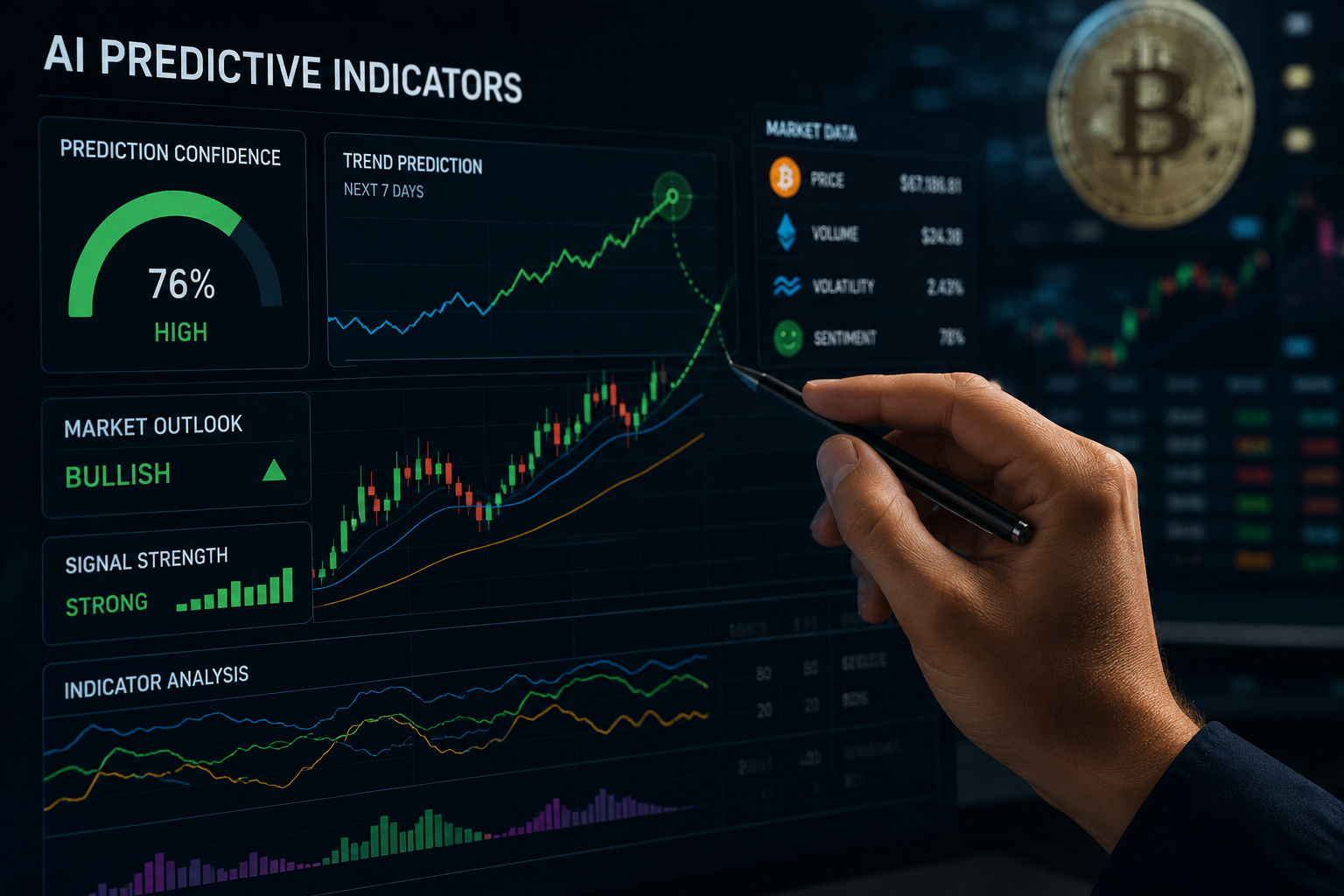
Smart Predictive Indicators are advanced analytical models that estimate the probability of future market movements by analyzing historical and real-time data. Instead of reacting only to past price action, Smart Predictive Indicators combine statistical methods, artificial intelligence, machine learning, and pattern recognition to identify trends that may help traders make more informed decisions.
Cryptocurrency markets move quickly, and prices can change dramatically within minutes. As a result, investors constantly look for better ways to evaluate opportunities and manage risk. Smart Predictive Indicators address that challenge by processing multiple data sources at the same time, including price history, trading volume, market sentiment, and, in some cases, blockchain activity. Consequently, they provide broader insights than many traditional indicators and support a more data-driven approach to market analysis.
Even so, traders should not confuse prediction with certainty. Financial markets respond to unexpected news, shifting investor behavior, and macroeconomic events that no model can fully anticipate. Therefore, Smart Predictive Indicators estimate probabilities rather than guarantee outcomes. Most experienced market participants use these insights alongside technical analysis, sound risk management, and independent research to strengthen their decision-making instead of relying on a single signal.
What Are Smart Predictive Indicators and How Do They Work?
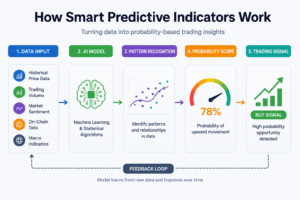
At their core, Smart Predictive Indicators examine large datasets to detect patterns that may precede future price movements. Unlike many conventional indicators, they evaluate relationships among multiple variables instead of relying on a single mathematical formula.
For example, a moving average simply calculates the average price over a selected period. By contrast, a Smart Predictive Indicator may combine that information with volatility metrics, momentum signals, liquidity conditions, historical trends, and predictive analytics to estimate the likelihood of a bullish or bearish scenario.
This multi-layered process helps traders analyze market conditions from different angles instead of depending on isolated signals. As a result, many professionals treat Smart Predictive Indicators as decision-support systems rather than automatic buy or sell generators.
Key Characteristics of Smart Predictive Indicators
| Feature | Smart Predictive Indicators | Traditional Indicators |
|---|---|---|
| Data sources | Price, volume, sentiment, and sometimes blockchain data | Mostly historical price and volume |
| Adaptability | Responds to changing market conditions | Relies on fixed formulas |
| Analysis style | Uses probability and pattern recognition | Confirms existing trends |
| Complexity | Often includes AI or statistical models | Uses simpler mathematical calculations |
| Primary goal | Estimates possible future scenarios | Describes or confirms past behavior |
Successful traders rarely depend on these models alone. Instead, they combine predictive signals with technical analysis, market research, and sound risk management to build stronger trading strategies.
Why Are Smart Predictive Indicators Becoming More Popular?
Several trends have increased interest in Smart Predictive Indicators across financial and cryptocurrency markets.
First, modern computing systems process enormous datasets within seconds. That capability allows predictive models to uncover relationships that manual analysis might overlook.
Next, today’s markets generate far more information than simple price charts. News events, social sentiment, liquidity shifts, and blockchain data all influence market behavior. Smart Predictive Indicators can integrate many of these inputs into one analytical framework, making research more comprehensive.
In addition, traders increasingly recognize the limits of relying on a single indicator such as RSI or a moving average crossover. Combining multiple signals often creates a clearer picture of market conditions and reduces dependence on one metric.
Finally, advances in machine learning encourage developers to build adaptive models that continuously compare historical patterns with new market data. Although these systems cannot eliminate uncertainty, they can highlight situations that resemble previous market conditions and help traders make more informed decisions.
By understanding what Smart Predictive Indicators are—and by recognizing their limitations—investors can use them as practical tools for evaluating probabilities instead of expecting guaranteed predictions.
The Role of AI and Machine Learning in Market Forecasting
Artificial intelligence and machine learning have transformed the way analysts interpret financial markets. Instead of relying on fixed mathematical formulas alone, Smart Predictive Indicators can process large datasets, identify hidden relationships, and adapt to changing market conditions over time. As a result, many modern trading systems use AI-driven techniques to improve signal quality and reduce reliance on a single metric.
Machine learning models work by analyzing historical examples and searching for recurring patterns. For instance, they may evaluate how price movements, trading volume, volatility, and market sentiment interacted during previous bull or bear markets. After identifying these relationships, the models estimate the probability of similar outcomes when comparable conditions appear again.
Readers interested in the broader principles of machine learning can explore introductory educational resources from MIT Open Learning, which explain how data-driven models identify patterns and improve predictions over time.
Even so, these systems do not “predict the future” with certainty. They simply recognize statistical patterns that have appeared in past data. Therefore, traders should always interpret AI-generated signals as additional evidence rather than guaranteed forecasts.
How AI Enhances Predictive Analysis
Unlike traditional indicators that follow predefined calculations, AI-powered models continuously process new information and adjust their internal assumptions. This flexibility allows them to respond more effectively when market conditions evolve.
Some predictive systems combine multiple inputs, including:
- Historical price movements
- Trading volume and liquidity
- Volatility measurements
- Market sentiment from news or social platforms
- Momentum indicators
- On-chain activity in cryptocurrency markets
By evaluating these variables together, Smart Predictive Indicators can produce more comprehensive insights than single-factor indicators alone.
Smart Predictive Indicators vs Traditional Technical Indicators
Although both approaches support market analysis, they serve different purposes and rely on different methodologies.
| Smart Predictive Indicators | Traditional Technical Indicators |
|---|---|
| Analyze multiple datasets simultaneously | Primarily analyze historical price and volume |
| Often use AI or statistical learning models | Use predefined mathematical formulas |
| Estimate probabilities of future scenarios | Confirm existing trends or momentum |
| Adapt as new information becomes available | Produce fixed calculations based on selected periods |
| Support decision-making through pattern recognition | Support analysis through historical signals |
Traditional tools such as RSI, MACD, or moving averages remain valuable because they are transparent, easy to interpret, and widely understood. Meanwhile, Smart Predictive Indicators attempt to combine many of those signals into broader forecasting models.
If you want to explore these traditional methods in more detail, our guide to crypto technical indicators explains how popular signals like RSI, MACD, and moving averages can complement predictive models and improve market analysis.
Common Data Sources Used by Smart Predictive Indicators
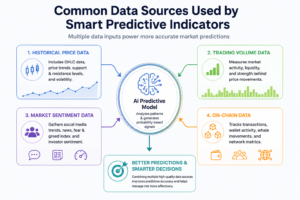
The quality of any predictive model depends heavily on the data it analyzes. Better inputs generally lead to more meaningful outputs, while incomplete or inaccurate information can reduce reliability.
Price history remains the most common foundation because it reflects previous market behavior across different conditions. However, many advanced models expand beyond charts and incorporate several additional sources.
Volume statistics often reveal whether buying or selling pressure supports a price move. Likewise, volatility measurements help estimate changing levels of market uncertainty.
In cryptocurrency markets, developers may also integrate blockchain activity, wallet behavior, exchange flows, and network participation into predictive systems. Combining these metrics with technical analysis creates a richer understanding of overall market conditions. Readers who want to understand these on-chain metrics in greater depth can explore our guide to blockchain analysis, which explains how transaction data and network activity support market research.
Furthermore, sentiment indicators extracted from financial news or public discussions can provide another layer of context. Sudden shifts in investor confidence sometimes influence prices before traditional charts fully reflect those changes.
Why Probability Matters More Than Prediction
One of the biggest misconceptions surrounding Smart Predictive Indicators involves certainty. Many newcomers assume that advanced algorithms can accurately forecast every market movement. In reality, successful predictive systems focus on probabilities instead of guarantees.
A model might estimate that historical conditions resemble previous bullish periods, but unexpected news or macroeconomic events can quickly invalidate that expectation. Consequently, responsible traders combine predictive insights with independent research, disciplined position sizing, and predefined exit strategies.
Rather than replacing human judgment, Smart Predictive Indicators work best as analytical assistants that help users organize information and evaluate possible scenarios. When used in this way, they can strengthen decision-making without creating unrealistic expectations about market certainty.
Key Benefits of Predictive Market Models
When traders use Smart Predictive Indicators correctly, they can improve research and decision-making in several ways. Instead of focusing on a single chart pattern or momentum signal, these systems evaluate multiple variables at once and present a broader market perspective.
One major advantage is the ability to detect emerging trends earlier than many traditional indicators. By combining price action with historical behavior, volatility analysis, and pattern recognition, predictive models may highlight changes before they become obvious on standard charts.
Another benefit is improved consistency. Rather than making emotional decisions during periods of market stress, traders can follow a structured process supported by data-driven insights. This disciplined approach often reduces impulsive actions and encourages more objective analysis.
Smart Predictive Indicators also simplify complex datasets. Large amounts of market information become easier to interpret when algorithms organize them into practical signals or probability-based forecasts. Consequently, investors can spend less time processing raw data and more time evaluating potential scenarios.
Risks and Limitations of AI-Driven Forecasting Models
Despite their advantages, Smart Predictive Indicators have important limitations that every trader should understand.
First, no predictive model can guarantee future price movements. Financial markets respond to unexpected events such as regulatory announcements, geopolitical developments, security incidents, or sudden shifts in investor sentiment. Because of these factors, even sophisticated algorithms may generate inaccurate signals.
Second, many models rely heavily on historical data. While past behavior can provide useful context, markets constantly evolve. Conditions that existed during one cycle may not repeat in the next, reducing the reliability of previously successful patterns.
Another challenge involves overfitting. In some cases, developers build models that perform extremely well on historical datasets but struggle when faced with new market conditions. Proper backtesting and continuous evaluation help reduce this risk but cannot eliminate it completely.
False signals also remain a concern. A predictive model may identify what appears to be a strong opportunity, only for prices to reverse unexpectedly due to external factors. Therefore, traders should always combine predictive outputs with sound judgment and appropriate risk controls.
Smart Predictive Indicators in Cryptocurrency Trading
Cryptocurrency markets offer an environment where predictive analysis can be especially valuable because prices often move rapidly and volatility remains elevated.
Many advanced systems evaluate not only price and volume but also blockchain activity, liquidity conditions, and market sentiment. For example, a predictive model may detect increasing buying pressure while also recognizing improving network activity and favorable momentum. Together, these signals may strengthen confidence in a potential trend.
However, crypto markets frequently experience sudden news-driven moves that no algorithm can anticipate with perfect accuracy. As a result, investors should treat predictive indicators as one component of a broader research framework rather than as standalone trading systems.
Successful market participants often combine predictive analysis with traditional technical indicators, fundamental research, and disciplined portfolio management. This balanced approach provides multiple perspectives before capital is committed.
Best Practices for Using Predictive Trading Models
The most effective strategy is to view Smart Predictive Indicators as decision-support tools instead of automatic trading systems.
Before acting on any signal, traders should:
- Confirm findings with additional technical indicators.
- Review overall market conditions and volatility.
- Consider recent news and sentiment changes.
- Evaluate position size based on acceptable risk.
- Define exit strategies before entering a trade.
- Monitor whether market conditions continue to support the original thesis.
Many traders also combine predictive models with crypto alerts so they can monitor important market conditions automatically instead of watching charts throughout the day. Timely notifications make it easier to react when predefined criteria are met while maintaining a disciplined trading process.
Conclusion
Understanding What Are Smart Predictive Indicators helps traders appreciate both their strengths and their limitations. These advanced systems combine predictive analytics, machine learning, historical data, and pattern recognition to estimate possible market outcomes rather than guarantee them.
Although Smart Predictive Indicators can improve analysis by identifying trends and organizing complex information, they should never replace critical thinking or disciplined risk management. Markets remain uncertain, and unexpected events can quickly change price direction.
For that reason, the best approach is to combine predictive models with traditional technical analysis, broader market research, and sound trading practices. When used responsibly, Smart Predictive Indicators become valuable tools that support smarter, data-driven decisions instead of unrealistic expectations about perfect market forecasts.