

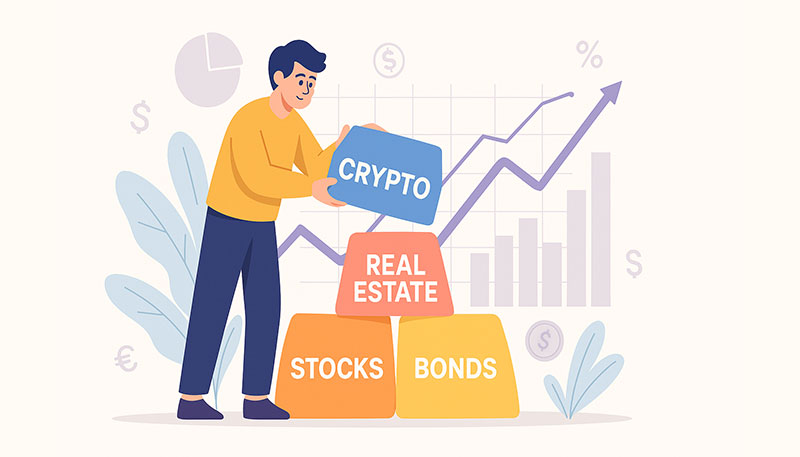
A crypto portfolio for beginners should be simple enough to understand, small enough to survive mistakes and structured before any asset is purchased. The first decisions are not which coins could rise fastest; they are how much total capital can be exposed, how assets will be researched and stored, and what rules will prevent one loss from damaging an essential financial goal.
Short answer: establish an emergency reserve outside crypto, set a maximum crypto budget you can afford to lose, begin with a small number of researched and liquid assets, cap each position, choose secure custody and account controls, buy using a written schedule, and review the portfolio without reacting to every price movement.
Crypto assets can be extremely volatile and less liquid than traditional investments, and they may involve fraud, theft, platform failure and limited investor protections. FINRA’s crypto-asset risk guidance warns that losing the entire investment is possible. This guide is educational and does not provide personalized investment, legal or tax advice.
How to Build a Beginner Crypto Portfolio in 7 Steps
- Prepare your finances before investing.
- Define the goal, time horizon and loss limit.
- Set crypto’s maximum share of your total portfolio.
- Create a simple allocation with concentration limits.
- Research each asset and choose where to buy and store it.
- Enter gradually using a written purchase plan.
- Track, review and rebalance without chasing the market.
Each step is a control. Skipping the early controls and starting with token selection turns the portfolio into a collection of guesses.
Step 1: Prepare Your Finances Before Buying Crypto
Crypto is not a substitute for an emergency reserve, insurance, essential expenses or a plan for high-cost debt. Money needed soon can be forced out of the market at the worst time. Keep near-term obligations outside volatile assets and decide which capital is genuinely available for long-term risk.
| Readiness check | Question to answer |
|---|---|
| Emergency liquidity | Can an unexpected expense be covered without selling crypto? |
| Debt and obligations | Would investing interfere with required payments or essential goals? |
| Time horizon | Can the capital remain invested through a severe and prolonged decline? |
| Loss capacity | What amount could be lost completely without changing essential plans? |
| Record keeping | Can purchases, transfers, fees and disposals be documented? |
| Security readiness | Can accounts, recovery information and devices be protected responsibly? |
If these answers are unclear, the next action is planning—not purchasing. Investor.gov explains that investment choices should reflect time horizon and risk tolerance.
Step 2: Write the Goal, Time Horizon and Loss Limit
A portfolio needs a purpose. “Make money from crypto†is not specific enough to guide risk decisions. Write the objective, expected holding period, maximum crypto allocation and maximum acceptable loss in plain language.
An educational policy might say:
“This is a long-term, high-risk allocation funded only with capital not needed for essential goals. I will not use leverage. I will limit single-asset, platform and speculative exposure, review monthly and change targets only after a documented policy or thesis review.â€
The statement is an example, not a recommended strategy. Its value is that decisions can be checked against a rule created before fear or excitement takes over.
Step 3: Set Crypto’s Maximum Share of the Total Portfolio
The first allocation question is not “Bitcoin or Ethereum?†It is “How much of the total financial portfolio may be in crypto at all?†A portfolio that holds several tokens can still be dangerously concentrated if crypto represents most of the investor’s savings.
There is no universal beginner percentage. The ceiling depends on goals, time horizon, income stability, liquidity needs, other assets and the real ability to accept a total loss. Do not copy an influencer’s allocation or treat an online risk quiz as personalized advice.
Once a ceiling exists, write the exact boundary: which wallets, exchanges, stablecoins, locked positions and cash balances count as part of the crypto portfolio. This prevents assets from being omitted or counted twice.
Step 4: Create a Simple Allocation
A beginner allocation should prioritize clarity over novelty. Use a few defined risk buckets and set a maximum for each one. The table below is a template for organizing research, not a recommended mix:
| Bucket | Purpose | Beginner control |
|---|---|---|
| Higher-liquidity core assets | Primary long-term crypto exposure | Use assets that can be researched, valued and traded responsibly |
| Additional network or sector exposure | Limited diversification beyond the core | Cap shared chain, protocol and narrative risks |
| Stable-value or operational balance | Temporary liquidity inside the crypto workflow | Treat issuer, reserve, redemption, depeg and platform risks explicitly |
| Speculative assets | Optional high-risk learning allocation | Set a combined ceiling and assume every position could go to zero |
Equal weighting is not automatically safer. An equal amount in a liquid, established asset and an early-stage token ignores differences in liquidity, security, supply and downside. A target weight should follow a risk limit and investment thesis.
Read our deeper guide on how to diversify a crypto portfolio to map assets, sectors, networks and counterparties. Use the crypto portfolio allocation framework when you are ready to document target weights.
Step 5: Research Every Asset Before Adding It
A familiar name, large community or exchange listing does not make an asset suitable. Every holding should have a written reason for inclusion and a condition that would invalidate it.
- Purpose: what problem does the network or product solve?
- Token role: why is the token needed, and how does usage affect demand?
- Team and governance: who builds, controls and changes the system?
- Supply: how much circulates, who owns it and when do tokens unlock?
- Security: what has been audited, who holds admin powers and what incidents occurred?
- Adoption: is usage supported by independent evidence rather than promotion?
- Liquidity: can the intended position be bought and sold responsibly?
- Dependencies: which chain, bridge, oracle, stablecoin and service providers can fail?
Use our complete crypto project due diligence checklist. Forvest’s Crypto Trust Score analysis can help organize several credibility and risk signals, but it should support independent verification rather than replace it.
Choose an Exchange, Wallet and Custody Plan
Portfolio risk includes where assets are bought and stored. A strong asset thesis cannot protect funds from a compromised account, fake application, lost recovery phrase or insolvent service provider.
| Decision | What to verify |
|---|---|
| Trading platform | Legal entity, jurisdiction, fee schedule, withdrawal controls, liquidity and incident history |
| Account security | Unique password, supported multifactor authentication, withdrawal allowlist and login alerts |
| Wallet | Official source, supported networks, recovery procedure and device security |
| Self-custody | Secure offline backup, tested recovery process and protection against unauthorized access |
| Transfer | Correct asset, network and address; small test transaction when appropriate |
Self-custody removes some intermediary risk but adds responsibility. Losing a seed phrase, signing a malicious transaction or using the wrong network can create irreversible loss. Never share private keys, recovery phrases or authentication codes with a person, website or support agent.
Step 6: Enter Gradually With a Written Purchase Plan
A beginner does not need to predict the perfect entry. Choose a rule that controls both timing and total exposure. Common educational approaches include:
| Approach | How it works | Main trade-off |
|---|---|---|
| Lump sum | Invest the approved amount at once | Immediate exposure but high timing risk |
| Fixed schedule | Invest equal amounts on predetermined dates | Reduces timing decisions but cannot prevent losses |
| Staged entry | Divide the approved amount into a few planned tranches | Balances speed and timing risk but requires clear rules |
Dollar-cost averaging is a purchase schedule, not a guarantee of profit or a reason to keep buying an asset whose thesis has failed. State the total budget, dates, eligible assets and stop conditions before the first order.
Avoid leverage, borrowed funds and complex derivatives while learning. They can amplify loss, create liquidation risk and make a simple portfolio difficult to understand.
Know the Real Cost of a Purchase
The displayed token price is only part of the cost. Record:
- trading fees on both sides of the transaction;
- bid-ask spread and slippage;
- deposit, withdrawal and network fees;
- currency-conversion costs;
- tax lots, basis and local reporting information.
Small recurring purchases can become inefficient when fees are large relative to the order. Compare the all-in cost with the size and frequency of the plan. Tax treatment differs by jurisdiction, so keep records and obtain qualified advice where needed.
Step 7: Track, Review and Rebalance
Use one base currency and valuation time across all wallets and exchanges. Match transfers between your own accounts so they are not recorded as income, expense or duplicate holdings.
| Field to track | Reason |
|---|---|
| Units and location | Know exactly what is held and where |
| Current and target weights | Identify concentration and allocation drift |
| Cost basis and fees | Measure performance and support records |
| Network and counterparty exposure | Reveal shared dependencies |
| Unlocks and thesis triggers | Know when the research requires review |
| Security review date | Keep account and recovery controls current |
The Forvest Portfolio Management tools can help organize allocation and performance. Software supplies measurements; the investor still defines the boundary, targets and response rules.
Market movements will change weights. Rebalancing restores still-valid targets under a written calendar or tolerance-band rule. It is not a signal to buy every falling asset. Our crypto portfolio rebalancing guide covers drift, thresholds, costs and execution.
A Hypothetical Beginner Portfolio Worksheet
Use a worksheet before choosing percentages. The entries below are placeholders, not recommendations:
| Policy field | Your written decision |
|---|---|
| Total financial goal | ____________________ |
| Crypto portfolio boundary | ____________________ |
| Maximum crypto allocation | ____________________ |
| Maximum acceptable crypto loss | ____________________ |
| Eligible risk buckets | ____________________ |
| Single-asset limit | ____________________ |
| Network and counterparty limits | ____________________ |
| Purchase schedule and total budget | ____________________ |
| Review and rebalancing rule | ____________________ |
| Conditions that pause new purchases | ____________________ |
If you cannot explain an entry in plain language, leave it unapproved until more research is complete.
Beginner Mistakes to Avoid
- Investing money needed for essential expenses or near-term goals.
- Buying because of social-media urgency, celebrity promotion or fear of missing out.
- Holding many tokens that depend on the same market narrative or network.
- Using leverage before understanding liquidation and downside.
- Leaving the full portfolio exposed to one exchange, wallet or stablecoin.
- Ignoring supply unlocks, fees, liquidity and tax records.
- Changing the strategy after every price movement.
- Continuing to buy after the original investment thesis has failed.
Final Takeaway
The best beginner crypto portfolio is not the one with the most coins or the most aggressive return forecast. It is the one the investor can explain, secure, measure and follow through difficult markets. Prepare finances first, set a loss-based crypto ceiling, keep the allocation simple, research every asset and use written rules for purchasing and rebalancing.
Disclaimer: This article is for educational and informational purposes only. It is not financial, investment, legal or tax advice. Crypto assets involve substantial risk, including possible total loss. Conduct independent research and consult qualified professionals where appropriate.
Related reading: Related Forvest guides: beginner crypto investment strategies, starting a crypto portfolio with $100, and beginner portfolio-management blueprint.