


Fundamental analysis in crypto is often misunderstood, even by experienced investors. At first glance, evaluating a cryptocurrency seems simple. You look at the price, compare it to your entry, and assume you understand whether an asset is worth investing in. However, this assumption is exactly why so many investors fail to use fundamental analysis in crypto correctly.
In fact, most users searching for what is fundamental analysis in crypto are not just looking for a definition. Instead, they want to understand how to analyze crypto fundamentals, evaluate projects, and make better long-term investment decisions.
However, in real market conditions, this approach quickly breaks down.
Instead of relying on assumptions, you can use a crypto profit calculator to evaluate your real returns based on fees, multiple entries, and position structure and clearly see how your portfolio performs under real market conditions.
Many investors rely on price-based thinking. As a result, they assume that strong price performance reflects strong value. In reality, crypto fundamental analysis exists to answer a completely different question:
👉 Does this project actually have long-term value, or is it driven by short-term speculation?
👉 Insight:
In crypto markets, price reflects attention in the short term. However, fundamentals determine survival in the long term.
What Is Fundamental Analysis in Crypto (Beyond Definition)
Fundamental analysis in crypto is the process of evaluating a cryptocurrency’s intrinsic value by analyzing the structure behind it—not just its price.
Unlike traditional markets, where financial statements dominate analysis, cryptocurrency fundamental analysis requires a broader and more adaptive approach. In other words, investors need to combine multiple data layers to understand how a project performs over time.
For example, a proper evaluation typically includes tokenomics, utility, development activity, and network adoption. Additionally, on-chain metrics provide deeper insights into how the network is actually used.
Therefore, crypto project evaluation is not based on a single factor. Instead, it depends on how these elements interact and influence long-term sustainability.
Fundamental Analysis vs Price-Based Thinking
One of the most common mistakes in crypto investing is relying only on price movements.
To understand this better, consider the difference between price-based thinking and fundamental analysis in crypto investing:
| Approach | What It Focuses On | Main Limitation |
|---|---|---|
| Price-Based Thinking | Entry price and short-term trends | Ignores real project value |
| Fundamental Analysis | Structure, utility, adoption, data | Requires deeper evaluation |
👉 Insight:
Price shows what the market is doing. Meanwhile, fundamentals explain why it matters.
Why Crypto Fundamental Analysis Is Different From Traditional Markets
At this point, it is important to understand that applying traditional stock-based analysis directly to crypto is a major mistake.
In traditional markets, investors focus on revenue, earnings, and financial statements. However, crypto markets operate under a completely different structure.
For instance, most blockchain projects do not generate traditional revenue. Instead, their value is driven by network usage, adoption, and token economics. Moreover, transparency often comes from on-chain data rather than regulated reports.
As a result, understanding how to analyze crypto fundamentals requires a new framework, not recycled methods from equity markets.
Key Differences Between Traditional and Crypto Fundamental Analysis
To make this clearer, here is a direct comparison:
| Factor | Traditional Markets | Crypto Markets |
|---|---|---|
| Financial Data | Structured financial reports | Limited or non-standard |
| Value Drivers | Profit and revenue | Utility, adoption, tokenomics |
| Transparency | Regulated disclosures | On-chain and public data |
| Market Behavior | Relatively stable | Highly volatile |
👉 Insight:
Crypto fundamental analysis is not simpler. Instead, it is less structured and requires more interpretation.
The Real Purpose of Fundamental Analysis in Crypto Investing
At its core, fundamental analysis in crypto is not designed to predict short-term price movements.
Instead, it helps investors answer a more important question:
👉 Is this project worth holding in the long term?
Because of this, fundamental analysis is most useful for long-term portfolio decisions. To better understand how real performance is measured across different market conditions, you can explore this guide on how to calculate crypto ROI correctly across different investment scenarios.
It allows investors to evaluate new projects, filter out weak assets, and understand risk beyond simple price volatility.
However, it is equally important to recognize its limitations. For example, it is not effective for short-term trading or precise market timing.
👉 Insight:
Fundamental analysis helps you choose the right asset. However, it does not tell you the best moment to enter the market.
Why Most Investors Fail at Crypto Fundamental Analysis
Even when investors understand the basics, they often fail in execution.
On the one hand, they rely too heavily on narratives. On the other hand, they ignore critical factors such as tokenomics and supply dynamics. In addition, many overestimate short-term trends and fail to connect analysis with real investment decisions.
As a result, a gap forms between knowledge and outcomes.
Therefore, understanding crypto market fundamentals alone is not enough. Instead, investors need a structured approach that turns data into clear decisions.
What Comes Next
Now that the foundation is clear, the next step is moving beyond theory.
In the next section, we break down the key factors of crypto fundamental analysis, including tokenomics, on-chain data, and evaluation metrics. This will help you apply these concepts in real investment scenarios.
Key Factors of Crypto Fundamental Analysis (How to Analyze a Crypto Project Correctly)
Now that you understand what fundamental analysis in crypto is, the next step is learning how to apply it in real scenarios.
In theory, evaluating a crypto project sounds straightforward. However, in practice, most investors struggle because they do not follow a structured process. Instead, they jump between metrics without knowing what actually matters.
Therefore, to analyze crypto fundamentals correctly, you need a clear framework. This framework helps you filter noise, focus on relevant data, and make consistent decisions.
Step 1: Start With Tokenomics (The Foundation of Value)
First, you need to understand how the token itself works.
Tokenomics defines how supply is created, distributed, and managed over time. As a result, it directly impacts price behavior and long-term sustainability.
For example, a project with unlimited supply or poor distribution can struggle, even if it has strong marketing.
At this stage, focus on:
- Total supply and circulating supply
- Inflation or emission schedule
- Token distribution (team, investors, community)
👉 Insight:
Even a strong project can fail if its token structure creates constant selling pressure.
Step 2: Evaluate Real Utility and Use Case
Next, you need to answer a critical question:
👉 Does this project solve a real problem, or is it just another narrative?
In many cases, projects gain attention because of trends. However, attention does not equal value.
Therefore, when performing crypto fundamental analysis, always evaluate:
- What problem the project solves
- Whether the solution is actually needed
- If users are actively using the product
For instance, a blockchain with no real usage will struggle to maintain value, regardless of its hype.
👉 Insight:
Utility creates demand. Without demand, price cannot sustain itself.
Step 3: Analyze Team and Development Activity
After that, you should evaluate the people behind the project.
Although crypto markets are decentralized, strong teams still play a critical role. In fact, consistent development often separates serious projects from short-lived ones.
To assess this properly, consider:
- Team transparency and track record
- Developer activity (GitHub, updates, releases)
- Long-term commitment to the project
However, it is important to go beyond surface-level checks. A known team is not enough. What matters is whether they are actively building.
👉 Insight:
In crypto, inactive development is often an early warning signal.
Step 4: Measure Network Adoption and On-Chain Data
At this point, you move from theory to real usage.
Unlike traditional markets, crypto provides access to on-chain data, which allows you to track how a network is actually used.
Therefore, instead of relying on assumptions, you can measure real activity using publicly available blockchain data and analytics platforms that track network usage and user behavior in real time.
Key indicators include:
- Number of active addresses
- Transaction volume
- Network growth over time
- User retention and engagement
For example, if a project claims strong adoption but on-chain data shows declining activity, there is a clear mismatch.
👉 Insight:
On-chain metrics reveal what users do—not what projects claim.
How These Factors Work Together
Individually, each factor provides useful information. However, real insight comes from combining them.
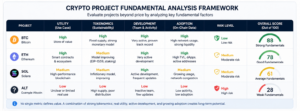
To simplify this, here is how the framework works in practice:
| Factor | What It Tells You | Risk if Ignored |
|---|---|---|
| Tokenomics | Supply pressure and incentives | Hidden inflation risk |
| Utility | Real demand | Hype-driven collapse |
| Team | Execution ability | Project stagnation |
| On-chain Data | Actual usage | Misleading narratives |
👉 Insight:
No single metric defines value. Instead, value emerges from the interaction between all factors.
Why Most Investors Misuse This Framework
Even with the right framework, mistakes still happen.
On the one hand, some investors focus only on one factor, such as tokenomics. On the other hand, others rely entirely on narratives without verifying data.
As a result, their analysis becomes incomplete.
Another common issue is inconsistency. Investors may analyze one project deeply but evaluate another based on surface impressions.
Therefore, the real advantage comes from applying the same framework every time.
👉 Insight:
Consistency matters more than complexity in fundamental analysis.
From Analysis to Decision-Making
At this stage, you have enough data. However, data alone does not lead to better decisions.
To use fundamental analysis in crypto investing effectively, you need to translate insights into action.
For example:
- Strong fundamentals + weak adoption → wait
- Strong adoption + weak tokenomics → high risk
- Balanced structure → potential long-term hold
This is where most investors fail. They collect information but do not turn it into a decision framework.
👉 Insight:
Fundamental analysis is not about collecting data—it is about making structured decisions.
What Comes Next
Now that you understand how to analyze crypto fundamentals step by step, the next challenge is knowing when this approach works—and when it fails.
In the next section, we explore the limitations of crypto fundamental analysis, including situations where fundamentals can be misleading or insufficient.
When Fundamental Analysis Fails in Crypto (And Why It Matters)
At this point, fundamental analysis in crypto may seem like a complete solution. However, relying on it blindly can lead to serious mistakes.
In fact, one of the biggest misconceptions is assuming that strong fundamentals always lead to price growth. While this may be true in traditional markets over long periods, crypto behaves differently.
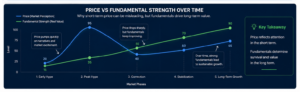
Therefore, understanding the limitations of crypto fundamental analysis is just as important as understanding how it works.
Limitation 1: Fundamentals Do Not Control Short-Term Price
First, it is important to recognize that crypto markets are highly sentiment-driven.
Even if a project has strong fundamentals, its price can remain flat—or even decline—for extended periods. This happens because short-term price movements are often driven by:
- Market sentiment
- Liquidity conditions
- Narrative trends
For example, a technically weak project may outperform in a hype cycle, while a fundamentally strong one may lag behind.
👉 Insight:
Fundamentals influence long-term value. However, they do not control short-term price behavior.
Limitation 2: Narratives Can Override Data
Another major challenge is the power of narratives.
In crypto, narratives can drive massive price movements regardless of underlying fundamentals. As a result, investors who rely only on data may miss key market shifts.
For instance, sectors like AI, DeFi, or Layer 2 solutions can experience rapid growth simply because attention flows into them.
However, this does not always reflect real adoption.
👉 Insight:
In crypto markets, perception can temporarily outweigh reality.
Limitation 3: Data Interpretation Is Not Always Objective
Although crypto provides access to on-chain data, interpreting that data is not always straightforward.
Different metrics can tell different stories. For example:
- Rising transaction volume may indicate growth
- However, it may also reflect short-term speculation
Similarly, an increase in active addresses does not always mean genuine adoption.
Therefore, how to analyze crypto fundamentals correctly depends not only on data—but also on interpretation.
👉 Insight:
Data is available to everyone. However, correct interpretation is what creates an edge.
Limitation 4: Tokenomics Can Change Over Time
Another overlooked risk is that tokenomics are not always fixed.
Projects may adjust supply mechanisms, introduce new incentives, or change distribution strategies. As a result, a project that initially looked strong can become weaker over time.
This makes static analysis unreliable.
👉 Insight:
Fundamental analysis is not a one-time process—it requires continuous updates.
When to Trust Fundamental Analysis—and When Not To
To make better decisions, you need to understand when fundamental analysis is most reliable.
The table below summarizes this clearly:
| Situation | Reliability of Fundamental Analysis |
|---|---|
| Long-term investing | High |
| Early-stage project evaluation | High |
| Short-term trading | Low |
| Hype-driven markets | Low |
👉 Insight:
Fundamental analysis works best when time horizon is long and noise is low.
Combining Fundamental Analysis With Other Strategies
At this stage, the goal is not to replace fundamental analysis—but to use it correctly.
In practice, the most effective approach is combining it with other tools. To apply this in real-world investing, it is essential to understand how to calculate position size and manage risk in crypto investing based on your portfolio structure, especially when working with multiple assets and varying exposure levels.
For example:
- Use fundamental analysis to select strong projects
- Use risk management to control exposure
- Use position sizing to manage capital allocation
- Use performance tracking to evaluate results over time
This integrated approach transforms analysis into a complete investment strategy.
👉 Insight:
Fundamental analysis tells you what to buy. Strategy determines how to manage it.
A Simple Decision Framework You Can Apply
To make this practical, here is a simplified framework you can reuse:
| Step | Question | Outcome |
|---|---|---|
| 1 | Does the project have real utility? | Filter weak projects |
| 2 | Is tokenomics sustainable? | Identify hidden risks |
| 3 | Is adoption growing? | Validate demand |
| 4 | Does it fit your portfolio strategy? | Make final decision |
By following this structure, you avoid random decision-making and move toward consistency.
Why Accurate Analysis Changes Investor Behavior
Ultimately, the value of crypto fundamental analysis is not just in understanding projects—it is in improving decision-making.
Without structure, investors react emotionally to price movements. As a result, they:
- Buy based on hype
- Hold weak positions
- Misjudge risk
However, when analysis is structured, behavior changes.
Investors begin to:
- Evaluate assets objectively
- Manage risk more effectively
- Focus on long-term outcomes
👉 Insight:
Better analysis leads to better decisions—and better decisions lead to better results.
Final Insight: Structure Matters More Than Information
At a surface level, crypto markets appear to reward those who act quickly. However, over time, they reward those who act with structure.
Price alone does not define value. Instead, value emerges from:
- Utility
- Adoption
- Tokenomics
- Consistent evaluation
Without structure, these factors create confusion. With structure, they create clarity.
👉 Insight:
In crypto investing, structure is your advantage—not information alone.
Closing
Understanding how to use fundamental analysis in crypto is not about memorizing concepts. Instead, it is about applying a consistent framework.
When you approach analysis this way:
- your decisions become more objective
- your expectations become more realistic
- your results become more consistent
If you want to simplify this process, you can use a structured crypto analysis approach to evaluate your positions based on real data, including fundamentals, performance, and risk.