
AI Investing Bots vs Human Investors: A Side-by-Side Comparison
The debate between AI investing bots vs human investors has become increasingly important as financial markets generate more data than ever before. Prices change by the second, news breaks around the clock, and investor sentiment often shifts long before a trend becomes visible on a chart.
As a result, many investors are turning to artificial intelligence for faster analysis and deeper market insights. Some believe AI investing bots can make better decisions than humans, while others argue that human judgment remains irreplaceable.
The reality is far more nuanced.
Before deciding whether AI investing bots or human investors make better decisions, it helps to understand how artificial intelligence actually analyzes market data. Our guide on Analyze Cryptocurrencies with AI explores how modern systems evaluate digital assets, identify patterns, and transform raw information into investment insights.
What Is an AI Investing Bot?
An AI investing bot is a software system that uses artificial intelligence to analyze financial data, identify patterns, and support investment decisions.
Instead of relying entirely on manual research, these systems evaluate large amounts of information simultaneously and monitor market conditions continuously.
However, AI investing bots do not predict the future with certainty.
They analyze available information, identify relationships within that data, and estimate potential outcomes based on probabilities.
This distinction matters because successful investors rarely focus on predicting the future. Instead, they focus on making informed decisions despite uncertainty.
Why Are Investors Interested in AI Investing Bots?
The appeal of AI is easy to understand.
Modern markets move quickly, and the amount of available information continues to grow. Investors must monitor price movements, market trends, news developments, sentiment shifts, and broader economic events while managing risk and controlling emotional reactions.
AI systems help investors handle this growing complexity.
They process information faster, monitor multiple assets simultaneously, and highlight patterns that many people would miss during manual analysis.
For most investors, the biggest benefit does not come from better predictions. The real value comes from faster research, broader market coverage, and more efficient decision-making.
AI Investing Bots vs Traditional Trading Bots
Many investors use the terms AI investing bot and trading bot interchangeably, but important differences separate the two.
Traditional trading bots follow predefined rules. When a specific condition appears, the bot executes an action. The system continues following those instructions until someone changes the underlying rules.
Many traditional trading systems fall under the broader category of algorithmic trading, where predefined rules and automated execution play a central role in investment workflows.
AI investing bots take a broader approach.
Rather than relying on a single condition, they evaluate multiple inputs simultaneously and identify relationships between different variables. This approach gives them greater flexibility, especially in markets where conditions change rapidly.
That flexibility does not make AI infallible. It simply means AI systems analyze information differently than rule-based automation.
The Biggest Misconception About AI Investing Bots
Many investors assume artificial intelligence exists to replace human decision-making.
In reality, developers create the most effective AI systems to improve decisions, not eliminate the need for them.
Investors often assume that a system capable of processing more information should automatically make better investment choices.
But investing is not simply a data-processing challenge.
It is also a judgment challenge.
Regulations change. Market narratives evolve. Unexpected events emerge. Human behavior shifts constantly.
AI can recognize patterns within data, but investors still need judgment to determine whether those patterns actually matter.
AI Is Designed to Improve Decisions, Not Replace Them
Artificial intelligence excels at processing information at scale.
Human investors excel at interpreting information within a broader context.
Once investors view AI through this lens, the debate changes completely.
The question is no longer whether AI performs better than humans.
The more useful question asks which tasks benefit from automation and which still require human judgment.
| AI Strengths | Human Strengths |
|---|---|
| Processing large datasets | Understanding context |
| Monitoring markets continuously | Evaluating unexpected events |
| Detecting recurring patterns | Strategic thinking |
| Generating signals quickly | Assessing risk tolerance |
| Reducing emotional reactions | Adapting to uncertainty |
This framework highlights a reality that many discussions about investing automation ignore.
The future of investing will not belong exclusively to AI or exclusively to humans.
Investors will likely achieve the best results when they combine AI-driven analysis with human judgment.
To understand how AI generates those insights, we first need to examine the information these systems analyze and how they transform raw market data into actionable signals.
How AI Investing Bots Process Market Data Compared to Human Investors
Financial markets generate an enormous amount of information every day.
Prices move continuously, trading volume fluctuates, investor sentiment changes rapidly, and major news events can reshape market conditions within minutes. Most investors cannot realistically monitor all of these variables at the same time.
AI investing bots attempt to solve that problem.
Rather than focusing on a single chart or indicator, they collect information from multiple sources, identify relationships between datasets, and transform raw information into actionable signals. This ability allows AI systems to analyze markets at a scale that would be difficult to replicate manually.
However, understanding how AI processes data is only part of the story.
The more important question is whether processing more data actually leads to better investment decisions.
Market Data: The Foundation of Most AI Models
Most AI investing bots begin with market data.
Historical prices, trading volume, volatility levels, liquidity conditions, and order-book activity provide the foundation for many AI-driven models.
By analyzing these datasets, AI systems attempt to identify recurring relationships that may help explain current market behavior.
For example, a sudden increase in trading volume may indicate growing market participation, while rising volatility can signal changing market conditions.
Market data helps AI understand what is happening in the market.
It does not always explain why it is happening.
Sentiment Data: Measuring Market Psychology
Numbers tell part of the story.
Human behavior tells the rest.
Markets are heavily influenced by fear, optimism, uncertainty, and speculation. For this reason, many AI investing bots incorporate sentiment analysis into their research process.
These systems often evaluate:
- Financial news coverage
- Social media discussions
- Community activity
- Market narratives
- Investor reactions to major events
Sentiment analysis helps AI understand how investors feel about a market at a particular moment.
In some situations, changing sentiment can influence prices long before technical indicators reflect that shift.
On-Chain Data: A Unique Advantage in Cryptocurrency Markets
Cryptocurrency markets offer something traditional financial markets cannot provide: transparent blockchain data.
Every transaction leaves a digital footprint that investors can analyze.
AI investing bots frequently monitor:
- Wallet activity
- Exchange inflows and outflows
- Transaction volume
- Network participation
- Large holder movements
These metrics help AI identify behavioral patterns that may not appear in price charts alone.
The Four Core Data Sources Used by AI Investing Bots
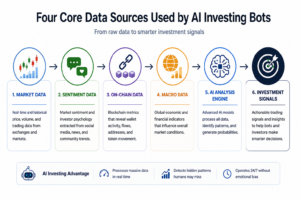
Although platforms use different methodologies, most AI systems rely on four primary categories of information.
| Data Source | What It Measures | Why It Matters |
|---|---|---|
| Market Data | Price, volume, volatility, liquidity | Reveals market behavior and trends |
| Sentiment Data | News, social discussions, investor opinions | Reflects market psychology |
| On-Chain Data | Wallet activity, exchange flows, transactions | Reveals blockchain behavior |
| Macro Data | Interest rates, inflation, regulations | Provides broader economic context |
Each source provides a different perspective.
The challenge is not collecting information.
The challenge is determining which information matters most.
Why More Data Doesn’t Always Mean Better Decisions
One of the biggest misconceptions about artificial intelligence is that more data automatically leads to better outcomes.
In reality, more information often creates a new problem: competing signals.
An AI model may detect bullish sentiment across social media while on-chain activity suggests growing selling pressure. Technical indicators may support a positive outlook while macroeconomic conditions increase overall market risk.
This challenge also highlights one of the key limitations of AI price forecasting. Investors interested in understanding how predictive models generate forecasts—and where those forecasts can fail—can explore our guide to Predicting Crypto Prices with AI.
None of these signals are necessarily wrong.
They simply tell different parts of the story.
This creates what many investors overlook:
The real challenge is not finding signals. The real challenge is deciding which signals deserve the most attention.
Artificial intelligence excels at discovering patterns.
Prioritizing those patterns is far more difficult.
The more data a system analyzes, the more frequently it encounters conflicting information. As a result, additional data can improve analysis while simultaneously increasing complexity.
This is one of the most important limitations of AI investing bots—and one of the most important advantages of human judgment.
Data Processing vs Decision-Making
The distinction between processing information and making decisions helps explain why AI and human investors often complement each other.
| What AI Does Best | What Humans Do Best |
|---|---|
| Process large datasets | Understand context |
| Monitor markets continuously | Evaluate conflicting signals |
| Identify recurring patterns | Assess strategic importance |
| Generate signals quickly | Interpret unique events |
| Reduce emotional reactions | Adapt to uncertainty |
AI excels at finding patterns across massive datasets.
Human investors excel at deciding which patterns actually matter.
The strongest investment process rarely depends entirely on automation or entirely on intuition. Instead, it combines AI’s ability to process information with a human investor’s ability to evaluate context, uncertainty, and strategic priorities.
This distinction becomes even more important when comparing AI investing bots directly with human investors—a comparison that reveals where automation creates genuine advantages and where human judgment remains essential.
AI Bots vs Human Investors: A Side-by-Side Comparison
If processing more data automatically created better investment decisions, AI investing bots would already outperform every human investor.
Yet reality tells a different story.
Many of the world’s most successful investors still rely on experience, judgment, and contextual thinking when making decisions. This raises an important question: if AI can process more information than any human, why hasn’t it completely replaced human investors?
The answer lies in understanding the difference between analysis and decision-making.
Speed, Scale, and Pattern Recognition
One area where AI investing bots clearly excel is information processing.
Modern systems can analyze vast datasets within seconds, track multiple markets simultaneously, and monitor changing conditions around the clock. As market complexity increases, this capability becomes increasingly valuable.
A human investor may struggle to follow hundreds of assets, news sources, and market indicators at the same time. Artificial intelligence, on the other hand, can evaluate these inputs continuously without fatigue.
Pattern recognition represents another significant advantage. By examining large datasets, AI systems can identify relationships and anomalies that would be difficult to detect through manual analysis alone.
Even so, recognizing a pattern and understanding its significance are not always the same thing.
Where Human Judgment Still Matters
Financial markets do not operate in a vacuum.
Economic policy, regulation, geopolitical developments, technological innovation, and investor psychology can all influence market behavior. In many situations, these factors require interpretation rather than calculation.
Consider a sudden increase in market activity.
An AI system may detect the change immediately. However, determining whether the activity reflects genuine adoption, speculative enthusiasm, or short-term panic often requires broader context.
Experience also plays an important role.
When markets enter unfamiliar territory, investors frequently rely on judgment rather than historical patterns alone. This ability becomes particularly valuable during periods of uncertainty, when previous data provides limited guidance.
Why AI Investing Bots and Human Investors Work Better Together
One of the most common misconceptions about artificial intelligence is the belief that more information automatically produces better decisions.
In practice, the opposite can happen.
Large datasets often generate multiple signals that point in different directions. Sentiment may appear positive while macroeconomic conditions deteriorate. On-chain activity may suggest accumulation while technical indicators signal weakness.
Finding signals is rarely the problem.
Prioritizing those signals is far more difficult.
This is where human judgment continues to provide value.
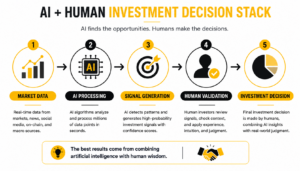
Artificial intelligence helps investors discover opportunities faster. Human decision-makers determine which opportunities deserve attention and which risks outweigh potential rewards.
Rather than competing with each other, AI and human judgment often complement one another.
What AI Does Best vs What Humans Do Best
| What AI Does Best | What Humans Do Best |
|---|---|
| Process large datasets | Understand context |
| Monitor markets continuously | Evaluate conflicting signals |
| Detect recurring patterns | Assess strategic importance |
| Generate signals quickly | Interpret unique events |
| Maintain consistency | Adapt to uncertainty |
Neither side dominates every category.
Instead, each contributes different strengths to the investment process. The strongest results often emerge when investors combine both perspectives rather than relying exclusively on one approach.
A Practical Framework for Evaluating AI Decisions
Before acting on an AI-generated signal, investors should validate the information from multiple perspectives rather than relying on a single output.
Technical indicators can help confirm whether the signal aligns with broader market structure, while sentiment analysis may reveal whether investor behavior supports the same direction. In cryptocurrency markets, on-chain activity provides an additional layer of verification by highlighting how participants are actually interacting with the network.
External factors deserve attention as well. News developments, regulatory announcements, and macroeconomic conditions often influence outcomes in ways historical models cannot anticipate.
Investors should also compare current market conditions with the environment that originally produced the signal. If those conditions differ significantly, the reliability of the AI output may decrease.
Most importantly, risk management should remain part of every decision-making process. Even the most sophisticated AI models operate with uncertainty, making validation and risk control essential components of responsible investing.
Investors can also use a Crypto Portfolio Calculator to evaluate portfolio exposure, assess allocation decisions, and understand how individual positions may affect overall risk before acting on AI-generated insights.
Key Takeaway
The debate between AI investing bots and human investors often focuses on choosing one over the other.
A more useful perspective recognizes that each solves a different problem.
Artificial intelligence excels at processing information quickly and efficiently. Human investors excel at interpreting information within a broader context.
When these strengths work together, investors gain access to both analytical scale and strategic judgment.
For most market participants, that combination offers a greater advantage than relying entirely on automation or intuition alone.