


Quick answer: An AI crypto prediction model is useful only when testing shows that it adds reliable information beyond a simple baseline. A high accuracy number is not enough. The evaluation must respect time order, prevent future-data leakage, include realistic costs, test different market regimes, and show uncertainty honestly.
This guide is for readers who need to audit or compare prediction models. If you first need a beginner-friendly explanation of what AI models can and cannot predict, read AI Crypto Price Analysis: What Models Can and Cannot Predict. The workflow below focuses specifically on backtesting, calibration, failure modes, and production monitoring.
1. Define the Prediction Task and Baseline
Before choosing a model, write down the exact target, time horizon, available data, decision the output will support, and cost of being wrong. A model that predicts next-day direction should not be evaluated like a model that estimates a weekly price range or a volatility regime.
| Evaluation item | Question to answer |
|---|---|
| Target | Direction, return range, volatility, or market regime? |
| Horizon | Next hour, day, week, or longer? |
| Baseline | What simple method must the model beat? |
| Decision | What changes when the output changes? |
| Failure cost | What happens when the model is confidently wrong? |
Specify the Output Before Choosing a Model
Every test needs a fixed target and timestamp. Define when each input becomes available and when the prediction is produced. This prevents a model from accidentally using information that was not known at prediction time.
Require a Simple Baseline
Compare the model with a naive forecast, historical average, or simple volatility rule. If a complex model cannot beat an appropriate baseline after costs, the extra complexity has not demonstrated practical value.
Audit Data Availability
Check timestamps, missing values, revised data, delisted assets, survivorship bias, and whether news or on-chain inputs were genuinely available at the test time. Record these assumptions before reviewing performance.
2. Backtest Without Leaking the Future
If Part 1 was about what AI prediction is, this part is about something more important: how to judge whether an AI crypto prediction is actually reliable.
Most “AI crypto prediction” pages look convincing because they show charts, confident language, and a few cherry-picked calls. The problem is that crypto is noisy, regimes shift, and a model can look great in one market phase and fail badly in another. So the only professional way to evaluate a model is through clear targets, correct backtesting, and the right metrics.
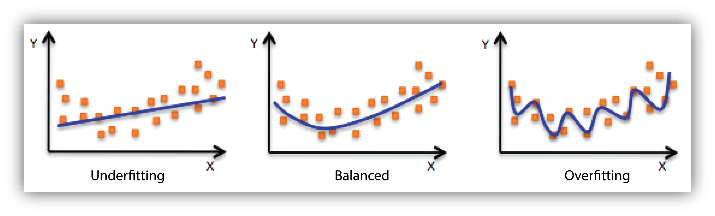
Source: Machine learning bias–variance illustration (conceptual).
This section gives you an investor-safe evaluation framework—no hype, no “signals,” just how a serious crypto analysis with AI system is validated.
1) Start by defining what “good prediction” means
Before metrics, you must lock three definitions:
-
Horizon: what time frame is the prediction for? (next hour, next day, next week)
-
Target: what output does the model give?
-
direction (up/down),
-
range (probability bands),
-
volatility (risk),
-
regime (risk-on/off).
-
-
Actionability: what would a user do with it?
-
reduce exposure,
-
rebalance,
-
hedge,
-
or simply monitor risk.
-
Without these, “accuracy” is meaningless because you might be judging the wrong thing.
Example:
A model that predicts “up” correctly 55% of the time can still be useless if losses on wrong calls are larger than gains on correct ones. That’s why finance rarely stops at raw accuracy.
Prevent Future-Data Leakage
The biggest failure in predicting crypto prices with AI is improper testing. Many models look brilliant because they accidentally “see” the future through bad splits.
Here are the main leakage traps to avoid:
-
Random train/test split on time-series (invalid for markets).
-
Using indicators computed with future data (even indirectly).
-
Mixing timestamps from different sources (price vs on-chain vs news) without alignment.
-
Survivorship bias (testing only coins that still exist today).
-
Look-ahead labeling (targets that accidentally include future context).
A professional approach uses walk-forward testing.
Use Walk-Forward Backtesting
Walk-forward (also called rolling or expanding window validation) matches reality:
-
Train on historical window A
-
Predict on future window B
-
Roll forward and repeat
That gives you performance across multiple market conditions, not just one lucky segment.
Good practice choices:
-
Use multiple windows (e.g., 6–12 months train → 1 month test, repeated).
-
Track results by regime (bull, bear, sideways).
-
Always compare to baselines (more on this below).
Match Metrics to the Prediction Output
Different outputs need different metrics. Here’s the most practical way to think about it:
Evaluation Metrics by Prediction Type
| Prediction type | Good metrics | What it tells you | Misleading if used alone |
|---|---|---|---|
| Direction (Up/Down) | Precision/Recall, F1, Balanced Accuracy | true signal vs false alarms | plain Accuracy (especially with imbalance) |
| Return forecast | MAE/RMSE + hit-rate on sign | error size + direction | RMSE without distribution checks |
| Range / probability bands | Calibration (Brier score), coverage rate | whether probabilities are honest | “confidence” numbers without calibration |
| Volatility / risk | MAE on vol, correlation, tail error | risk forecasting quality | average error ignoring extremes |
| Regime classification | confusion matrix by regime, stability | robustness across phases | single overall score hiding regime failures |
Key idea: Markets punish bad downside calls more than they reward small wins, so you must track where the model fails—not just average performance.
Require the Model to Beat a Simple Baseline
A serious cryptocurrency price analysis with artificial intelligence page always checks baselines.
Baselines you should include internally (even if you don’t expose every detail publicly):
-
Naive forecast: “tomorrow = today”
-
Momentum baseline: “continue last trend”
-
Volatility baseline: simple rolling volatility
-
Simple technical rule: e.g., moving average direction
If your AI model can’t consistently beat these (after costs and slippage assumptions if applicable), it’s not adding real value.
Test Robustness Across Market Regimes
Crypto is a regime machine. A model trained in a bull phase often learns “buy the dip always works.” Then the bear phase arrives and the same logic becomes a drawdown engine.
So you should segment performance:
-
Bull: trending up, dips recover quickly
-
Bear: risk-off, rallies fade
-
Sideways: chop, false breakouts
-
High-volatility shock: liquidation cascades, news spikes
A model that looks “accurate” overall can actually be dangerous if it fails systematically in one regime (especially bear/high-volatility).
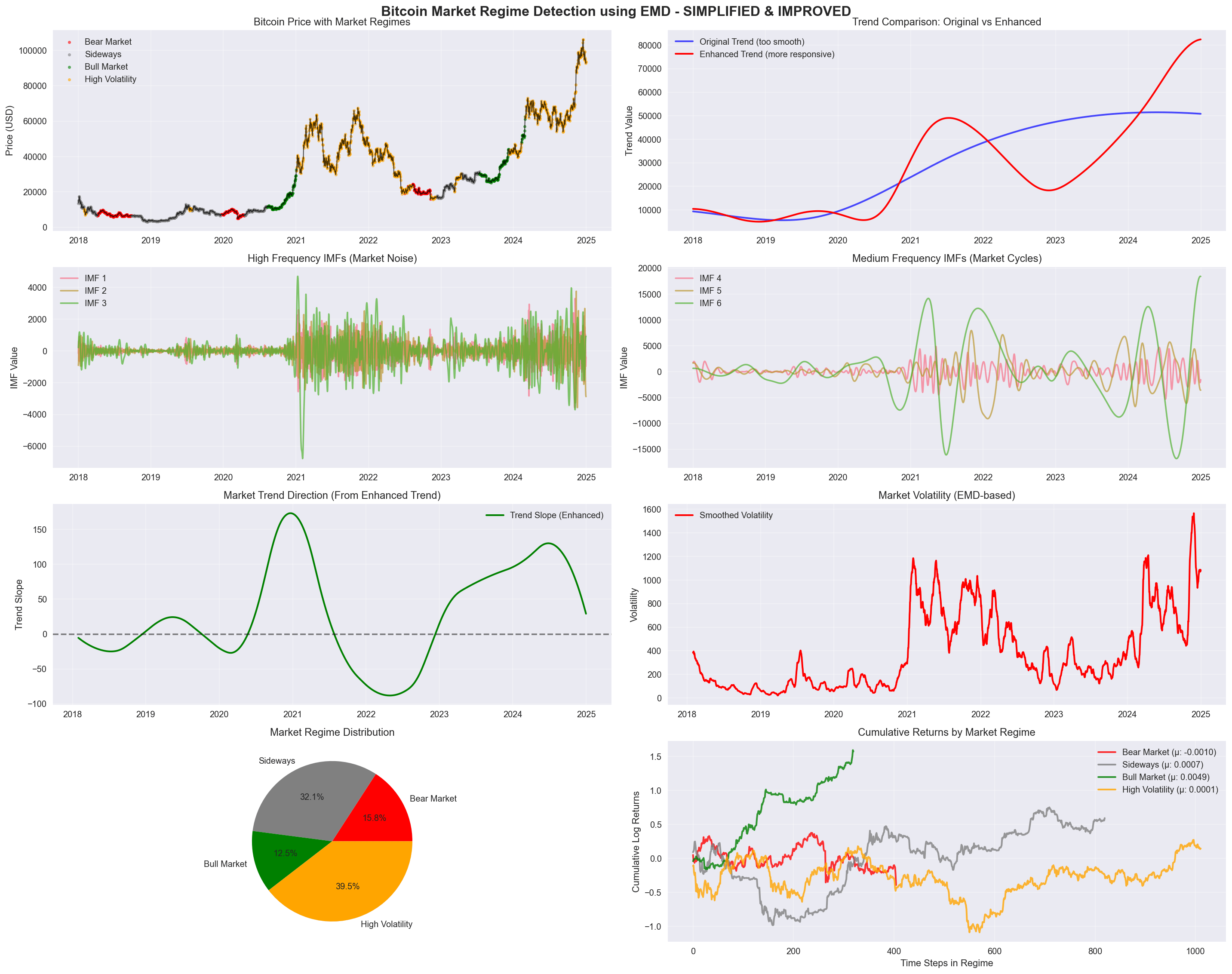
Source: Regime detection visualization (EMD-based market regime model example).
Check Probability Calibration
Many AI tools output probabilities like “BTC has a 72% chance to go up.” That number is only useful if it’s calibrated.
A calibrated model means:
When it says “70%,” it should be right about 7 times out of 10 over many cases.
Uncalibrated probabilities create false confidence and bad decisions.
Practical checks:
-
reliability plots (calibration curves)
-
Brier score (lower is better)
-
coverage tests for prediction intervals
This is how you turn an “AI crypto forecast” into something closer to professional risk modeling.
Include Fees, Spread, and Slippage
Even if your content isn’t about trading, evaluation should acknowledge friction:
-
spreads,
-
fees,
-
funding costs (if using derivatives),
-
slippage in volatility spikes.
A prediction model that only works when conditions are perfect is not robust. In crypto, the best models are often those that:
-
reduce exposure in bad conditions, and
-
avoid overreacting.
Practical Model Evaluation Checklist
Use this as a “trust filter” inside your pillar (it also matches high-intent search queries):
-
Is the prediction target clearly defined (direction/range/vol/regime)?
-
Is validation walk-forward (not random split)?
-
Are data sources aligned by time (UTC) and frequency?
-
Are baselines included and beaten?
-
Is performance shown by regime (bull/bear/sideways)?
-
Are probabilities calibrated (if probabilities are used)?
-
Are failure cases disclosed?
Green Flags and Red Flags
| Green flags (credible) | Red flags (marketing) |
|---|---|
| Defines horizon + target precisely | “AI predicts the next price” with no definition |
| Walk-forward testing explained | random split backtest or no backtest details |
| Uses baselines + regime breakdown | only one overall “accuracy” number |
| Shows uncertainty/probabilities properly | guaranteed outcomes / confident price targets |
| Mentions limitations + failure modes | ignores bear markets and tail risk |
How to Use This Evaluation Guide
Use this page when a model or platform makes a forecasting claim and you need to verify the evidence behind it. For a broader investment decision, combine the result with the five-factor crypto market analysis checklist. For portfolio-level testing, continue with the crypto portfolio backtesting guide.
3. Build and Monitor the Evaluation Pipeline
This final part turns everything into a practical, professional blueprint: how an “AI crypto prediction” system is built end-to-end in a way that is realistic for crypto markets and safe for long-term, risk-aware decision making.
Instead of promising perfect forecasts, the focus stays on what strong financial teams actually do: structured inputs, disciplined validation, and continuous monitoring. Because market regimes shift, models can degrade, and uncontrolled confidence becomes a liability.
Define the Model Output
Before touching data or modeling, clarify what your AI output is. For a public-facing blog (and for a tool like Fortuna/Forvest), the most defensible outputs usually fall into a few categories:
-
Direction probability (e.g., next-day up/down likelihood)
-
Range forecast (e.g., expected return band with uncertainty)
-
Volatility / risk forecast (e.g., expected volatility regime)
-
Regime classification (risk-on vs risk-off)
-
Confidence / uncertainty (calibrated, not vibes)
From an investor standpoint, the strongest “prediction” is often risk-aware rather than directional. As an example, “volatility likely rising, uncertainty high” is usually more actionable than a single price target.
Build the Data Layer
In crypto, forecasts improve when you combine price data with market structure and context. However, that only works if the data is clean, aligned, and free of leakage.
A robust data stack usually includes:
A) Market data
-
OHLCV (spot, and derivatives if relevant)
-
Funding rates and open interest (OI)
-
Liquidations and volatility indices (when available)
-
Order book snapshots (optional; heavy to maintain)
B) On-chain and flow context (optional but powerful)
-
Exchange inflows/outflows (netflow)
-
Stablecoin supply changes / exchange reserves
-
Whale activity, active addresses, realized metrics (only when they match the thesis)
C) Narrative / attention signals (use carefully)
-
News intensity and sentiment indexes
-
Google Trends or social activity proxies
-
Event markers (ETF headlines, major hacks, macro releases)
More data does not automatically mean better performance. In fact, extra sources increase both leakage risk and misalignment bugs, so quality usually beats quantity.
Engineer Features Without Hiding Assumptions
Most production-grade systems rely on features that remain stable across regimes. Therefore, start with simple, interpretable signals and expand only when you can prove durability.
Signals that tend to be useful include:
-
Returns across multiple horizons (1h, 4h, 1d, 1w)
-
Volatility features (realized volatility, ATR-like measures)
-
Trend + mean-reversion (moving averages, z-scores)
-
Market structure (OI changes, funding deviations, liquidation spikes)
-
Regime features (vol expansion, correlation shifts, range compression/expansion)
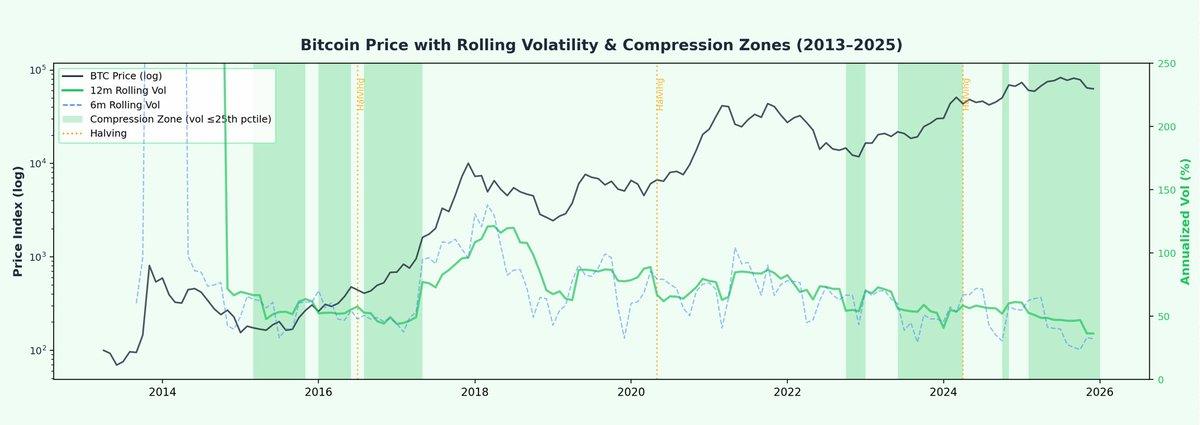
Source: Historical BTC data visualization (2013–2025).
In contrast, these patterns often fail:
-
Overfitting to dozens of indicators with weak economic meaning
-
Using complex feature sets without stability testing
-
Injecting sentiment signals without calibration (they can invert across regimes)
Choose the Simplest Defensible Model
A practical strategy is to begin with strong baselines and only escalate complexity when the evidence supports it. As a result, you’ll avoid “fancy but fragile” systems.
A good progression looks like this:
-
Baselines: naive, momentum, volatility baseline
-
Linear models: ridge/lasso, logistic regression (surprisingly strong with good features)
-
Tree ensembles: XGBoost/LightGBM (often top performers for tabular market features)
-
Sequence models: LSTM/Temporal CNN/Transformers (only if you truly need them and can control overfitting)
Because crypto is non-stationary, “smart but simple” plus monitoring often outperforms sophisticated models that break silently.
Train and Validate in Time Order
To avoid misleading results, time-series evaluation is non-negotiable. Specifically:
-
Use time-based splits only
-
Use walk-forward evaluation (rolling or expanding window)
-
Evaluate by market regime (bull/bear/sideways/high-vol)
-
Compare against baselines every time
Additionally, test:
-
stability over time (does performance decay?)
-
sensitivity to parameter changes
-
feature importance drift (which signals stop working?)
Present Predictions With Honest Uncertainty
Raw model outputs usually need refinement. For instance, probabilities often require calibration to match real-world frequencies.
Common post-processing steps include:
-
Probability calibration (for classification outputs)
-
Prediction intervals (for range forecasts)
-
Uncertainty flags when the model is out-of-distribution
A high-integrity output might look like:
-
“Direction: 58% up (calibrated)”
-
“Expected daily move range: -2.1% to +2.7%”
-
“Risk regime: Elevated (vol expansion)”
-
“Confidence: Low (model uncertainty high)”
This is generally more credible than an exact price target.
In practice, regime shifts are a risk-management problem first, not a prediction problem—our risk management framework covers how to treat these transitions as exposure and sizing decisions.
Monitor Drift and Failure in Production
In practice, prediction systems require monitoring because exchanges change microstructure, liquidity shifts, correlations rotate, and macro regimes reshape behavior. Consequently, a model that worked last quarter can degrade quickly.
In practice, prediction systems need monitoring because market structure changes. Exchanges shift microstructure, liquidity moves, correlations rotate, and macro regimes evolve—so a model that worked last quarter can degrade fast.
A monitoring layer should track:
-
Data quality: missing values, timestamp drift, outliers
-
Feature drift: distribution changes vs training period
-
Performance drift: rolling hit-rate, calibration decay
-
Regime alarms: shock detection (liquidations, volatility spikes)
When drift is detected, retraining is one option. Alternatively, you can down-weight unstable features or throttle confidence until stability returns.
Build From a Minimal Baseline to a Robust System
If you want a credible “AI crypto prediction” workflow, build in phases. That approach keeps quality high while expanding coverage.
Phase 1 — Minimum viable, high integrity
To begin, keep the scope narrow and measurable:
-
1–2 assets (BTC/ETH)
-
daily horizon (less noisy than hourly)
-
direction probability + volatility regime
-
walk-forward validation + baselines
Phase 2 — Better coverage
Next, expand carefully while protecting data integrity:
-
multi-horizon outputs (1d + 1w)
-
on-chain/flow features (carefully aligned)
-
calibration + regime breakdown charts
Phase 3 — Production-grade
Finally, treat the system like a maintained product, not a one-off model:
-
monitoring dashboards
-
drift detection + retraining policy
-
model versioning + audit logs (what changed and when)
End-to-End Evaluation Pipeline Checklist
| Layer | What you build | What “done right” looks like |
|---|---|---|
| Output definition | target + horizon + format | precise target, clear uncertainty |
| Data | market + optional on-chain + context | aligned timestamps, no leakage |
| Features | returns, vol, structure, regime | interpretable, stress-tested |
| Model | baseline → ensembles → sequence (optional) | beats baselines across regimes |
| Validation | walk-forward | regime breakdown + calibration |
| Post-processing | calibration + intervals | probabilities match reality |
| Monitoring | drift + performance | detects decay before users suffer |
Common Model Failure Points
-
Random train/test split on time-series
-
No baselines (can’t prove real value)
-
No regime testing (model collapses in bear markets)
-
No calibration (probabilities look confident but lie)
-
Too many indicators (overfitting disguised as sophistication)
-
No monitoring (performance rots silently)
Final Evaluation Standard for AI Crypto Models
A professional AI crypto prediction system doesn’t promise certainty. Instead, it promises structure: clearer inputs, disciplined validation, honest uncertainty, and continuous monitoring. As a result, the user gets a framework that stays reliable even when the market gets noisy.
Choose the right next step: use the beginner guide for a general explanation of AI price analysis, this evaluation guide for testing model claims, and the portfolio backtesting guide for allocation-level decisions.
Sources and Evaluation Standards
- NIST AI Risk Management Framework — governance, measurement, and ongoing risk management.
- Bank for International Settlements: AI for monitoring financial markets — financial-market applications and model-risk context.
This article is educational and does not provide investment advice. Crypto forecasts remain uncertain and can fail during regime changes, data disruptions, or unexpected events.