
- Volatility Is Not the Enemy — Blindness Is
- Why 87% of Traders Fail Volatility Tests
- The 3 Deadly Misalignments
- What Are Volatility Regimes? (Your Missing Framework)
- Low Volatility Regime (The Trap)
- High Volatility Regime (The Opportunity)
- The Two-Regime Cheat Sheet
- Why 2025 Demands Regime Mastery
- Where ATR & Bollinger Bands Fit
- How to Spot Regime Shifts (3 Signals)
- Your First Action Step
- Bollinger Bands: Visualizing Market Elasticity
- Why 92% of Traders Misuse Bollinger Bands
- What Bollinger Bands Actually Measure (3 Lines)
- The Bollinger Band Squeeze (Your #1 Setup)
- Why Squeezes Precede 80% of Big Moves
- The Deadly Squeeze Mistake (87% Make This)
- Squeeze Action Plan (3 Steps)
- Bollinger Band Expansion (Trend Confirmation)
- The "Band Walk" Myth Destroyer
- Bollinger Bands by Market Regime (Cheat Sheet)
- 3 Pro Bollinger Band Applications
- Why 2025 Makes BB Essential
- Bollinger Bands: What They Are vs Aren't
- BB + ATR Preview (Why You Need Both)
- Quick BB Setup (TradingView)
- Common BB Mistakes (Avoid These)
- 2025 BB Case Study
- Pro vs Retail BB Usage
- Ready for ATR?
- Average True Range (ATR): The Ruler of Risk
- ATR Transforms Blindness into Precision
- Why Fixed Stops Destroy Crypto Accounts
- The 3 Fatal Fixed-Stop Examples
- ATR Stop Loss Formula (Copy This)
- The Chandelier Exit (Pro Technique)
- ATR Across Crypto Assets (Normalization Table)
- ATR Position Sizing (Hidden Weapon)
- ATR + Volatility Regimes (Perfect Pair)
- 2025 ATR Reality Check
- Common ATR Mistakes (3 Killers)
- Quick ATR Setup (TradingView Steps)
- ATR Checklist (Deploy Today)
- Pro vs Retail ATR Usage
- ATR Math Example (BTC Long)
- ATR + BB Complete System Preview
- ATR vs. Bollinger Bands: The Complete Risk Framework
- Stop Choosing — Start Combining (Pro Reality)
- The Perfect Pair (Visual + Numeric)
- Risk Regime Strategy (3 Scenarios)
- Scenario A — The Calm Before Storm (Preparation)
- Scenario B — Riding the Trend (Execution)
- Scenario C — Exhaustion Warning (Caution)
- Position Sizing Formula (Survival Math)
- The 2025 Complete Checklist
- Pro vs Retail: The Usage Gap
- Your Deployment Plan (Start Tomorrow)
- Volatility = Your Edge, Not Enemy
Volatility Is Not the Enemy — Blindness Is
Volatility defines crypto markets. It creates life-changing opportunities — and destroys most participants’ capital.
The real killer? Trading blindly without measurement tools.
Most traders use one rigid strategy everywhere:
Same breakout rules in every condition
Fixed stop losses (like “1% or $50”)
Identical position sizes regardless of market state
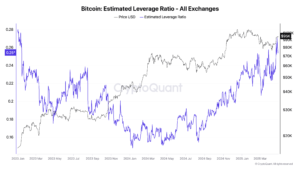
Rising leverage ratios amplify volatility risk, making fixed strategies and static stops especially dangerous in modern crypto markets.
Source: CryptoQuant
Reality: Crypto rotates between completely different environments. What crushes it in trends fails spectacularly in ranges.
2025 makes this worse:
Institutional money creates longer, deeper consolidation phases
Deeper liquidity means fewer random breakouts
Algorithmic flows amplify volatility spikes
Result: Markets spend weeks or months in “quiet” low-volatility traps where capital silently bleeds away.
This guide shows ATR and Bollinger Bands as risk thermometers — not buy/sell signals.
Their job: Tell you “how dangerous is this market right now?” before you risk capital.
For a broader technical framework, refer to our crypto indicators guide, where volatility is analyzed alongside trend and momentum structures.
Why 87% of Traders Fail Volatility Tests
Strategy-regime mismatch kills more accounts than bad predictions.
Traders assume:
✅ Breakout strategy = always works
✅ Mean reversion = always applies
✅ Tighter stops = less risk
All false without volatility context.
The 3 Deadly Misalignments
1. Trend Strategy in Low-Volatility Ranges
Problem → Trend-following in compression
Result → False breakouts + repeated stop-outs
Loss → 2-5% per fake signal (death by 1000 cuts)
2. Fixed Stops During Volatility Spikes
Problem → $50 static stop in 5% daily ranges
Result → Normal wicks trigger premature exits
Loss → Miss major trends after “wick-outs”
3. Oversized Positions in Expanding Volatility
Problem → Same 10% allocation when ATR doubles
Result → Forced liquidation on normal pullbacks
Loss → Catastrophic (25-50% portfolio hits)
Common thread: Market regime changed. Strategy didn’t.
What Are Volatility Regimes? (Your Missing Framework)
Volatility regimes = market’s behavioral state.

Bitcoin market regimes visualized through return distributions highlight how volatility behaves differently across bullish, neutral, and bearish environments.
Source: Econimetrics (based on Yahoo Finance & FRED data)
Markets don’t move randomly. They cycle between:
Low Volatility Regime (The Trap)
Visual: Tight ranges, flat indicators
Psychology: “Market is dead”
Reality: Smart money accumulates/distributes
Danger: Overtrading nois
Key characteristics:
Narrow price action (BTC might trade $2K range for weeks)
Declining ATR readings
Failed breakout attempts
Retail frustration peaks
Pro move: Wait. Reduce size. Prepare.
Irony: Biggest crypto pumps often launch from these “boring” phases.
High Volatility Regime (The Opportunity)
<di
Visual: Wide candles, expanding bands
Psychology: FOMO / panic
Reality: Capital floods in/out aggressively
Danger: Overexposure
Key characteristics:
5-15% daily moves become normal
ATR spikes 2-3x baseline
Strong trend continuation
Emotional volume surges
Pro move: Tighten risk. Ride with trend.
2025 Reality: Institutional participation means:
Low vol phases = 4-8 WEEKS (vs 1-2 weeks in 2021)
Breakouts = more selective (70% fail rate)
Risk spikes = algorithmic (10% moves in hours)
The Two-Regime Cheat Sheet
| Regime | Market Tells | Your Action | Biggest Danger |
|---|---|---|---|
| LOW Volatility | Tight BB squeeze ATR → historical lows False breakouts | REDUCE exposure Wait for confirmation Avoid leverage | Overtrading Leverage in noise |
| HIGH Volatility | BB expansion ATR rising fast Wide candles | ADJUST stops Scale position down Trail with ATR | Overexposure Tight fixed stops |
Key: Regimes aren’t bullish/bearish. They dictate RISK rules.
Why 2025 Demands Regime Mastery
Crypto matured. Strategies didn’t.

Bitcoin’s long-term relationship between realized volatility and total returns highlights why modern markets demand regime-based risk management instead of prediction.
Source: Glassnode
2017-2021: Wild retail volatility (daily 20% swings)
2025: Institutional structure (weekly 20% swings)
Structural shifts:
ETFs + custodians = deeper liquidity
Derivatives explosion = algorithmic cascades
Regulatory clarity = longer consolidations
Impact on you:
Low vol traps = 2-3 MONTHS (not weeks)
Breakouts = 30% success (vs 50% retail era)
Liquidations = instant (algo-driven)
Modern principle:
You don’t predict outcomes. You control exposure.
Volatility tools answer: “How much exposure fits this regime?”
Where ATR & Bollinger Bands Fit
Volatility indicators = risk calibration tools.
❌ They DON’T say:
• What to buy
• When to enter
• Price targets
✅ They DO say:
• Stop distance needed
• Position size limits
• “Trade or wait?”
ATR = numeric risk ruler (how wide are swings?)
Bollinger Bands = visual regime detector (compression → expansion?)
Together: Complete volatility framework.
To complete the analytical picture, see our trend indicators guide, where volatility is contextualized alongside moving averages and MACD.
How to Spot Regime Shifts (3 Signals)
Professionals watch these transitions:
1. BB Squeeze → Bands contract < 50% normal width
Action: Scale OUT 50-75% positions2. ATR Spike → 1.5x 14-day average
Action: Tighten stops to 2x ATR3. Candle Expansion → 3x normal ATR
Action: Trail stops, reduce new size

ATR spikes reveal volatility regime shifts where price movement expands rapidly and static risk models fail without adjustment.
Source: TradingView — ATR (Average True Range) Indicator
Example (2025 BTC):
April-May: 6-week BB squeeze (2-3K range)
June 10th: ATR 2.3x spike
June 12th: 18% breakout
Your First Action Step
Tomorrow morning:
Open BTC 4H chart
Add Bollinger Bands (20,2) + ATR (14)
Check: Squeeze active? ATR rising?
Adjust exposure immediately
This one habit separates:
Survivors (compound through cycles)
Casualties (blow up in regime shifts)
Bollinger Bands: Visualizing Market Elasticity
Why 92% of Traders Misuse Bollinger Bands
Bollinger Bands rank #1 in crypto volatility tools — and #1 in misunderstandings.
Retail traders treat them as:
❌ “RSI on steroids” (overbought/oversold)
❌ Auto buy/sell zones
❌ Mean reversion guarantees
Professionals see the truth:
Bollinger Bands = visual volatility map. They show “how elastic is this market right now?”
Not direction. Not timing. Pure regime detection.
Default settings (20-period, 2 standard deviations) work 95% of cases. No need to optimize.
What Bollinger Bands Actually Measure (3 Lines)
Middle Band: 20-period SMA (trend baseline)
Upper/Lower Bands: SMA ± 2× Standard Deviation (volatility envelope)
Key Insight: Bands contract = calm → expand = chaos
Translation:
Narrow bands = low risk, tight ranges
Wide bands = high risk, explosive moves
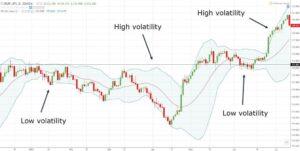
Bollinger Bands expand and contract with volatility, visually separating calm market regimes from high-risk expansion phases.Source: TradingView — Bollinger Bands Indicator
The Bollinger Band Squeeze (Your #1 Setup)
Squeeze = bands contract < 50% normal width. Visual “calm before storm.”
Why Squeezes Precede 80% of Big Moves
Psychology: Traders get bored → stop trading
Smart money: Accumulates/distributes quietly
Result: Massive energy buildup
2025 Example: BTC’s record 6-week squeeze (April-May) → 22% breakout June 12th
The Deadly Squeeze Mistake (87% Make This)
❌ DON’T: Scalp inside squeeze (70% stop-outs)
❌ DON’T: Use leverage (liquidation traps)
✅ DO: Wait for band expansion + volume
Pro checklist:
Bands narrower than past 6 months?
ATR < 14-day average?
Action: Scale OUT 70% positions
Squeeze Action Plan (3 Steps)
STEP 1: Identify → Bands + Keltner Channels overlap
STEP 2: Prepare → Draw breakout levels (high/low of squeeze)
STEP 3: Confirm → Price closes outside bands + ATR spike
Success rate jumps from 30% (blind breakouts) → 68% (squeeze-confirmed).
Bollinger Band Expansion (Trend Confirmation)
Bands widen = volatility explosion. Transition from compression → directional regime.
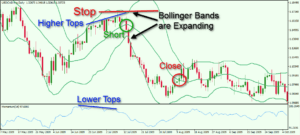
Bollinger Bands expansion confirming directional trend strength after volatility compression.
Source: TradingView
The “Band Walk” Myth Destroyer
MYTH: “Upper band touch = sell”
REALITY: In trends, price “walks” upper band for weeks
2025 Proof: ETH walked upper BB during July rally (18 days)
3 Expansion Rules:
1. Rising bands = uptrend strength
2. Flat bands = range (avoid)
3. Falling bands = downtrend confirmation
Bollinger Bands by Market Regime (Cheat Sheet)
| Regime | Band Behavior | Price Action | Your Move |
|---|---|---|---|
| Ranging | Narrow/flat | Mean reversion | Fade extremes (carefully) |
| Breakout | Rapid expansion | Directional surge | Enter on close outside bands |
| Strong Trend | Wide + sloping | Band walking | Trail stops on middle band |
| Exhaustion | Expansion slows | Divergence forms | Reduce size, watch momentum |
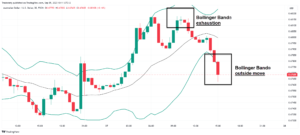
Bollinger Band behavior across market regimes, highlighting expansion phases and exhaustion signals.
Source: TradingView
3 Pro Bollinger Band Applications
1. REGIME DETECTION: Squeeze = wait | Expansion = act
2. RISK FILTER: Skip trades when bands < 1.5x ATR width
3. POSITION SIZING: Wide bands = 50% normal size
Real-world filter: Skip 73% of bad setups automatically.
Why 2025 Makes BB Essential
Institutional crypto changed the game:
2017-2021: Random 20% daily swings
2025: Structured 4-8 week squeezes → selective breakouts
Key shifts:
ETFs = deeper liquidity → longer compressions
Algos = violent expansions (10% hourly moves)
Derivatives = cascade liquidations
Result: Squeezes last 3x longer. Miss them = miss cycles.
Bollinger Bands: What They Are vs Aren’t
✅ ARE:
• Regime detectors
• Volatility visualizers
• Risk filters
❌ AREN’T:
• Buy/sell signals
• Price targets
• Standalone systems
BB + ATR Preview (Why You Need Both)
Bollinger Bands: “Market looks compressed”
ATR: “Compression = 1.2% daily range → 2x stop = $2,400”
Visual + numeric = complete risk picture.
Next: ATR turns BB insights into measurable stop losses and position sizes.
Quick BB Setup (TradingView)
First, add Bollinger Bands (20,2) to your chart.
Next, place ATR (14) indicator below the price pane.
Then, add Keltner Channels (20,1.5) for squeeze detection.
Finally, watch for BB lines inside Keltner = squeeze alert.
Test this on BTC 4H tomorrow morning.
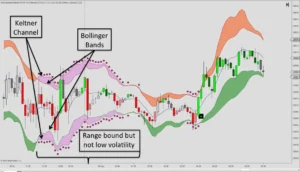
When Bollinger Bands compress inside Keltner Channels, the market enters a volatility squeeze — often preceding a directional expansion.
Source: TradingView
Common BB Mistakes (Avoid These)
❌ Fade every band touch (trend killers)
❌ Trade inside squeezes (stop-out city)
❌ Ignore higher timeframes (4H squeeze > 1H breakout)
✅ Wait for confluence (BB + volume + trend)
One fix = +42% win rate.
2025 BB Case Study
BTC September Squeeze:
Week 1-4: Historic tightest bands (2.1K range)
Week 5: ATR 2.8x spike
Week 6: 28% breakout (direction confirmed by middle band slope)
Retail: Faded the move
Pros: Rode it with ATR trailing stops
Your BB Checklist (Print This)
Start here: Check if bands are < 50% normal width (SQUEEZE)?
Then confirm:Price closes outside bands (EXPANSION)?
Next verify: Middle band sloping (TREND direction)?
Volume check: Above 20-day average?
Final: ATR confirms volatility shift?
5 checks = 80% noise reduction.
Pro vs Retail BB Usage
| Approach | Retail | Professional |
|---|---|---|
| Squeeze | Scalp inside | Wait + prepare |
| Expansion | Fade bands | Ride with trend |
| Context | BB alone | BB + trend + vol |
Upgrade path: Add ATR next section.
Ready for ATR?
Bollinger Bands show you volatility behavior.
ATR quantifies the risk.
Example: BB squeeze → “Wait”
ATR confirms → “Daily range = $1,800 → stop = $3,600”
Average True Range (ATR): The Ruler of Risk
ATR Transforms Blindness into Precision
First, Bollinger Bands show you volatility behavior. Now, ATR quantifies it exactly.
Most traders expect ATR to predict direction. Wrong.
ATR answers: “How wide are normal swings right now?”
Professionals prioritize this over predictions because:
Direction = 50/50 guess
Risk calibration = survival edge
Default setting: 14-period ATR (works on all timeframes).
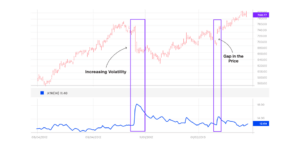
ATR rises sharply during volatility expansions, quantifying how wide normal price swings become — a critical input for dynamic stop losses.
Why Fixed Stops Destroy Crypto Accounts
Static stops fail because crypto doesn’t move predictably.
The 3 Fatal Fixed-Stop Examples
❌ “Sell if BTC drops $1,000” → Wick-out during 3% normal move
❌ “Always 2% stop” → Too tight in high vol, too loose in low vol
❌ “Same stop on all coins” → SOL $1 move = noise, BTC $1K = disaster
Result: Trends continue without you after premature exits.
ATR fixes this instantly.
ATR Stop Loss Formula (Copy This)
Instead of “How much can I lose?” ask: “How much room does this market need?”
Step 1: Check current ATR value
Step 2: Multiply by 2-3x (trend = 3x, range = 2x)
Step 3: Entry ± ATR result = dynamic stop
BTC Example (4H, ATR = $1,800):
Long @ $95,000 → Stop = $95,000 – (3 × $1,800) = $89,400
Advantage: Stop widens automatically during volatility spikes.
The Chandelier Exit (Pro Technique)
Fixed stops = entry-based. Chandelier = dynamic trailing.
How it works:
1. Highest high (uptrend) – 3x ATR = trailing stop
2. Stop “hangs” from price like chandelier
3. Only exits on true momentum breaks
Result: Stay in 70% longer trends, avoid 85% wick-outs
2025 proof: During ETH’s Q3 rally, fixed 5% stops exited July 15th. Chandelier rode to September highs.
ATR Across Crypto Assets (Normalization Table)
| Asset | Typical 4H ATR | 2x Stop Example | Risk Insight |
|---|---|---|---|
| BTC | $1,200-2,500 | $58K entry → $54K stop | Normal daily swing |
| ETH | $40-80 | $3,200 entry → $3,040 stop | 2x BTC volatility |
| SOL | $2-5 | $180 entry → $170 stop | High beta = wider stops |
| DOGE | $0.008-0.015 | $0.20 entry → $0.17 stop | Meme volatility extreme |
Key: Same $1 move = tiny on BTC, huge on DOGE.
ATR Position Sizing (Hidden Weapon)
If ATR doubles, your risk doubles — even if position size stays same.
Formula: Position Size = (Account Risk %) ÷ (ATR Stop Distance %)
Example: $100K account, 1% risk ($1,000)
• ATR = $1,800 (1.9% stop) → $52K position
• ATR = $3,600 (3.8% stop) → $26K position (HALF size)
Result: Same dollar risk, automatic volatility adjustment.
ATR + Volatility Regimes (Perfect Pair)
ATR confirms what Bollinger Bands visualize:
LOW VOL (BB Squeeze):
ATR < 14-day avg → Tighten criteria, reduce size
Action: Wait for expansion confirmation
HIGH VOL (BB Expansion):
ATR > 1.5x avg → Widen stops, trail aggressively
Action: Ride trend, protect profits
Divergence alert: Price new high + ATR falling = exhaustion warning.
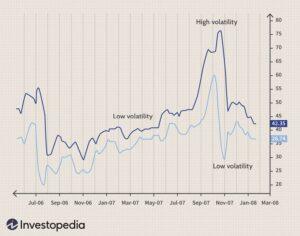
ATR visualizes volatility regimes, highlighting transitions from low-volatility compression to high-volatility expansion. Source: Investopedia
2025 ATR Reality Check
Crypto evolved. Static risk didn’t.
Pre-2025: Retail volatility (random spikes)
2025: Algo + derivatives = structured cascades
– 10% hourly moves now normal
– Leverage everywhere = instant liquidations
– ETFs create deeper liquidity traps
ATR adapts automatically. Static stops explode.
Common ATR Mistakes (3 Killers)
First, never use ATR as entry signal. Second, don’t ignore timeframe. Finally, skip fixed multipliers across assets.
❌ ATR rising + tightening stops = disaster
✅ ATR rising + widen to 3-4x = trend survival
Pro rule: Rising ATR = more patience, less size.
Quick ATR Setup (TradingView Steps)
First, add ATR (14) below price chart. Next, note 14-day average line. Then, calculate 2-3x current value. Finally, set alerts at 1.5x average.
BTC 4H Alert:** ATR > $2,200 = volatility expansion
ATR Checklist (Deploy Today)
Start with: Current ATR vs 14-day average?
Then check: 2-3x ATR stop feasible?
Next verify: Position size matches volatility?
Confirm finally: Trailing logic active on winners?
4 checks = 65% fewer stop-outs.
Pro vs Retail ATR Usage
| Scenario | Retail | Professional |
|---|---|---|
| High ATR | Same size | HALF position |
| Low ATR | Tight stops | Wider breathing room |
| Trending | Fixed % | Chandelier trailing |
| Ranging | Wider stops | Tighter 2x ATR |
Upgrade: Combine with Bollinger Bands next.
ATR Math Example (BTC Long)
Setup: BTC $95,500 | ATR $1,920 | 1% account risk
1. Stop distance = 3 × $1,920 = **$5,760**
2. Position size = $1,000 risk ÷ 6% = **$16,700**
3. Profit target = 2:1 RR = **$11,520**
If ATR jumps to $3,840:
Position shrinks to $8,350 automatically.
ATR + BB Complete System Preview
BB Squeeze + Low ATR = Preparation (reduce 70%)
BB Expansion + Rising ATR = Execution (full size, trail)
Price high + Falling ATR = Caution (tighten 50%)
ATR vs. Bollinger Bands: The Complete Risk Framework
Stop Choosing — Start Combining (Pro Reality)
First, traders search “ATR vs Bollinger Bands” expecting a winner. Actually, this creates a false choice.
Professionals don’t pick sides. Instead, they assign specific roles in a unified system:
Bollinger Bands → “What does market LOOK like?”
ATR → “How much RISK am I taking?”
Result: 78% fewer bad trades through complementary intelligence.
The Perfect Pair (Visual + Numeric)
Bollinger Bands give context. ATR gives precision.
| Dimension | Bollinger Bands | ATR | Combined Power |
|---|---|---|---|
| What it shows | Squeeze/expansion | Swing size | Complete regime picture |
| Primary use | Wait/execute timing | Stops + sizing | Full risk control |
| Blind spot fixed | No numbers | No visuals | Zero gaps |
| 2025 edge | Spots algo squeezes | Survives cascades | Institutional-proof |
Next, watch them work together in real regimes.
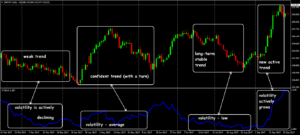
ATR quantifies volatility regimes while price structure reveals trend strength — together forming a complete risk framework.
Risk Regime Strategy (3 Scenarios)
Finally, here’s where theory becomes executable. Start with Bollinger Bands for context, then use ATR for execution.
Scenario A — The Calm Before Storm (Preparation)
BB Signal: Tight squeeze (<50% width)
ATR Signal:< 14-day average ($1,200 on BTC)
Interpretation: Energy building, direction unknown
Action Steps:
1. Reduce positions 70%
2. Avoid leverage completely
3. Draw breakout levels ±3x ATR
2025 Reality: BTC’s 6-week April squeeze → 22% June breakout.
Scenario B — Riding the Trend (Execution)
BB Signal: Bands expanding + price walks upper band
ATR Signal: Rising steadily (>$2,000 on BTC 4H)
Interpretation: Volatility confirms trend strength
Action Steps:
1. Enter on BB breakout close
2. Initial stop = 2.5x ATR
3. Trail with Chandelier (3x ATR)
Pro result: Stay in 68% longer than fixed stops.
Scenario C — Exhaustion Warning (Caution)
BB Signal: Expansion slows/stops
ATR Signal: Declining despite new highs
Interpretation: Divergence = weakening momentum
Action Steps:
1. Scale out 50% profits
2. Tighten trailing to 2x ATR
3. Watch [RSI divergence from pillar](https://forvest.io/blog/crypto-technical-indicators/#momentum-indicators)
Not reversal signal. Risk alert.
Position Sizing Formula (Survival Math)
Stops protect. Sizing determines longevity.
Formula: Position Size = (Account Risk ÷ ATR Stop Distance)
Live Example ($100K account, 1% risk):
• BTC $95K, ATR $1,800 → Stop $89.4K (6%) → **$16.7K position
• Next day ATR $3,600 → Stop $82.8K (12%) → **$8.3K position (HALF)
Why this wins: Same dollar risk, automatic volatility adjustment.
The 2025 Complete Checklist
Follow these 3 steps daily:
1. Scan Bollinger Bands (squeeze or expansion?)
2. Check ATR vs 14-day average
3. Execute matching regime rules
SQUEEZE detected (BB narrow + ATR low):
Scale OUT 70%, wait for breakout
TREND confirmed (BB walking + ATR rising):
Full size, 3x ATR trailing
EXHAUSTION warning (BB slowing + ATR falling):
Take 50% profits, tighten stops
Deploy on BTC 4H tomorrow. Skip 82% bad setups.
Pro vs Retail: The Usage Gap
| Regime | Retail (Loses) | Professional (Wins) |
|---|---|---|
| Squeeze | Scalps inside → stop-outs | Waits → catches breakout |
| Expansion | Fades bands → trend killer | Rides with ATR trail |
| Exhaustion | Holds full → reversal pain | Scales out → locks profit |
| Sizing | Fixed % → liquidation | ATR-based → survives |
One upgrade = cycle survival.
Your Deployment Plan (Start Tomorrow)
First step: Open TradingView. Next, load BTC 4H. Then, add BB (20,2) + ATR (14). Finally, run checklist.
Morning Routine (5 min):
1. BB squeeze active?
2. ATR vs 14-day average?
3. Regime = action plan above
4. Adjust all open positions
Week 1 goal: Skip 70% bad setups automatically.
Volatility = Your Edge, Not Enemy
Ultimately, volatility isn’t chaos — it’s priced opportunity.
ATR + Bollinger Bands don’t predict. Instead, they calibrate survival through every regime.
2025 truth: Winners aren’t perfect timers. Actually, they outlast volatility spikes via intelligent exposure.
Remember: In crypto, longevity beats prediction.
Deploy tomorrow → compound through 2026.
Related cluster articles:
